1.반도체 공정에 필수 원소인 '헬륨' 공급이, 호르무즈 해협 봉쇄로, 전 세계 공급의 27% 감소.
타이완의 대표적인 반도체 공장 (TSMC)도 헬륨 공급 부족을 호소하고 있는 상황.
2025년 한국은 헬륨 55%~64%를 카타르 등 아랍 6개국가에서 수입.
타이완은 2024년 기준, 69%를 이 지역에서 수입.
(1) 한국 회사들 중에는 왜 헬륨 전담 회사가 없는가?
한국 정유사들은 헬륨보다 더 큰 시장인, 석유화학 제품 (에틸렌, 프로필렌)과 배터리 (2차 전지)에 투자.
헬륨 공급의 3대 게이트키퍼 - 세계 헬륨 유통의 70%를 장악한 빅 3 산업용 가스 기업이 모든 정보를 통제하면서 각 국가에 공급.
헬륨은 석유나 금처럼 공개된 거래소가 없다. 대부분 비밀스런 장기계약을 맺어 거래함.
1) 에어 리퀴드 (Air Liquide, 프랑스) 카타르 라스라판의 세계 최대 헬륨 정제 시설 운영하는 핵심 파트너. 삼성전자에 헬륨 공급
2) 린데 (Linde 독일-미국) 2006년, 독일의 린데 AG는 영국 '산소회사 BOC (British Oxygen Company)를 120억 유로에 인수.
에어 리퀴드를 제치고 1위로 등극 .당시 린데 대표는, 볼프강 라이츨레(Wolfgang Reitzle)의 결단으로, 헬륨 세계 공급망을 갖추게 됨.
3) 에어 프로덕츠(Air Products, 미국) - 세계 최대 수소 생산자이기도 함. 세계 헬륨 공급의 20~30%.
(2) 삼성전자와 SK 하이닉스의 헬륨 확보에는 문제가 없는가?
1) 삼성전자의 경우, 고갈성 헬륨을 다시 재활용하는 기술로, 18%~19% 재활용율을 보이고 있다고 함.
2) 언론보도에는, 6개월치를 장기 확보했다거나, 3년 장기 계약을 맺어 공급을 확보했다고 나옴.
헬륨 현물 가격이 미국의 이란 침략 이후, 2배로 폭등했다. 따라서 삼성과 SK 하이닉스의 장기계약이 완료된 시점에는 헬륨 가격이 상승할 가능성이 큼.
에어 리퀴드 등 빅 3 헬륨 공급사들이 '할당제'를 실시할 수도 있음. 예를들어 삼성전자가 하루 100의 헬륨이 필요한데, 에어 리퀴드는 70 헬륨만 공급해주고, 나머지 30은 현물 시장(Spot Market)에서 '비싸게 오른' 가격에 헬륨을 사야함.
반도체 생산비 증가로 귀결된다는 뜻임.
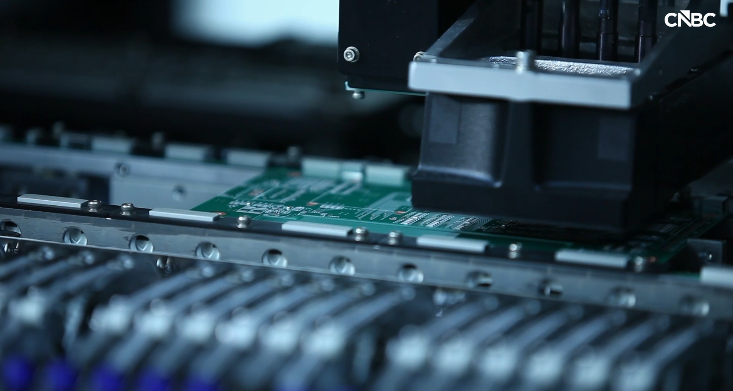
2. 반도체 제조 과정에서 헬륨은 필수원소. 헬륨은 반도체 제작에서 '초청정, 초저온, 에너지 및 전달 용도, 진공 체임버' 역할에 필수적임.
-2025년 전 세계 반도체 판매는 7910억 달러, 24년에 비해 25.6% 증가.
- 반도체 생산량 증가에 따른, 헬륨 수요량 증가함.
3.
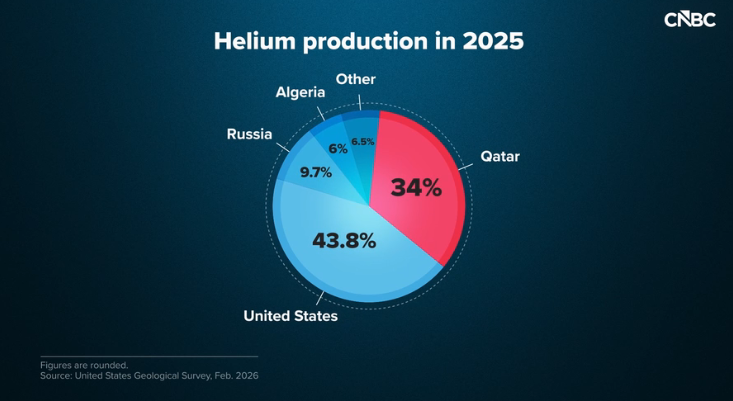
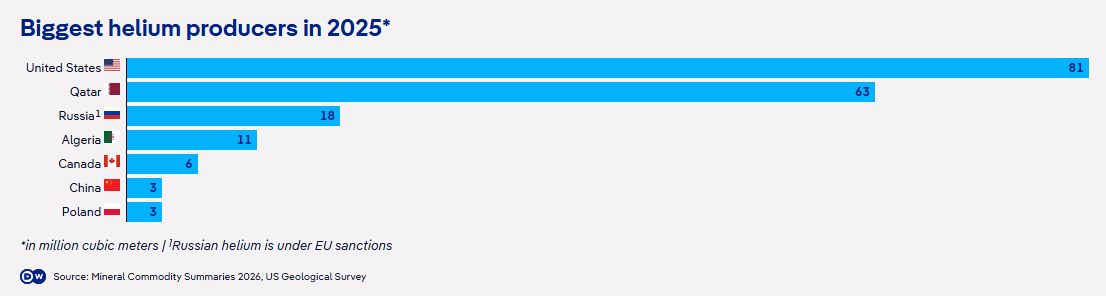
(1) 2025년 헬륨 생산국가 순위 (단위 큐빅 미터)
미국 8100만
카타르 6300만
러시아 1800만
알제리아 1100만
캐나다 600만
중국 300만
폴란드 300만
(2) 헬륨 매장량
전 세계 헬륨 매장량은 313억 큐빅 미터
카타르 101억 큐빅 미터 (헬륨 매장량은 세계 최고, 2025년 총생산의 3분의 1 담당)
미국 84억 9천 큐빅 미터,
알제리아 82억
러시아 68억
세계 4개의 민간 소유 헬륨 저장고. 미국 텍사스에 3개, 독일 그로나우-에페에 1곳.
[참고] Liquefied Natural Gas (LNG) extraction : 한국말로 액화천연가스(LNG) 채굴 또는 천연가스 추출. 지하에서 천연가스(메탄)를 추출. 기체 상태의 천연가스를 영하 162도로 냉각하여 부피를 600분의 1로 줄이는 액화과정을 거쳐 LNG로 됨 .
4. 헬륨이란?
헬륨은 대기중에 있음.
산업용 헬륨은 천연가스전에서 얻음. LNG
헬륨 매장량은 카타르가 1위이지만, 고갈성 천연자원 (헬륨)의 생산량의 1위는 미국이다.
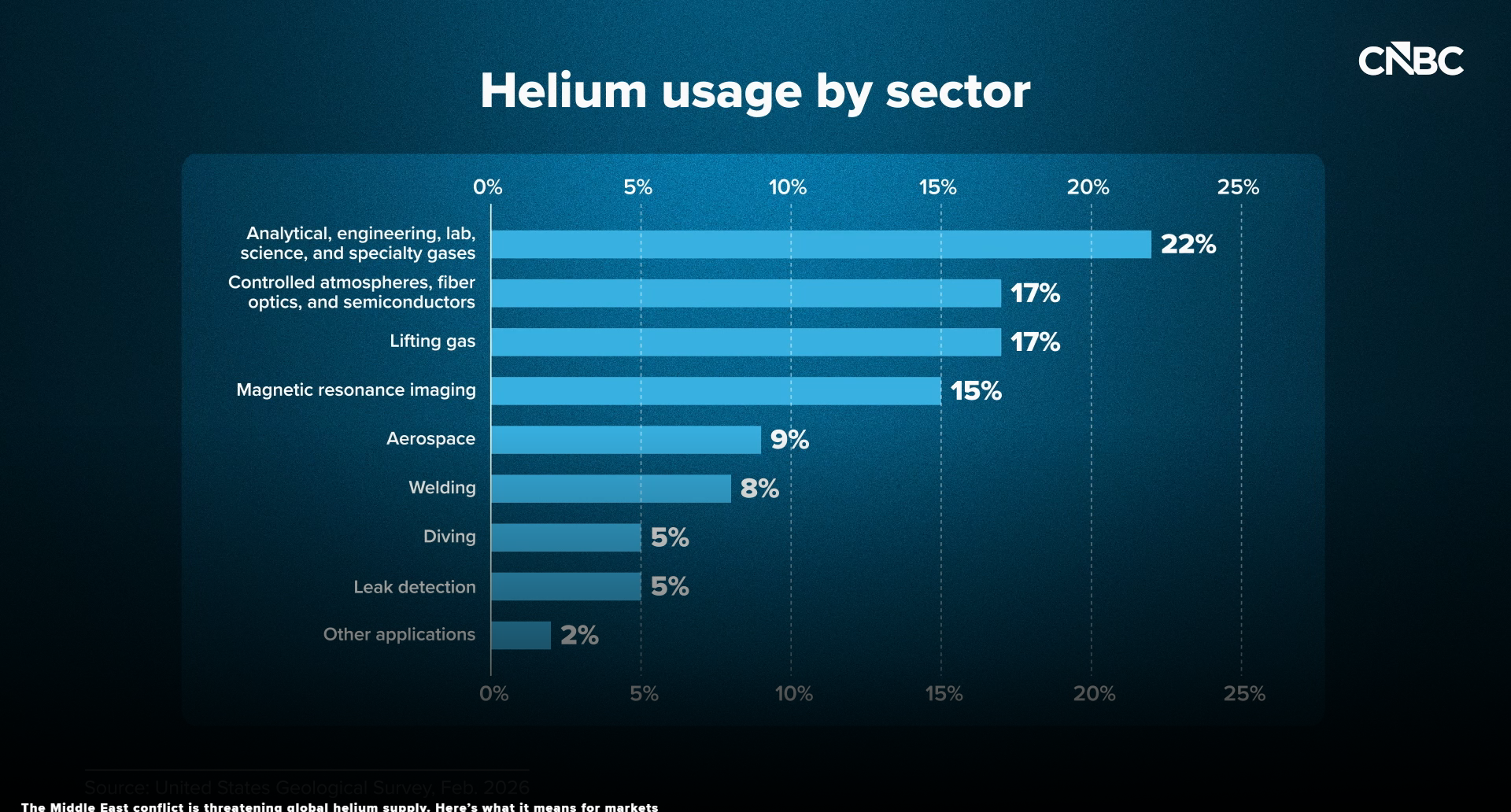
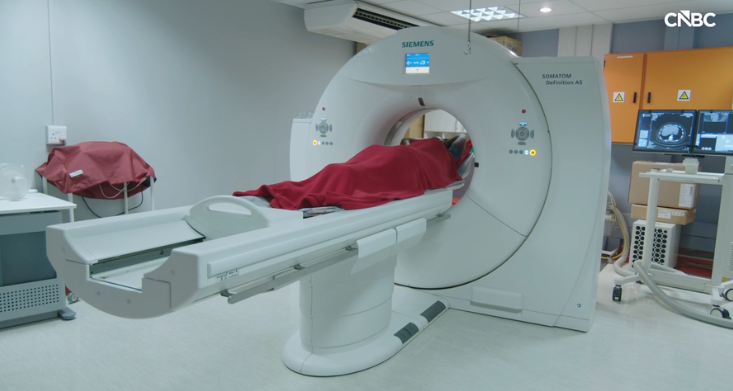
1) MRI 스캐닝 : 전 세계 헬륨 소비량의 30%. 액체 상태(-268.9°C)에서 냉각 능력. MRI(자기공명영상) 촬영시, MRI 내부의 강력한 초전도 자석이 열을 받지 않도록 식혀주는 유일한 냉각제.
2) 광섬유 제조 (optical-fiber manufacturing) 헬륨은 광섬유 제조 과정에서, 초고속으로 식혀주고, 청소해주는 역할.
3) 용접에서 헬륨은 불활성 기체라서, 용접시 '보호 기체' 역할. 불이 붙지도 않고, 금속을 녹슬게 하지도 않으며, 독성도 없다. 두 금속을 불순물없이 붙는데 도움이 돔.
4) 누출 찾기. Leak detection -헬륨은 자연 대기 중에 거의 없기 때문에(5ppm 미만), 아주 적은 양만 새어 나와도 즉시 기계가 포착해냄. 우주선 연료 탱크, 냉장고 냉매 배관, 반도체 장비 등 티끌만 한 누출도 허용되지 않는 곳에 필수입니다.
5) 에어백 (airbag inflation) -
에어백은 폭발적인 반응으로 부풀어야 하는데, 헬륨은 불이 붙지 않고 폭발 위험이 전혀 없는 안전한 기체
5. 헬륨이 반도체 공정에서 필수적인 이유
(1) 초청정(깨끗함) : 반도체-등급 헬륨은 칩 제작에 필수적임. 반도체는 나노미터 단위의 미세한 회로를 그리는 작업인데, 불순물이 회로에 섞이면 불량 발생. 오염되지 않은 헬륨이 에너지, 열전도,진공체임버에 필수적임. 웨이퍼 포면을 헬륨으로 덮으면, 산소나 습기와 같은 오염 물질이 달라붙지 못하게 막아줌.
(2) 초저온: 반도체 공정에서 원자를 특정 위치에 박아넣거나, 정밀 조작을 위해서는 ‘극저온’이 필요한 장비들이 있다. 장비 초전도 자석이나 정밀 센서는 뜨거워지면 오작동하기 때문에, 낮은 온도를 유지할 수 있는 냉각제인 헬륨이 필수적
(3) 에너지 및 열 전달 (Energy and Heat Transfer)
반도체 제조 과정(노광, 식각 등)은 강력한 레이저나 플라즈마를 사용하므로 엄청난 열이 발생.
이유: 열이 제때 식지 않으면 웨이퍼가 팽창하여 회로가 뒤틀림.
헬륨의 역할: 헬륨은 기체 중 수소 다음으로 열을 잘 전달하는 특성, 뜨거워진 웨이퍼 뒷면에 헬륨 가스를 흘려주면, 열을 순식간에 흡수하여 외부로 배출. 폭발 위험이 있는 수소 대신 안전한 헬륨을 사용.
A. 노광 (露光, Photolithography)-집적 회로 제작 등에서처럼 에칭을 위해 표면에 패턴을 사진으로 전사하는 공정
"빛을 드러내어 쬐다"라는 뜻-공정의 뜻: 반도체 웨이퍼 위에 감광액(빛에 반응하는 물질)을 바른 뒤, 회로 패턴이 그려진 마스크를 놓고 빛을 쬐어 회로의 밑그림을 그리는 과정
필름 카메라로 사진을 찍어 인화지에 상을 맺히게 하는 것과 원리가 같아 '사진 공정'이라고도 부름.
헬륨의 역할: 이 과정에서 강력한 레이저(EUV 등)를 사용하기 때문에 발생하는 엄청난 열을 식히고, 빛의 경로에 방해가 되는 이물질을 제거하는데 헬륨이 쓰임.
B 식각 (蝕刻, Etching) 갉아먹으며 새기다
노광 공정에서 그려진 밑그림을 제외하고, 필요 없는 부분을 깎아내어 실제 회로를 형성하는 과정.
판화에서 부식액을 이용해 동판을 깎아내는 '에칭' 기법과 동일한 원리.
액체 부식액을 쓰는 습식(Wet) 식각과 가스를 이용하는 건식(Dry) 식각.
헬륨의 역할: 건식 식각 시 챔버 내의 온도를 정밀하게 제어하고, 반응 가스가 골고루 퍼지게 돕는 매개체로 헬륨이 필수적
(4) 진공 체임버 내 활용 (Vacuum Chambers)
반도체 공정은 대부분 진공 상태인 '챔임버(Chamber)' 안에서 이루어짐.
이유: 진공 안에서도 장비를 움직이거나 가스를 순환시킴.
헬륨의 역할: 헬륨은 분자 크기가 매우 작고 가벼워 진공 환경에서도 아주 빠르게 퍼지고 순환함. 헬륨은 아주 미세한 틈이라도 있는지 실시간으로 감시하는 역할을 함.
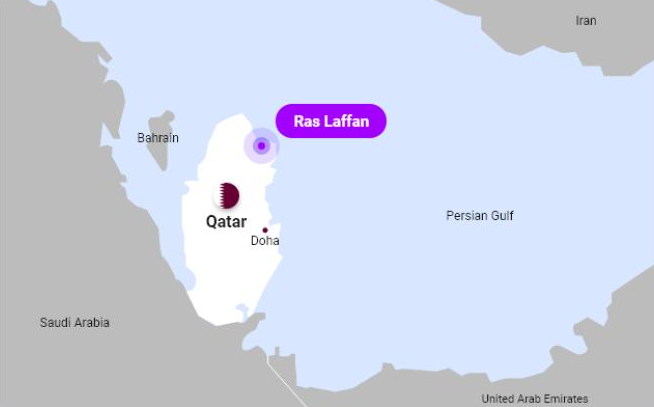
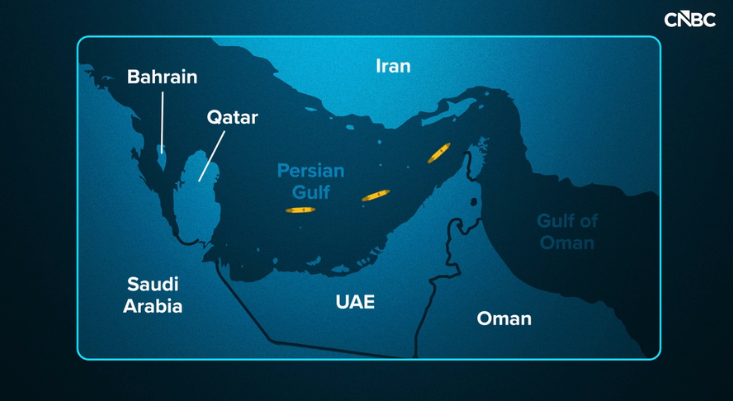
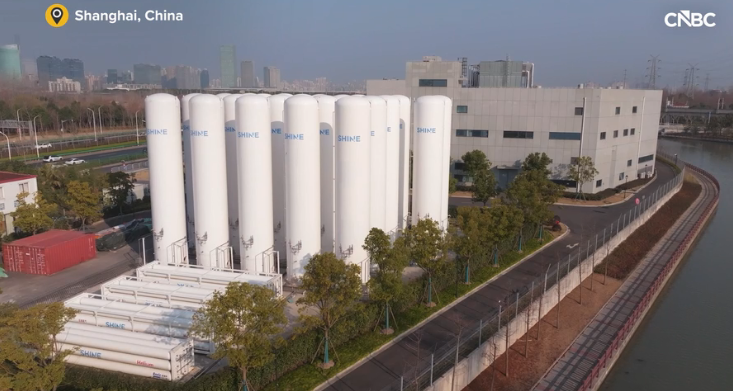
헬륨 생산지, 카타르, 라스 라판 (Ras Laffan) 위치.
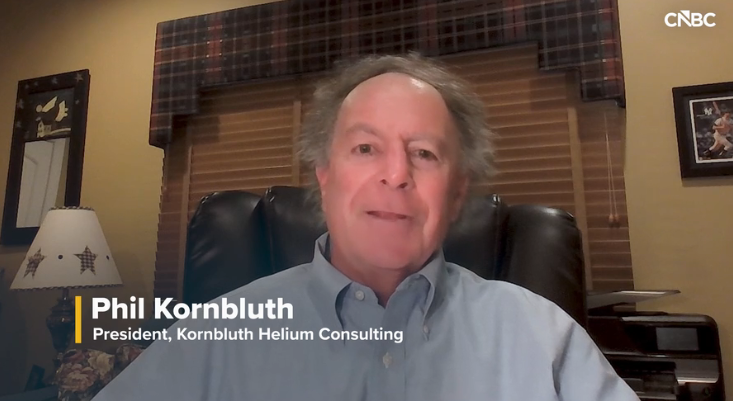
필 루쓰 헬륨 연구소 (Phil Kornbluth )
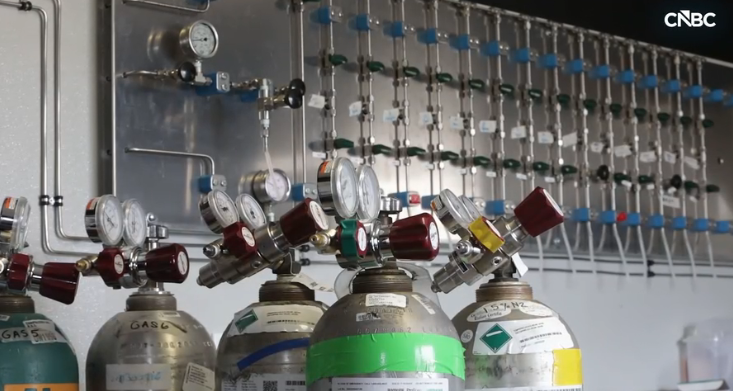
헬륨 용도 . MRI 촬영


Iran war triggers helium shortage, hits semiconductor supply
Timothy Rooks
03/18/2026March 18, 2026
Rising tension in the Middle East is rattling high-end chipmakers. Among the latest geopolitical uncertainties for the industry is a shortage of helium that could slow global production.
Iran war triggers helium shortage, hits semiconductor supply
Rising tension in the Middle East is rattling high-end chipmakers. Among the latest geopolitical uncertainties for the industry is a shortage of helium that could slow global production.
www.dw.com
An employee in lab gear works with a wafer in a production line of Dutch semiconductor company Nexperia, in Hamburg
Demand for helium has increased over the past decade in part due to demand from semiconductor and electronics manufacturersImage: Fabian Bimmer/REUTERS
Since the war in Iran started February 28, worries about oil and gas have made the biggest headlines and sparked the loudest complaints from consumers.
But another bottleneck in the global supply network is causing alarm: a shortage of helium, an essential component used to make, among other things, semiconductors — those tiny chips that help run everything from electric vehicles to smartphones.
A prolonged shortage of helium could lead to a shortfall of advanced chips and have knock-on effects for electronics manufacturers who depend on them, or force others to scale back their datacenter plans.
Why is helium essential for chipmakers?
Considering that helium is colorless, odorless and the second-lightest element in the universe, it has a surprising list of applications as a gas or in liquid form.
헬륨은 색깔과 냄새가 없고, 수소에 이어 두번째로 가벼운 원소이다. (수소는 양성자 1개, 헬륨은 양성자 2개, 중성자 2개로 구성, 헬륨은 수소보다 4배 무거) 기체 혹은 액체 형태로 다양한 용도로 쓰임.
Helium is used in things like MRI scanning, optical-fiber manufacturing, welding, leak detection and airbag inflation, not to mention balloons and dirigibles, said Phil Kornbluth, president of New Jersey-based Kornbluth Helium Consulting.
1) MRI 스캐닝 : 전 세계 헬륨 소비량의 30%. 액체 상태(-268.9°C)에서 냉각 능력. MRI(자기공명영상) 촬영시, MRI 내부의 강력한 초전도 자석이 열을 받지 않도록 식혀주는 유일한 냉각제.
2) 광섬유 제조 (optical-fiber manufacturing) 헬륨은 광섬유 제조 과정에서, 초고속으로 식혀주고, 청소해주는 역할.
3) 용접에서 헬륨은 불활성 기체라서, 용접시 '보호 기체' 역할. 불이 붙지도 않고, 금속을 녹슬게 하지도 않으며, 독성도 없다. 두 금속을 불순물없이 붙는데 도움이 돔.
4) 누출 찾기. Leak detection -헬륨은 자연 대기 중에 거의 없기 때문에(5ppm 미만), 아주 적은 양만 새어 나와도 즉시 기계가 포착해냄. 우주선 연료 탱크, 냉장고 냉매 배관, 반도체 장비 등 티끌만 한 누출도 허용되지 않는 곳에 필수입니다.
5) 에어백 (airbag inflation) -
에어백은 폭발적인 반응으로 부풀어야 하는데, 헬륨은 불이 붙지 않고 폭발 위험이 전혀 없는 안전한 기체
But it is the semiconductor chip industry that is sweating most right now.
A closeup of a group of Nvidia HGX H100 8GPU 80GB display cards
Helium isn't just for festive party balloons: The chemical element is important for a growing list of ever-important industriesImage: Kobe Li/ZUMAPRESS/picture alliance
Semiconductor-grade helium is essential for chipmakers to maintain ultraclean and ultracold manufacturing environments. This contaminant-free helium is also needed for energy and heat transfer, and in vacuum chambers.
There is no alternative to ultra-high-purity helium for these chipmaking processes and, without it, fabrication will slow down or even come to a halt.
"Helium is expensive relative to other gases, so, for the most part, where there are substitutes for helium, helium is no longer used," said Kornbluth, who has over four decades of experience with commercial helium.
Where does helium come from?
Although there is helium in the atmosphere, most industrial helium comes from natural gas fields and is separated during processing, especially in liquified natural gas (LNG) extraction. In effect, helium is a byproduct of LNG production, which is the more profitable business.
There is an estimated 31.3 billion cubic meters (1.13 trillion cubic feet) of recoverable helium underground in the world, according to a US Geological Survey report published in early 2026.
The US has 8.49 billion cubic meters of recoverable helium, Algeria has 8.2 billion cubic meters, and Russia has 6.8 billion cubic meters. Tiny Qatar has 10.1 billion cubic meters, the biggest deposit in the world and produced just over a third of the world's helium last year.
Following attacks from Iran, QatarEnergy stopped most of its LNG production in the country, which means that helium production is also on hold.
Iran has stopped ships from leaving the Persian Gulf through the Strait of Hormuz, so one-third of global helium supplies are simply offline.
Moving and stockpiling helium
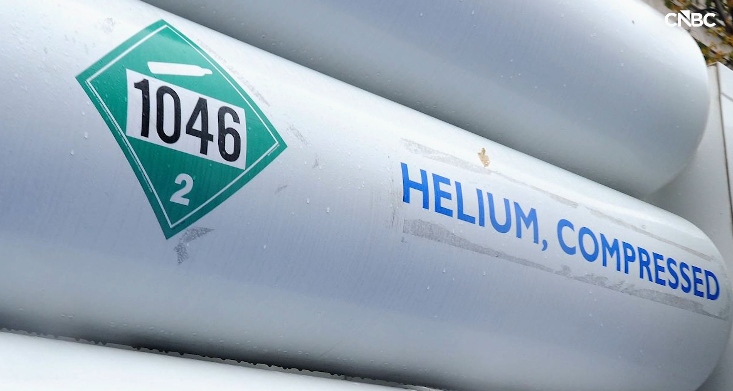
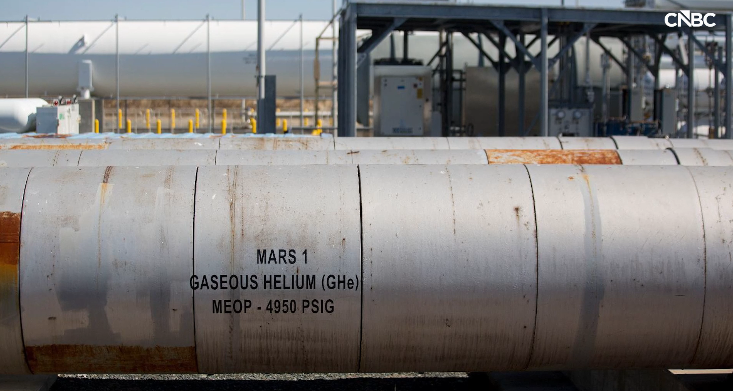
Handling helium is a specialized undertaking. Most helium is transported in bulk ultra-cold liquid form; the rest is moved around as a compressed gas.
As a gas, helium can be stored indefinitely, but the capacity for this is quite limited, Kornbluth said.
Another option is using underground caverns to store crude helium in large quantities, but capacity here is also limited. There are only four such privately owned storage facilities in the world: three in Texas and one in Gronau-Epe, Germany.
The majority of liquid-helium storage facilities only have tanks that can hold a few days' to a week's worth of production, Kornbluth said, which is relatively small compared to overall production capacity, let alone growing industrial demand.
Tiny helium reserves and higher prices
For now, companies can count on reserves. And since it takes several weeks or more for helium to get from Qatar to its primary markets in Asia and Europe, "it should be at least several weeks before helium users feel the impact of a helium supply deficit," said Kornbluth.
Because a significant portion of helium comes out of Qatar's gas fields, a blockade of the Strait of Hormuz "means available helium volumes will be lower and prices higher," said Michael E. Webber, a professor at the University of Texas at Austin who specializes in energy.
Iran war exposes global dependence on Middle East energy
07:38
For Qatar, much will depend on how long the waterway is blocked and how fast helium shipments get back online. For customers like semiconductor manufacturers, finding alternative sources will not be easy, especially since a lot of helium is locked up in long-term contracts.
There are other places with untapped helium, but finding it and bringing it to the surface takes many months, Webber said. When it finally comes to the market, there is likely to be tough competition for it.
Semiconductors and sourcing helium
In 2025, global semiconductor sales hit $791 billion (€687 billion), an increase of 25.6% compared with the previous year, according to the Semiconductor Industry Association (SIA).
2025년 전 세계 반도체 판매는 7910억 달러, 24년에 비해 25.6% 증가.
반도체 생산량 증가에 따른, 헬륨 수요량 증가.
2025년 헬륨 생산국가 순위 (단위 큐빅 미터)
미국 8100만
카타르 6300만
러시아 1800만
알제리아 1100만
캐나다 600만
중국 300만
폴란드 300만
With this growth comes an increased need for helium, and the industry body has warned about risks to supplies.
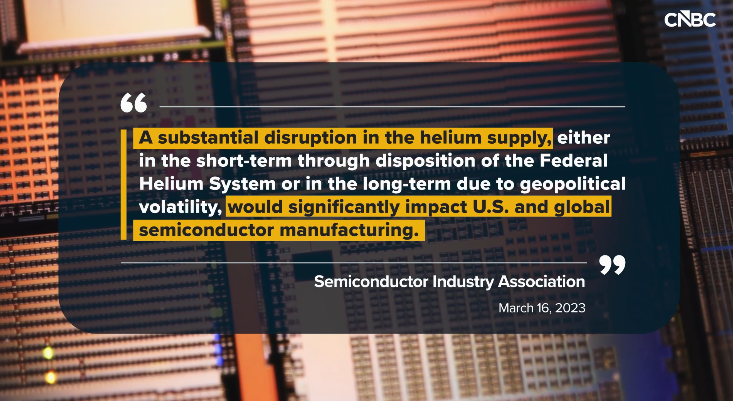
Back in January 2023, the SIA pointed out that a sudden supply shock could significantly impact semiconductor manufacturing in the United States and around the globe.
Although Qatar has the biggest reservoirs of untapped helium, the US was the biggest producer of the nonrenewable natural resource in 2025
헬륨 매장량은 카타르가 1위이지만, 고갈성 천연자원 (헬륨)의 생산량의 1위는 미국이다.
One of their biggest concerns was that much of the supply is concentrated in regions of potential geopolitical risk. As an added risk, specialized semiconductor-grade helium comes mainly from the Middle East and Russia.
Recycling helium is still in its infancy. And there isn't much room to increase efficiency when it comes to the chipmaking business, since manufacturers have already taken steps to reduce helium consumption in response to previous supply disruptions, according to SIA.
Kornbluth said the best way to reduce supply vulnerability was to purchase helium from suppliers who have diverse sources, even if that means having multiple suppliers.
Edited by: Rob Mudge
Timothy RooksTimothy Rooks
Timothy Rooks is one of DW's team of
출처.
Iran war triggers helium shortage, hits semiconductor supply
Rising tension in the Middle East is rattling high-end chipmakers. Among the latest geopolitical uncertainties for the industry is a shortage of helium that could slow global production.
www.dw.com
2.
Markets
The Iran war is threatening supply of a little-thought-of resource — helium. What it means for markets
Published Thu, Mar 19 202611:15 AM EDTUpdated Thu, Mar 19 20262:03 PM EDT
Lisa Kailai Han
@lisakailaihan
Key Points
Helium is key to many industries, most notably tech.
The U.S. Geological Survey estimates that before the war Qatar produced more than one-third of the world’s helium supply.
Lately, however, operations at QatarEnergy’s Ras Laffan Industrial City — the world’s largest liquefied natural gas export facility, which produces helium as a byproduct — were halted after it was struck by an Iranian drone early in the war.
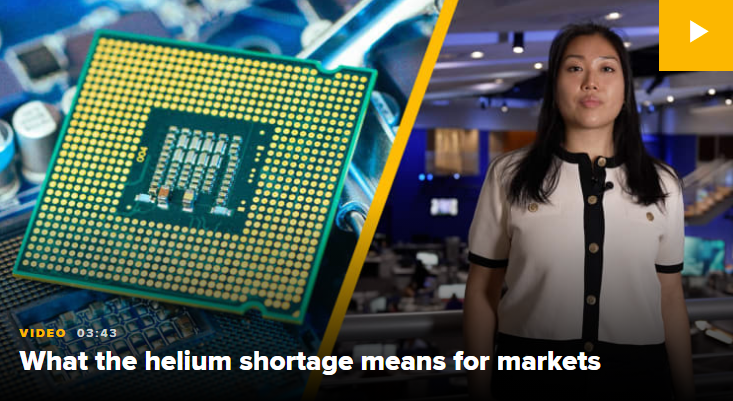
What the helium shortage means for markets
VIDEO03:43
What the helium shortage means for markets
The war in the Middle East could pose a threat to the semiconductor industry and other sectors dependent on a resource produced in the Gulf — helium.
Helium is a little-known but key input in many industries, most notably technology. In semiconductor manufacturing, its cooling properties are used to transfer heat. Helium is also indispensable in photolithography, a technique used to print each chip’s intricate circuitry.
The U.S. Geological Survey estimates that before the war Qatar produced more than one-third of the world’s helium supply. Lately, however, operations at QatarEnergy’s Ras Laffan Industrial City — the world’s largest liquefied natural gas export facility, which produces helium as a byproduct — were halted after it was struck by an Iranian drone early in the war. On Wednesday, Iranian missiles crippled the plant.
A global helium shortage would ripple across a range of industries.
“Qatar makes some 30% of the world’s helium — a key input for semiconductors, industrial manufacturing, and medical imaging — while several key ingredients for fertilizer production also move through the Strait,” according to a report early this week by the chief investment office of UBS Global Wealth Management. “Any lengthy disruption will not only impact energy prices, but also food prices and industrial production.”
Known choke point
Helium supply has always been a risk. In 2023, the Semiconductor Industry Association cautioned that “there would likely be shocks to the global semiconductor manufacturing industry” should the supply of helium be disrupted.
Today, a lengthy “prolonged regional conflict could potentially disrupt chipmakers’ manufacturing operations regarding sourcing materials like helium and bromine,” Ray Wang, computer memory analyst at SemiAnalysis, told CNBC. “For now, the impact appears to be limited. However, a prolonged conflict could eventually lead to disruptions or require adjustments in the sourcing of key materials.”
South Korea and Taiwan, the world’s two largest semiconductor makers, are particularly vulnerable to Middle East helium supply.
In 2025, South Korean manufacturers bought 55% of their helium from countries in the Gulf Cooperation Council, a union of six Arab nations. Taiwan bought 69% of its helium from the GCC in 2024, according to a report out Wednesday from analysts at Barclays.
The Strait of Hormuz’s effective closure has spiked helium prices by limiting supply. Bank of America estimated in a note last week that spot helium prices have surged as much as 40%, depending on the market. On Monday, Phil Kornbluth, president of Kornbluth Helium Consulting, told CNBC that prices were up by 70% to 100%, in some cases within a little more than a week.
Oil tankers and cargo ships line up in the Strait of Hormuz as seen from Khor Fakkan, United Arab Emirates, Wednesday, March 11, 2026.
Altaf Qadri | AP
Semiconductors are at the ‘top of the pecking order’
If helium supplies grow short, allocations will be determined by how critical the need for the gas is.
“Helium demand is concentrated in high-value, mission-critical applications, including semiconductors, aerospace, electronics manufacturing and medical imaging,” the Bank of America analysts said. “In these end markets, supply security is typically prioritized over price, particularly during periods of tightness. This dynamic historically allows suppliers to push pricing higher as customers move to lock in long-term supply during disruptions.”
Semiconductors, considered a critical industry, is at the “top of the pecking order,” Kornbluth said. Less vital industries — think party balloons — could get low to no allocation.
Still, Kornbluth said even the semiconductor industry would be hard-pressed to completely escape the effects of a helium shortage.
“Everybody’s going to feel it to some degree during that transition period,” he said, adding that even those buyers at the front of the line will see price hikes. “The industrial gas industry — they won’t play favorites to a large degree there. I mean, they’ll do their best to keep everybody supplied, or as well supplied as possible, but there’s a price for that.”
Length of war
Closing the Strait could take about 27% of the world’s helium offline, and any shortage will have lagged effects, Kornbluth said.
“Spot prices comprise a very small slice of helium sales because it’s mostly a long-term contract business. So even though it makes for good headlines, it doesn’t have that much impact on the marketplace,” said the consultant, who’s been in the business for more than 40 years. “Contract prices have not really moved yet.”
That may change soon, however, should a prolonged shortage pressure suppliers to declare force majeure on their contract customers.
Perhaps the only saving grace is that the helium market had been “in oversupply for the last two years going into this shortage,” Kornbluth said. Still, it would probably take at least five weeks to restart production after any ceasefire.
Past oversupply acts as insurance to cushion against the current shortage. As a result, the likely deficit in supply today is probably closer to 15%, than 30%, Kornbluth said.
If hostilities end “pretty quickly — there’s a truce within a couple of weeks, and [this] turns out to be a four-month kind of disruption — then I would refer to it as a significant hiccup within a period of plentiful oversupply,” Kornbluth said. “In the past when we’ve had shortages, folks have generally made good money during those periods because the price increase impact across their entire customer base offsets the loss of volume due to losing supply from Qatar. So it’s usually a positive event for the industry.”
Producers insulated
In their note, Bank of America analysts struck a similar tone, writing that while the Qatar disruption may tighten the helium market, the length of the conflict and any subsequent recovery are key. Diversified sourcing and stockpiles on hand mean that major industrial gas producers are relatively well insulated from direct supply disruption, the bank said.
“Helium typically represents a low to mid-single digit percent of gas company revenues, and so we suspect the outage in Qatar is only a neutral to modest net positive event for earnings assuming it continues for a few weeks. Longer outages drive more earnings upside,” Bank of America wrote. “It would take time for an eventual recommissioned Qatar LNG complex to normalize operations, but we suspect helium inflation would ease quickly.”
Other Wall Street banks, including Deutsche Bank, Wells Fargo and JPMorgan, all recently pointed to a tightening helium market as a positive catalyst for industrial gas supplier Linde
. Last week, JPMorgan analyst Jeffrey Zekauskas upgraded Linde, ahead 15% in 2026 through Wednesday, versus a 3% decline in the S&P 500.
Air Products and Chemicals
, another big gas producer, is 14% higher this year. Wells Fargo analyst Michael Sison upgraded the stock to overweight last week, saying the Allentown, Pennsylvania-based manufacturer stands to benefit from increased helium pricing.
— CNBC’s Arjun Kharpal and Dylan Butts contributed to this report.
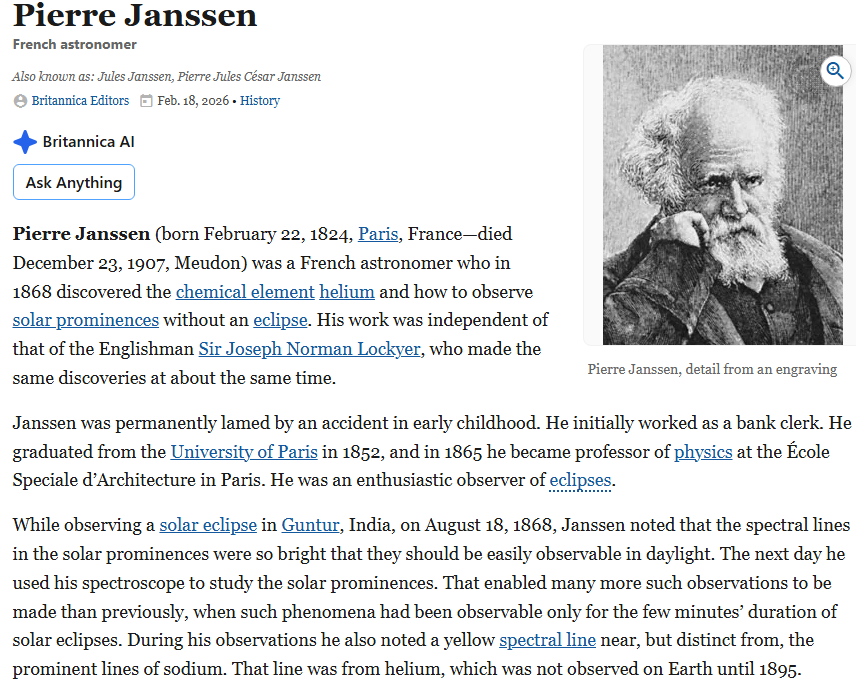
헬륨 발견의 역사.
1. 천문학,천체물리학자들
피에르 장센과 노먼 로키어가 동시에 태양 스펙트럼 중에서 '노란 선'을 발견.
피에르 장센이 1868년 인도에서 개기일식을 관측하던 중 태양의 스펙트럼에서 이전에 보지 못한 밝은 노란색 선 발견.
노먼 로키어 (1836-1920) 역시, 윌림엄 람지가 실제로 실험을 통해서 헬륨을 발견하기 27년 전에, 태양 관찰을 통해서 헬륨의 존재를 알아냄.
색깔 층 (Chromosphere) 색깔, 색을 의미하는 Chromo + 구 (sphere)
노란 선의 실체가 무엇인가?
노먼 로키어는 이 노란선이 나트륨과는 다르다는 것을 깨닫고, 이를 새로운 원소라고 주장, 태양신 '헬리오스'의 이름을 따서 '헬륨(Helium)'이라 명명. 헬륨은 칼륨처럼 '고체'로 간주.
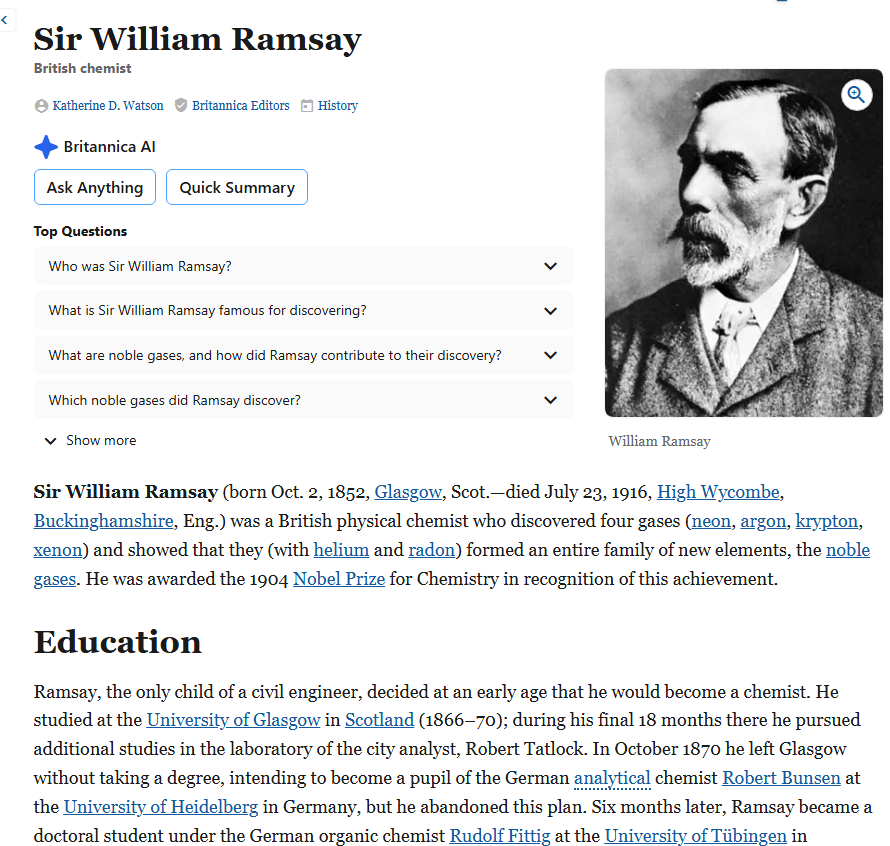
나중에 1895년 윌리엄 람지의 실험으로, 헬륨이 '기체'임을 알게됨.
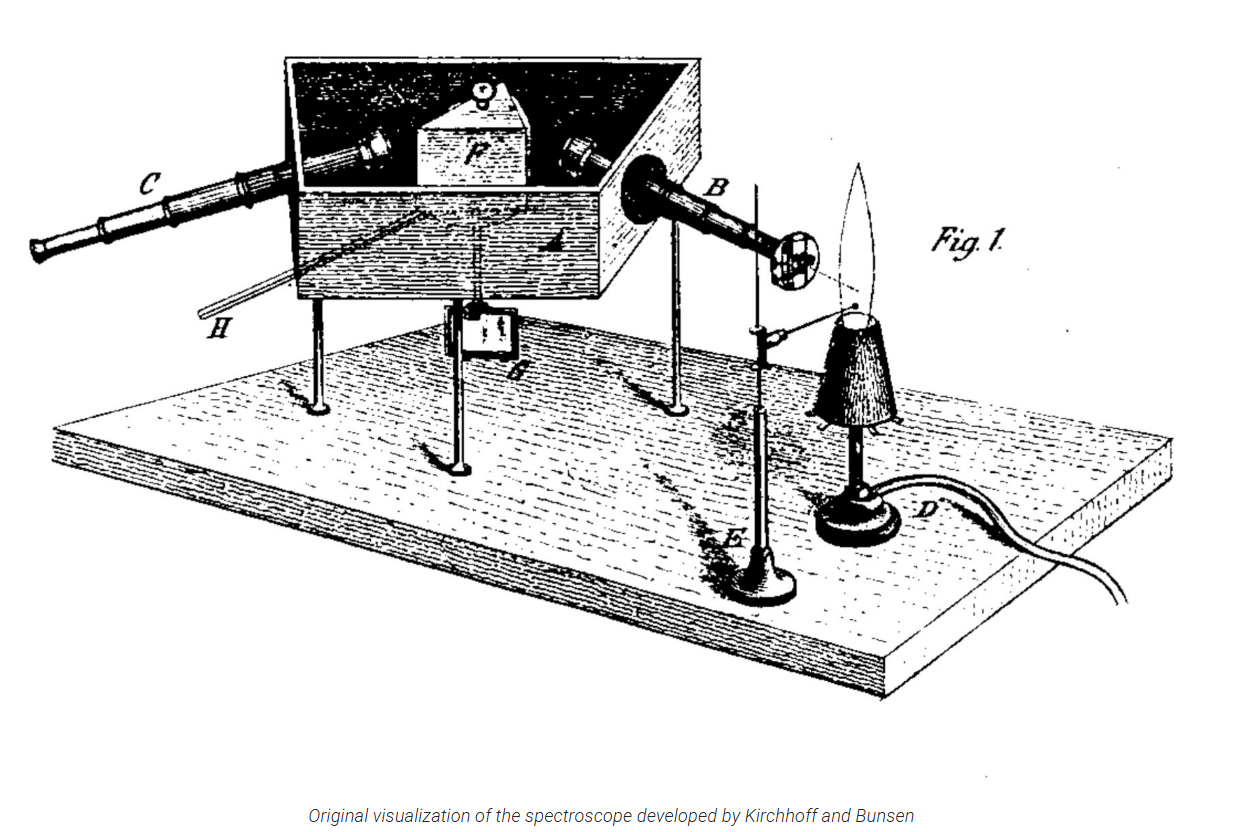
2. 도구의 중요성. 분광기 (현대적 의미 Spectroscope) 개발사.
1859년 , 독일 하이델베르크, 화학자 로베르트 분젠(Robert Bunsen)과 물리학자 구스타프 키르히호프(Gustav Kirchhoff)의 협업
필요성. 분젠은 불꽃 반응을 통해 원소를 구별하려 했으나, 불꽃의 색이 비슷비슷해서 육안으로는 한계가 있음.
키르히호프는 빛을 프리즘으로 쪼개서 선(Line)으로 관찰하자고 제안.
구조:
1) 분젠 버너: 시료를 태워 빛을 냄.
2) 슬릿(Slit)과 렌즈: 빛을 가늘고 평행하게 모음.
3) 프리즘(Prism): 빛을 파장별로 분산시킴.
4) 망원경(Telescope): 분산된 스펙트럼 선을 확대해서 관찰함.
성과. 특정 원소는 반드시 특정 위치에 선을 남긴다는 '분광 분석법'을 확립.
이 도구 덕분에 9년 뒤인 1868년, 장센과 로키어가 태양에서 헬륨을 찾아낼 수 있었음

(피에르 장센이 사용한 '분광기'를 만든 사람은 J.G. 호프만 )
3. 분광기 (Spectroscope) 를 장착한 망원경으로 태양 빛을 관찰.
빛을 프리즘처럼 통과시켜, 빛을 쪼개면, 그 안에 검은 선이나 밝은 색의 선들이 나탐. 이것이 원소들의 흔적이라고 봄.
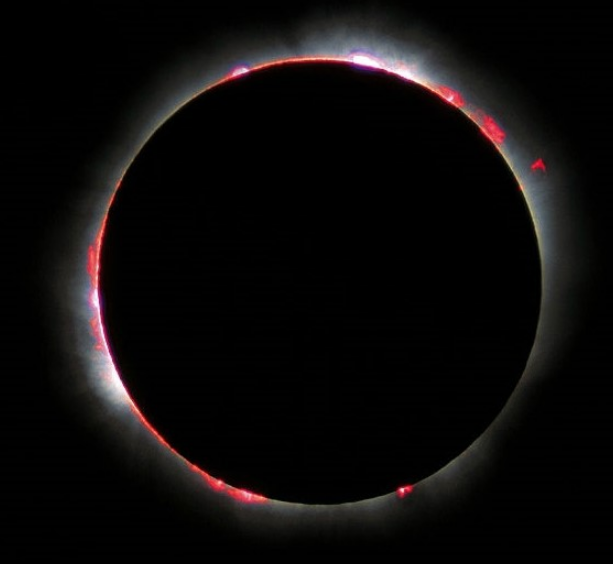
전체 망원경의 전압 렌즈 쪽에 다중 프리즘 분광기를 연결한 장치.헬륨을 발견 과정 - 개기 일식 때, 태양 가장자리에서 솟구치는 홍염 (Solar Prominence)를 보던 중,
나트륨 (D선)의 노란 선 바로 옆에 더 밝고 선명한 노란 선 (D3)이 나타나는 것을 발견.

출처.
https://www.en.silicann.com/blog/post/history-of-spectroscopy/
Milestones in the History of Spectroscopy
What is spectroscopy Spectroscopes and spectrometers allow us to learn far more about objects than what is possible with the naked eye alone. Visible light is electromagnetic radiation with wavelengths between approx. 400 nm and 780 nm. In the light of the
www.en.silicann.com

solar prominence (홍염)
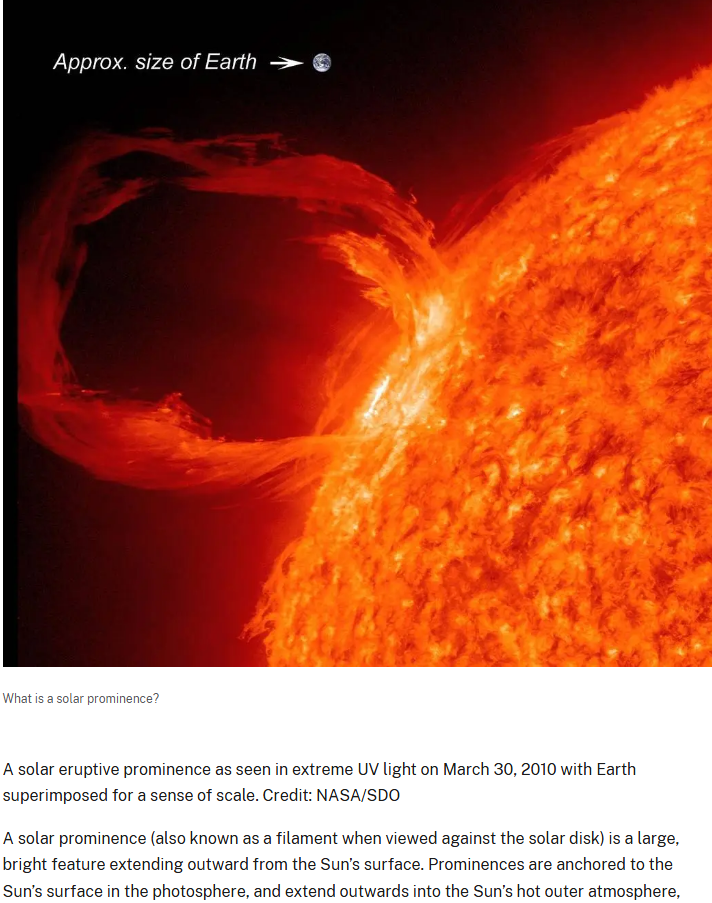
태양의 대기 층인 채층(Chromosphere)에서 수만 킬로미터 높이로 솟구치는 거대한 가스 기둥을 가리킴.
물질은 수소 가스, 붉은색 빛.
구조- 태양의 강력한 자기장에 의해 가스들이 고리 모양이나 기둥 모양으로 붙잡혀 있는 현상.
개기일식 때 보이는 채층 (태양 가장자리의 붉은 고리)
참고.
https://www.aps.org/archives/publications/apsnews/201409/physicshistory.cfm
This Month in Physics History
APS Archives
www.aps.org
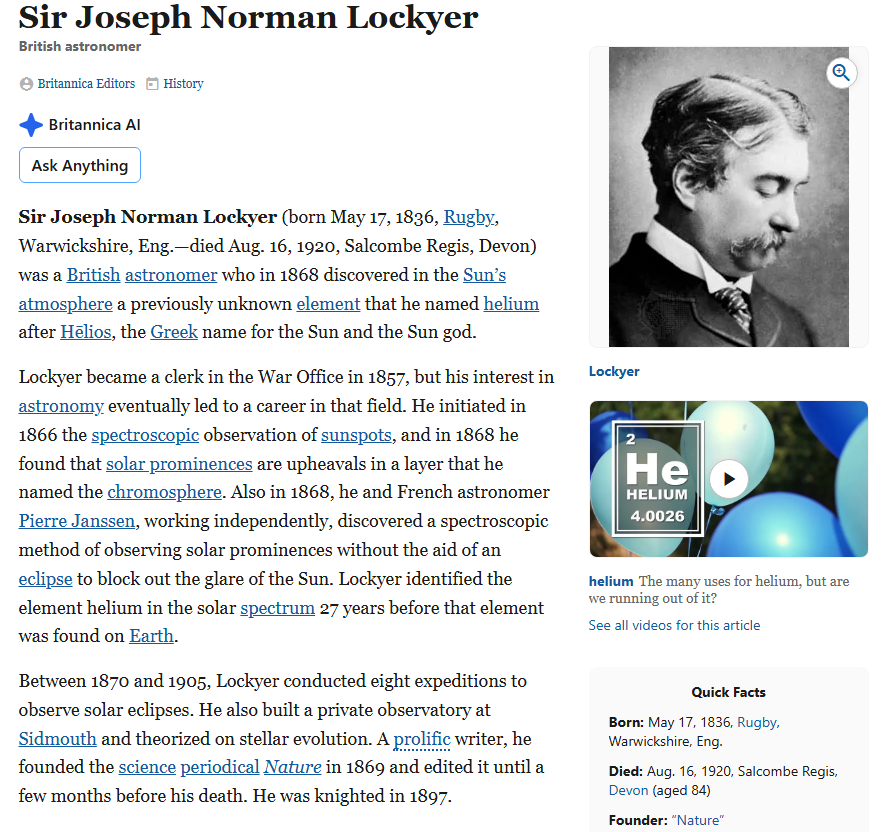
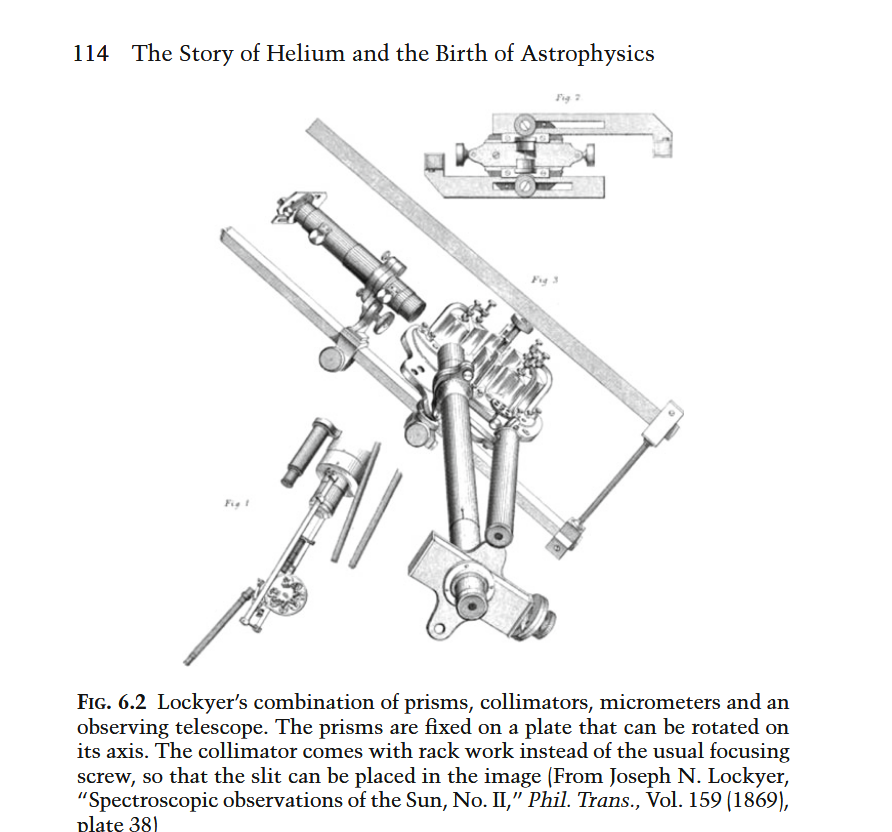
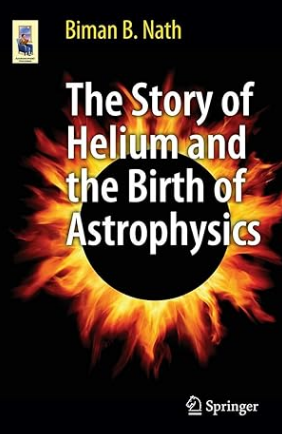
사진 출처. Nath, Biman. The Story of Helium and the Birth of Astrophysics. (New York: Imprint Springer) 2013
William Ramsey 윌리엄 람지가 1895년 , 헬륨을 실험실에서 발견하게 되었다.

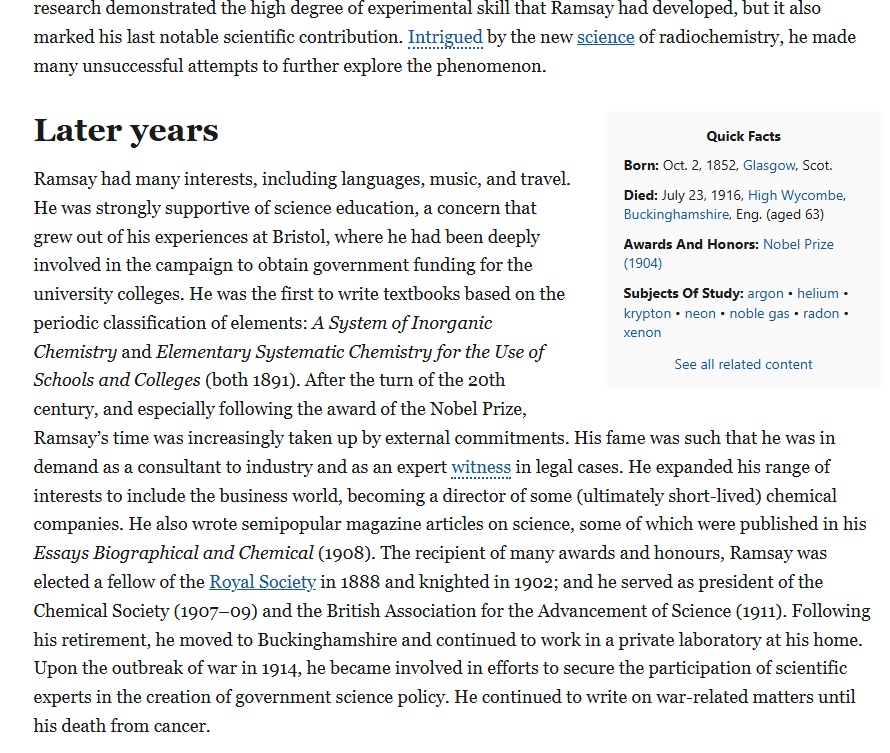

클레베이트(Cleveite)
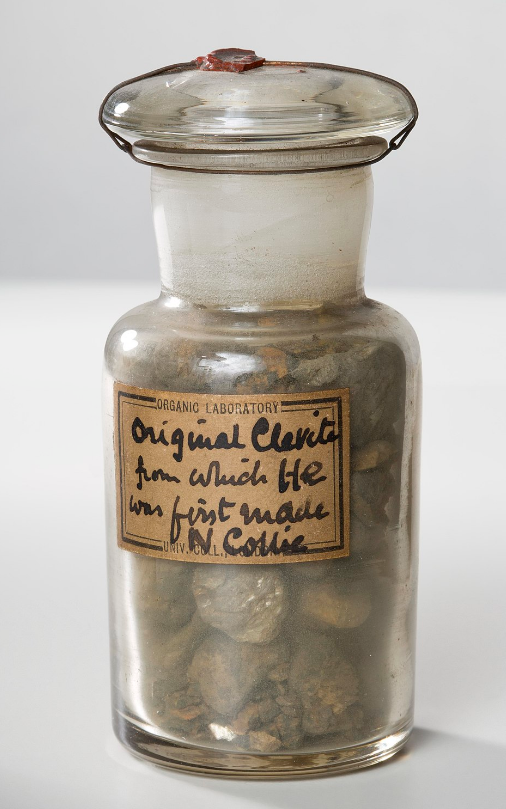
윌리엄 람지의 실험.
1895년 , 람지가 어떻게 해서 헬륨을 발견했는가?
미국 지질학자 힐브란트가 클레베이트(Cleveite)를 산에 녹였을 때, 질소가 발생했다는 것을 읽고, 람지는 '질소'가 아니라, 아르곤이나 다른 종류의 기체일 것이라고 가정.
런던 광물 상점에서, 노르웨이 아렌달(Arendal)산 클레베이트 구함.
이것을 가루로 만들어 '묽은 황산' (dilute sulphuric acid)으로 끓여서 가스를 발생시킴.
아래 그림에서, C 플라스크 안에서, 클레베이트 광물가루와 묽은 황산을 결합시키면, 여기서 발생한 가스가 관을 타고 A로 이동하고, 물을 거쳐, B로 간다.
A 수조. 기체가 외부로 새어나가지 않게 막아주는 수조입니다. 램지는 기체를 모으기 위해 '수상치환(Water displacement)' 방식
수조가 그 기초. 물이 담긴 A를 통과하게 함으로써, 우리가 숨 쉬는 공기(질소, 산소 등)가 포집관 B 안으로 섞여 들어가는 것을 원천 차단
B (포집관, Collection Tube): 발생한 기체가 모이는 곳. 처음에는 물이 가득 차 있다가, 아래에서 기체가 올라오면 물을 밀어내면서 상단에 기체가 고이게 됨.
C (반응 용기/플라스크, Reaction Flask): 클레베이트 광물 가루와 묽은 황산이 만나 실제 화학 반응 발생. 여기서 발생한 헬륨 가스가 관을 타고 A를 거쳐 B로 이동합니다.
B 포집관에 모인 기체를 작은 유리관 플뤼커 관( Plücker tube)으로 옮겨,
방전 준비 (Vacuum and Sealing) , 기체를 넣은 유리관 양끝에는 전극 달림. 관 내부에 압력을 아주 낮게 만든 후, 유리관을 가열하여 밀봉. 기체 분자들이 전기를 받아 빛을 발산.
이 유리관에 유도 코일(Induction coil)를 연결해 고전압 전기를 걸면, 유리관 안에 헬륨 원자들이 에너지를 받아 흥분하면서 특유의 빛을 발산.
람지가 이 빛을 처음 봤을 대, 밝은 황금빛 노란색.
분광기(Spectroscope)를 배치, 분광기의 슬릿 (Slit)이라는 좁은 틈으로 그 노란 빛을 통과.
분광기 내부 프리즘이 그 노란 빛을 파장별로 쪼개어 눈으로 볼 수 있는 '선' 형태로 투사.
이것은 나트륨의 노란 선 위치 (D1,D2)가 아니라, 그 보다 약간 옆에 위치한 파장 587.49nm 선이 선명하게 나타남.
1868년 피에르 장센과 노먼 로키어가 태양 홍염에서 발견한 D3선과 일치함을 확인.
- 태양이 아니라, 지구에서 헬륨을 확인하는 순간.

사건의 발단. 미국 캔자스 주, 덱스커 Dexter 에서 원유, 가스 시추.
1903년 당시,
헬륨이 아니라, inert residue 비활성 잔여물로 표기.
천연 가스 구성 성분 (메탄 15%, 질소 72%, 비활성 잔여물 12%, 산소 0.2%, 수소 0.8%)
비활성 잔여물에는 질소, 아르곤, 헬륨 등 혼합물이 섞여져 있음.
나중에 헬륨은 이 가스 중에 1.84% 포함되어 있음을 알게됨.
The Dexter, Kansas, Nitrogen Gas Well
Author(s): Erasmus Haworth, D. F. McFarland and H. L. Fairchild
Source:
Science , Feb. 3, 1905, New Series, Vol. 21, No. 527 (Feb. 3, 1905), pp. 191-193
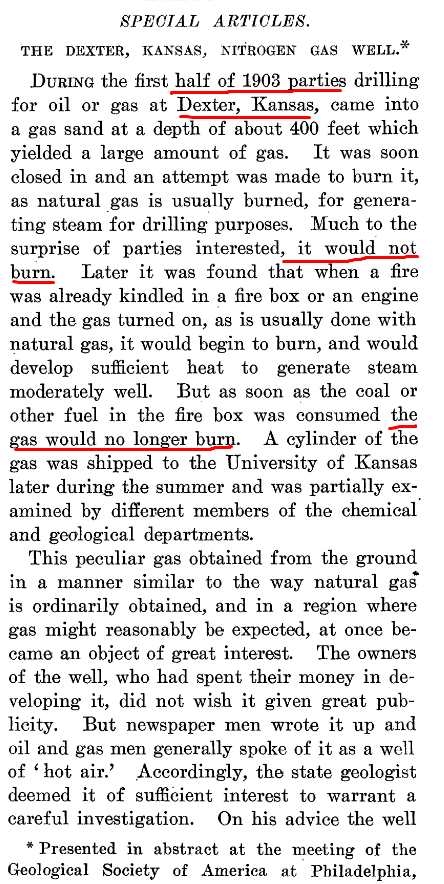
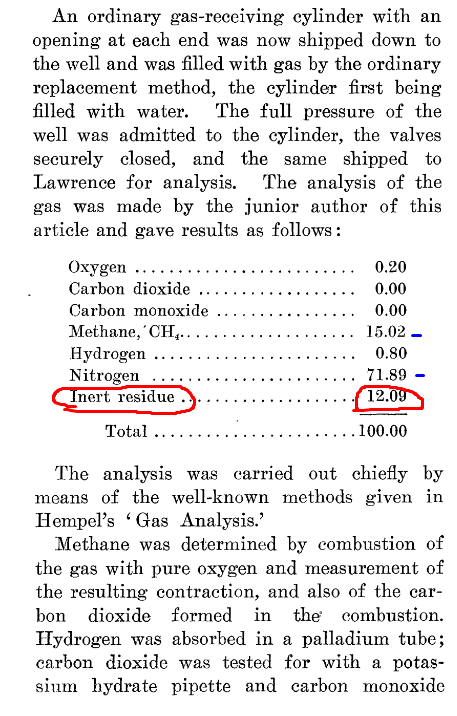

위 논문.
THE OCCURRENCE OF HELIUM IN NATURAL GAS AND THE COMPOSITION OF NATURAL GAS
Cady, Hamilton P ; McFarland, David F
Journal of the American Chemical Society, 1907-11, Vol.29 (11), p.1523-1536
1905년 실험한 것을, 1907년에 발표.
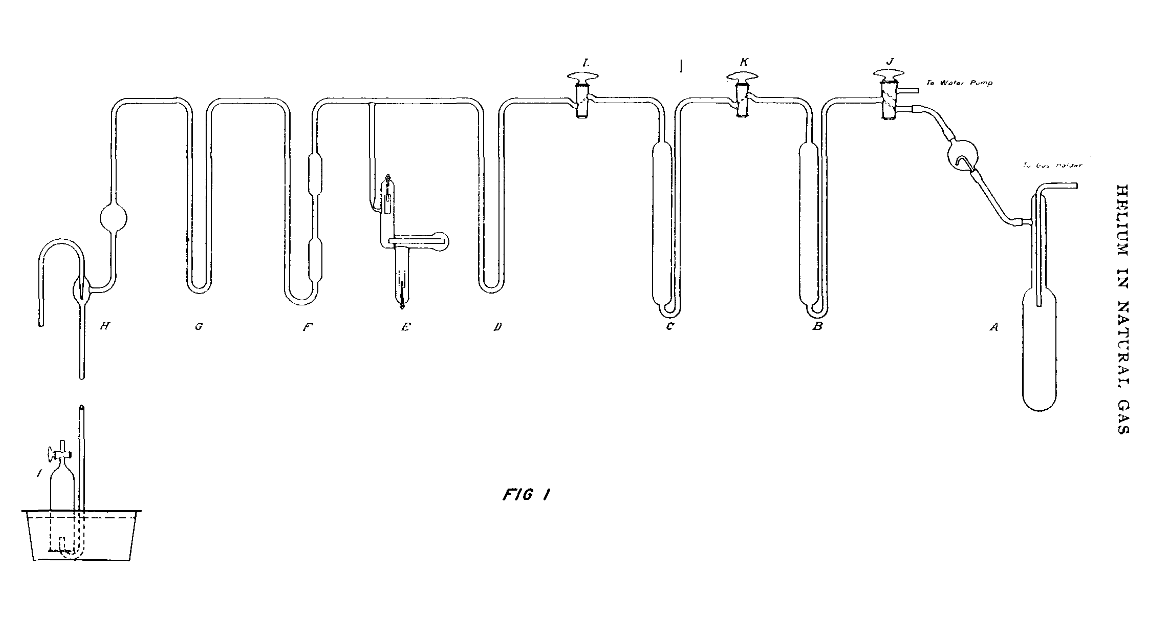
맥팔레인, '비활성 잔여물 inert residue'를 마그네슘 처리해서, 질소를 완전히 제거하는 실험을 반복.
질소가 고체인 질화마그레슘으로 변해서 제거될 때까지 이 과정을 수없이 반복.
질소가 사라지고 남은 순수 기체의 부피를 재고, 분광기로 D3 선을 확인. 그 천연가스 속에 헬륨이 1.84% 포함되어 있다는 것을 알아냄
Hamilton Cady , David Mcfarland 해밀튼 케디와 데이비드 팩팔레인 논문. (천연가스에서 헬륨 발생과 천연가스의 구성)
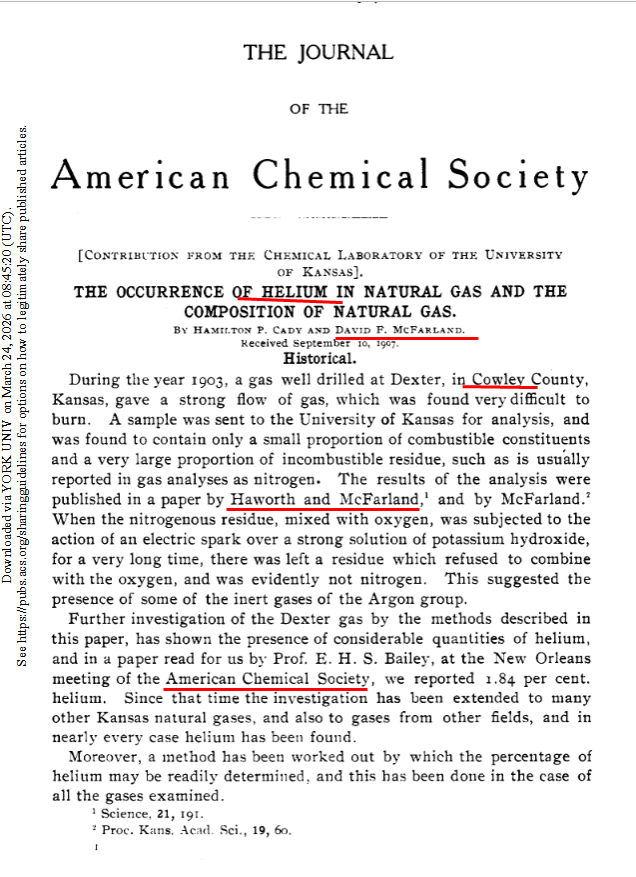
맥팔레인은 윌리엄 램지가 사용했던 방식을 응용.
1) 달궈진 마그네슘은 질소와 매우 강력하게 반응하여 고체인 질화마그네슘을 형성
2) 분리: 기체였던 질소가 고체로 바뀌어 유리관 벽에 달라붙으면서, 혼합 기체 중 질소는 사라지고 절대 반응하지 않는 헬륨만 기체 상태로 남게 됨
3) 반복 과정. 기체를 이 관에 여러 번 통과시킬수록 순도는 높아지며, 최종적으로 'Inert Residue'에서 질소가 완전히 빠진 1.84%의 순수 헬륨만 남게 됨.
4) 남은 순수 기체의 부피를 재고 분광기로 D3 선을 확인함. 천연 가스 안에 포함된 기체가 헬륨임을 확인, 그 비중이 1.84%라는 수치 얻음
칸사스 주, 미주리 주, 오클라호마 천연 가스들을 실험 - 41군데에서 1군데를 제외하고, 모두 헬륨을 채취함.
칸사스 주, 미주리 주, 오클라호마 천연 가스들을 실험 - 41군데에서 1군데를 제외하고, 모두 헬륨을 채취함.
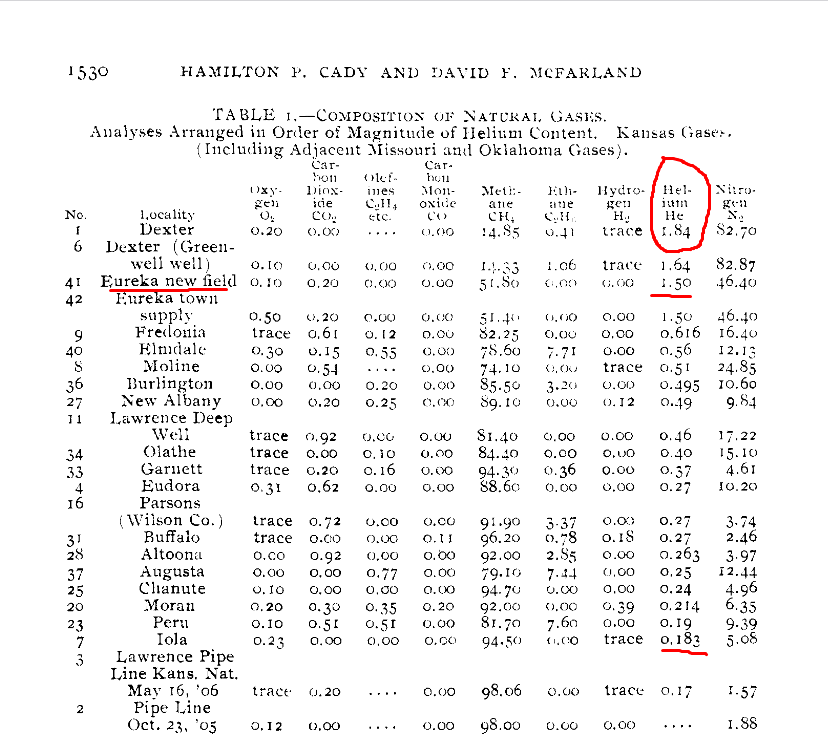

천연가스 층에서 헬륨을 채취할 수 있게 되었다.


