미국에 있는 '인권 활동가 뉴스 에이전시(HRANA)' 발표 , 1400명 이란인 사망, 그 중 15%가 어린이.
파라스테쉬 다하긴 (약사), 이스라엘 폭격으로 집에서 일하다가 사망. 가족들이 테헤란이 위험하다고 말했지만, 파라스테쉬는 테헤란 시민들이 약을 필요로 하기 때문에, 테헤란에 남아서 일하겠다고 가족들에게 말했다고 함.
베리반 몰라니는 침대에 누워있다가 폭격 파편에 맞고 숨져.
3세 아이, 에일마 빌키 사망 (사르다쉿 )
- 올 1월에는 정부가 사람들을 길거리에서 살해하고, 이제는 이스라엘 미국의 폭격으로 사람들이 죽어가고 있다. 공포에 휩싸인 이란인들
- 미국과 이스라엘은 의료 시설에도 폭격 (국제법 위반)
- 20군데 넘는 의료시설이 폭격당함.
명분없는 이 전쟁을 이스라엘과 미국은 당장 멈춰야 한다.
A pharmacist and a homesick lifestyle blogger: The 'alarming' civilian cost of war in Iran
4 hours ago
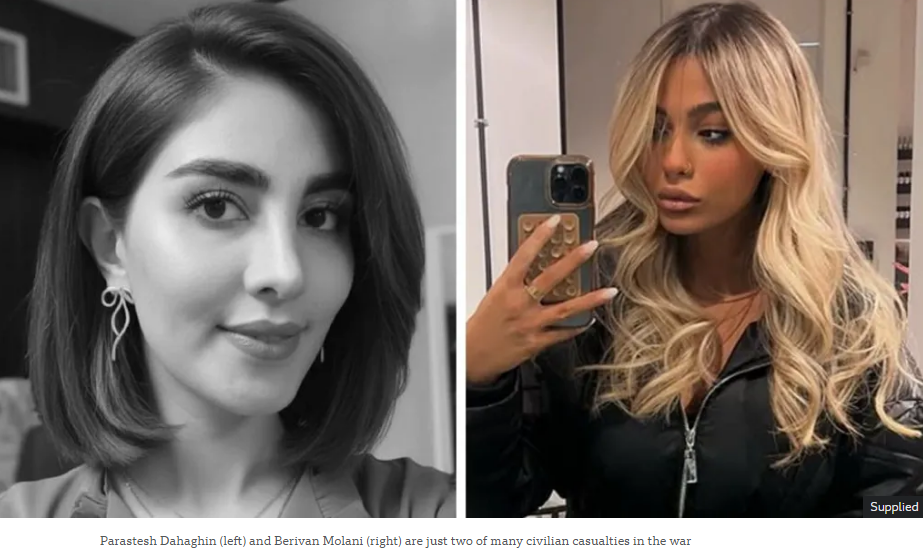
Parastesh Dahaghin (left) and Berivan Molani (right) are just two of many civilian casualties in the war
Parastesh Dahaghin was a young pharmacist killed in an explosion while she was at work.
Berivan Molani was in bed when debris from an air strike in Tehran struck her head.
For more than three weeks, Tehran and other cities have been pummelled by US and Israeli airstrikes - with thousands of targets hit across the country.
And reports of civilian casualties from these strikes are not limited to adults. Eilmah Bilki, aged 3, reportedly died a day after being injured in the western town of Sardasht.
The toll on civilians is mounting fast. Most of their stories will never be told.
But through the thick, black smoke of war and an internet blackout, small fragments of information are getting out of Iran. And the names of a tiny fraction of the civilian casualties of the US-Israeli war on the country are beginning to emerge.
Parastesh Dahagain had been in her pharmacy in Tehran's Apadana neighbourhood when the nearby building of an IT company that reportedly played a role in Iran's internet shutdown was struck, according to the Iran Human Rights Documentation Center.
Video posted online shows a mourning ceremony for Parastesh - framed pictures of her nestled among candles and flowers.
Her brother Poorya wrote on Instagram that his sister was just doing her job when she was killed.
He said the family had told her that Tehran wasn't safe but she had replied: "People need me, people have been wounded."
She told him: "They come to the pharmacy, and elderly people need their medication. I have to stay here and help my people."
"You were so noble," he added, in tribute.
How Iranians are evading internet blocks to contact family abroad
Iranian schools, hospital and landmarks among civilian sites hit during US-Israeli strikes
Why did US and Israel attack Iran and how long could the war last?
Less is known about 3-year old Eilmah Bilki - whose photo was provided to the BBC by the Kurdish human rights group, Hengaw. The group said she had been severely wounded in US-Israeli airstrikes in early March and died a day later.
Hengaw A picture of Eilmah Bilki.Hengaw
Eilmah Bilki died after US-Israeli airstrikes earlier this month
Berivan Molani – a 26-year-old lifestyle blogger who ran an online clothes shop - was an only child who had returned to Tehran from the safety of northern Iran just the day before she died, because she missed home.
Her family say they had no idea that Iran's minister of intelligence, Esmail Khatib, lived opposite them on Makouyipour Street in Tehran's wealthy Zafaraniyeh neighbourhood, according to Razieh Janbaz, a friend, posting on Instagram.
Night-time footage released by the Iranian Red Crescent shows rescuers removing fallen masonry to try to reach
Berivan's trapped mother as she begs to know: "Is my daughter alive?"
Berivan had already been pulled out of the rubble, but her crush injuries were fatal.
"She was killed in her bed, right before going to sleep, during the missile attack on March 17th," wrote Janbaz.
Several of Berivan's neighbours were killed in the Israeli airstrike that targeted Khatib last week, said Janbaz, a former member of Iran's handball team who went to the area after the attack and found that all that was left of her friend's life was a pair of trainers lying on the street.
"This was a family who did everything in their power to protect their child yet in the end – without even knowing who lives in the house across from them – they lost her," he said.
The US-based Human Rights Activists News Agency (HRANA) has so far recorded more than 1,400 civilian deaths, 15% of them children.
미국에 있는 '인권 활동가 뉴스 에이전시(HRANA)' 발표 , 1400명 이란인 사망, 그 중 15%가 어린이
One of the deadliest single incidents was a missile strike on a primary school in the southern town of Minab at the start of the war.
Reports point to US responsibility as it targeted a nearby military base. The US military has not publicly admitted hitting the school, but says it is investigating.
Kurdish human rights group Hengaw has identified 48 children and 10 adults killed in the school.
Hengaw expressed "grave concern" over rising civilian casualties.
Iran does not report its own military losses. HRANA reports at least 1,167 military personnel have been killed since the war began.
During the war, many Iranians have been arrested for using the internet.
But even for human rights groups with strong contacts on the ground, gathering information on casualties is extremely hard.
Hengaw says Iranian border guards have been given orders to shoot people trying to use Iraqi phone and internet networks - which can sometimes be accessed close to the border between the two countries - as the regime tries to control both the population and the narrative of the war.
"It's a really heartbreaking situation for people," said Hengaw's Awyar Shekhi.
People are "terrified", he told the BBC. 올 1월에는 정부가 사람들을 길거리에서 살해하고, 이제는 이스라엘 미국의 폭격으로 사람들이 죽어가고 있다. 공포에 휩싸인 이란인들
"Earlier this year they were being killed on the streets by the Iranian government and now they risk being killed by the bombings."
There are government buildings in residential areas, he said, before adding that even a big city like Tehran has no civilian bomb shelters.
"It's dire."
Civilians paying 'alarming' price for war
The International Committee of the Red Cross says civilians are paying an "alarming" price for the war.
A Red Crescent worker, Hamidreza Jahanbakhsh, is among the dead, and several of its facilities have been damaged.
"International humanitarian law is clear: Civilians and civilian infrastructure must be spared from attack. Medical workers and first responders, as well as medical transport and facilities and humanitarian personnel must be respected and protected," said ICRC delegation head, Vincent Cassard.
The World Health Organisation (WHO) has now verified more than 20 attacks on health care facilities, with reports of many more. It says at least nine health workers have been killed.
It classifies any collateral damage as an attack.
0:14
Verified video of Tehran's Gandhi hospital shows extensive damage
"It's not for us to determine if a strike was aimed directly at that facility or a facility next to it," says Ian Clarke, who is directing WHO's response to the war in the Middle East.
"It's an attack on health, and the onus is on the people who are pursuing a conflict to actively protect civilians and to protect and take the measures to ensure that the health facilities are not impacted."
"Any attack on health care is a breach of international law," he adds.
The US has previously said it does not target civilians and takes its obligations seriously.
The BBC has verified footage of several damaged hospitals, including the 17-story private Gandhi hospital in Tehran, close to the headquarters of the state broadcaster which was the target, a Red Crescent hospital in the town of Mahabad in western Iran, and a hospital in the southern port of Bushehr, from which babies in incubators were seen being evacuated on 3 March.
Just weeks after they tried to save the lives of injured protesters, doctors working in public hospitals are stretched and "extremely exhausted", according to Iranian surgeon Dr Hashim Moazenzadeh.
He is now based in France, but has been in touch with former colleagues in Tehran.
"The bombs being used are extremely large and we have a very high number of civilian casualties," he said.
Making an urgent plea, he added: "If you're bombing near places like hospitals, you have to prioritise their safety and protection."


