룰라의 역전승 원인은 1) 룰라 지지자들 중에 1차 투표에서 기권자들이 2차 투표를 했다는 점. 1차 전에서 우익 보우소나루에 루나가 패하자, 룰라 지지자들이 위기의식을 가지고, 2차 투표에서는 더 많은 표를 룰라에게 던졌다.
2) 1988년 대선 이후, 미나스 제라이스 주에서 이긴 후보가 대통령에 당선되었다. 2026년 결선 투표에서도, 1차전에서는 보우소나루가 이겼으나, 2차 전에서는 미나스 제라이스 주에서 룰라가 50.4%를 획득해, 4선에 성공했다.
룰라는 1차 투표에 비해, 2차 결선투표에서 1천 37만 6694표를 더 획득했다.
반면 보우소나루는, 372만 2438표를 더 획득했다.
분석. 결선 투표에서 누가 룰라를 선택했는가?
다음 수치는 경제사회학자 다니엘 슈타인가르트에 의거함.
1. 룰라가 1차에 비해 2차 투표에서 더 추가한 표는 어디서 왔는가?
(1) 1차 투표 백지투표들 중에, 129만표를,
(2) '무효투표' 중에, 162만표를,
(3) 1차 투표 기권자들 중, 134만표를 추가했다.
1차 투표에서 다른 후보자들, 쿠리 (340만표) 중에 54%를, 산투스 (270만표) 중에 48%를, 카이아도 (260만표) 중에 46%를, 제마 (32만 6천표 중에) 23%를, 다른 기타 후보들 (26만 1천표) 중 79%를 더 추가했다.
2.
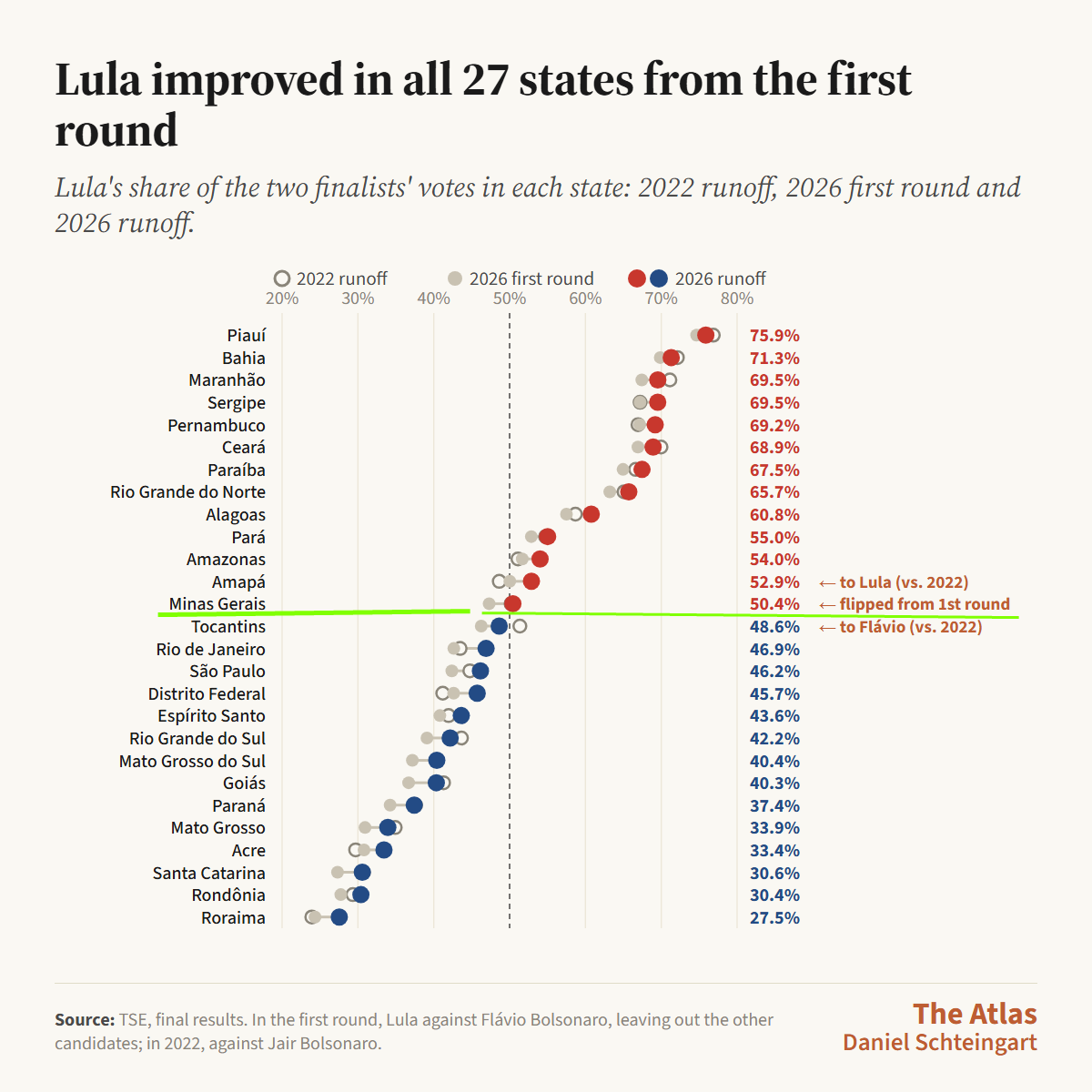
27개 주 표 분석 자료.
미나스 제라이스 주의 경우, 1차전에서는 룰라가 패배했으나, 2차 결선에서는 역전승을 거뒀다.
룰라가 1차전에서 승리를 거둔 12개 주의 경우, 1차 결선에서는 1차전보다 더 많은 득표를 획득했다. 룰라 지지자들이 더 집결했다는 뜻이아.
10월 25일 결선투표 결과
룰라 (브라질 노동당) 득표 6천 425만 6232표 (51.8%)
보우소나루 (브라질 자유당) 5천 982만 6941표. (48.21%)
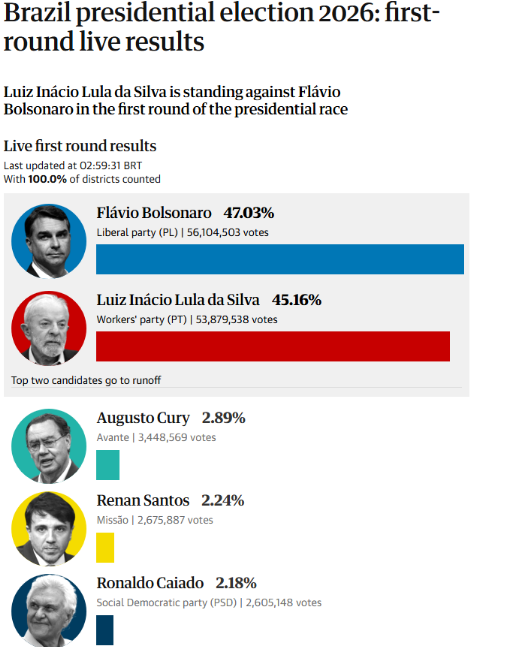
10월 4일 1차 투표 결과
룰라. 5천 387만 9538표 (45.16%)
보우소나루 . 5천 610만 4503표 (47.03%)
다니엘 슈타인가르트 - 경제사회학자. 산마르틴 국립대학교(UNSAM) 사회학 박사. 아르헨티나 정책연구기관 Fundar의 지속가능 생산발전 담당 국장.
출처. Daniel Schteingart
@danielschteingart
Economic sociologist with a Ph.D. from UNSAM. Director of Sustainable Productive Development at Fundar
출처. https://atlasdevelopment.substack.com/p/brazils-first-comeback
Brazil's first comeback
Against all odds, Lula won the runoff by 3.6 points and will be president for a fourth time. How did Brazil's electoral map change from the first round and from 2022?
atlasdevelopment.substack.com
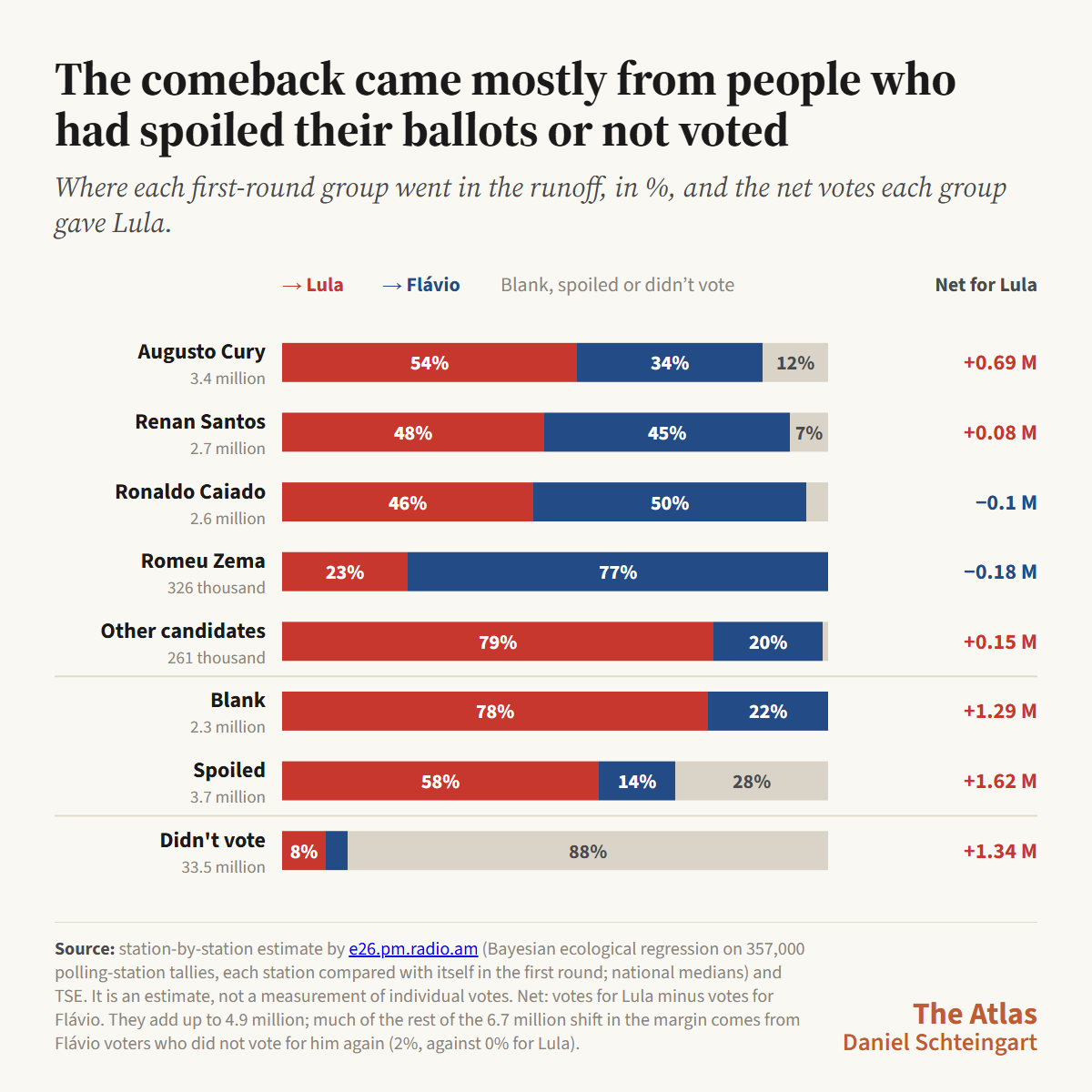
1차 투표에서 '백지 투표'한 사람들 230만명 중에 78%가 룰라를, 22%는 보우소나루를 선택해, 룰라가 129만표를 추가함.
1차 투표에서 '무효 (훼손)' 투표용지 370만 중에 58%가 룰라를, 14%가 보우소나루를 선택해, 룰라가 162만표를 1차에 비해 추가함.
1차 투표 결석자 3천 350만 표 중, 이 중 8%가 룰라에 투표했다. 룰라가 134만표를 더 추가할 수 있었다.
27개 주 표 분석 자료.
미나스 제라이스 주의 경우, 1차전에서는 룰라가 패배했으나, 2차 결선에서는 역전승을 거뒀다.
룰라가 1차전에서 승리를 거둔 12개 주의 경우, 1차 결선에서는 1차전보다 더 많은 득표를 획득했다. 룰라 지지자들이 더 집결했다는 뜻이아.
톰 필립스 (가디언 특파원)
1차 투표에서 룰라라 패배하자, 룰라 지지자들이 왓스앱에 '룰라 군대'를 만들어, 룰라 선거운동을 펼쳐나갔다.
특히 1차 투표에서 유권자의 21%가 기권하자, 룰라 지지자들이 이들의 투표를 독려했다. 선거 전날,10월 24일에는 리오의 코파카바나 해변에서 100만명 룰라 지지자들이 집결해, 막판 역전승의 발판을 만들었다.
룰라 당선의 의미.
룰라 1기와 2기에, 룰라의 업적은 1) 수천만 명 빈곤 타파 주력 2) 국제 원자재 수출
세계 시장에서 원자재 호황 시기 (2002~ 2011년)
중국의 철강 생산과 건설투자 증가로, 브라질이 철광석을 중국에 수출.
대두와 농업 생산물 역시 중국을 비롯한 해외로 수출. 외화 수입원.
석유 수출.
외화 유입되고, 무역수지 개선 등으로, 임금 인상, 복지 확대, 내수 진작 등
2022년~2026년 룰라 3기. 아마존 산림 남용 막았다. 원주민의 삶의 영역 보호.
자이르 보우소나루 집권기 (2018-2022)에, 아마존 강 북부, 야노마미 (Yanomami) 원주민 보호 구역에서 금광을 무분별하게 개발 착취함. 룰라의 3기에, 불법 광산업과 금광 채굴을 금지시켰다.
트럼프의 라틴 아메리카 영향력 억제하다.
룰라는 트럼프의 팽창주의를 '식민 디자인'이라고 비판했다. 트럼프 주도 '마약 카르텔'과의 전쟁에도 참여하지 않았다.
트럼프는 선거 직전 플라비우 보우소나루를 지지하고, 룰라 정부에 관세 50%를 부과했다. 룰라 승리 이후, 트럼프는 룰라의 당선을 공식적으로 인정하지 않고 있음.
Brazil election 2026: Full second round results as Lula wins comeback against Flávio Bolsonaro
After a shock defeat in the first round, the incumbent Brazilian president, Luiz Inácio Lula da Silva, has turned the election around to win the runoff.
Live blog: latest analysis and reaction
Seán Clarke and Tom Phillips
Mon 26 Oct 2026 00.15 GMT
Share
Live second round results
Last updated at 23:27:02 BRT
With 100.0% of districts counted
LULA Luiz Inácio Lula da Silva 51.79%
Workers' party (PT) | 64,256,232 votes
FLAVIO BOLSONARO Flávio Bolsonaro 48.21%
Liberal party (PL) | 59,826,041 votes
Guardian graphic. Source: TSE
Results by state
How the election works
Brazil’s president is elected purely by the popular vote. A winning candidate needs one more vote than 50% of votes cast; there is no role for the parliament and no electoral college.
Because no candidate achieved 50% in the first round on 4 October, the two leading candidates go into a runoff. One of them is Luiz Inácio Lula da Silva, the incumbent leftwing president, commonly known as Lula. The other, and the leading candidate in the first round, is Flávio Bolsonaro, the son of the far-right former president Jair Bolsonaro.
Bolsonaro senior is serving a 27-year prison sentence for plotting a failed coup attempt after he lost to Lula in the 2022 election, but has endorsed his son and hopes to be released if he wins. Bolsonaro junior is a lawyer and former senator from Rio.
In 2022, Lula beat Jair Bolsonaro in the second round, with an electoral base concentrated in the north-east of the country, while Bolsonaro led in the south. But on that occasion Lula entered the second round as the leading candidate from the first round, and won the bellwether state of Minas Gerais, north of Rio de Janeiro. In the first round of the 2026 election, Bolsonaro beat Lula in Minas Gerais by 48.43% to 43.33%.
Never, since the return of democracy to Brazil in 1985, has the first round runner-up managed to turn the game around and win the second vote. But Lula’s campaign has been buoyed by massive, student-led anti-Bolsonaro protests after the first round and hopes to stage a historic fightback on Sunday.
Lula is already the longest-serving president in Brazil’s modern history, serving two terms from 2003 to 2010, before returning to office in 2023. He will turn 81 on Tuesday. Bolsonaro is 45.
Brazil keeps left: what Lula’s victory means for his country and beyond
In today’s newsletter: As Luiz Inácio Lula da Silva secured victory in the presidential race, we look the implications for democracy, the environment and international relations
Libby Brooks
Mon 26 Oct 2026 06.44 GMT
Good morning. Chances are you woke this morning to news of two momentous election results. In Serbia, a student-led movement has ousted the country’s long-serving leader, Aleksandar Vučić (which you can read more about here). And just hours ago, Brazil’s president staged a sensational turnaround against his far-right opponent after a nail-biting vote.
Luiz Inácio Lula da Silva, known as Lula, won a forth nonconsecutive term as president, seeing off far-right senator Flávio Bolsonaro, who spearheaded the radical populist movement built by his father and former president, Jair. Jair Bolsonaro is serving a 27-year prison sentence for plotting a coup after he lost the 2022 election.
After Bolsonaro’s surprise first-round victory earlier this month, the Workers’ party incumbent Lula pulled off a historic fightback – a consolidation of the democratic resurgence the country has enjoyed since he took office – and an early birthday present for the veteran leftist, who turns 81 on Tuesday.
But with Bolsonaro refusing to accept the result, the victory is a tense one. I spoke to the Guardian’s Latin America correspondent Tom Phillips, who was in São Paulo at the Workers’ party vote count, to find out what the result means and what may lie ahead.
In depth: ‘This is the crescendo of Lula’s incredible, if sometimes controversial, 50-year political career’
Brazilian President Luiz Inácio Lula da Silva
This morning’s results were an unprecedented turnaround, according to election analysts. Photograph: Amanda Perobelli/Reuters
When the results were declared just after midnight UK time, the choice of Brazil’s 159 million voters was narrow, but clear. The 80-year-old leftist received 51.79% of the vote to his rival’s 48.21% – about 4.3m votes – in what Lula called “a defeat for denialism”.
A visibly angry Bolsonaro has already refused to concede, citing a decision to extend voting for an extra two hours – although both sides had called for it, for different reasons.
The outcome was an unprecedented turnaround after a populist surge in first-round voting at the beginning of the month left Brazil’s progressives reeling.
In those early October elections, Flávio Bolsonaro received 56.1m votes to Lula’s 53.8m – 47.03% to 45.16% – putting the 45-year-old scion of the authoritarian clan in pole position: not once, since the return of democracy to Brazil in 1985, has the first-round runner-up managed to turn the game around and win the second ballot.
In the intervening weeks, the polls tightened dramatically, putting Bolsonaro ahead by only fractions of a percentage point.
“This is the crescendo of an incredible, if sometimes controversial, 50-year political career,” Tom says. I can hear crowds of Lula supporters cheering in the background as we speak, and fireworks exploding. “It saw Lula go from rural poverty to union leader to the first elected working-class leader of Brazil, who has helped millions of people escape poverty and rode a commodities boom in his first two terms”.
For Brazil, a Lula win represents stability and the assurance that the country’s democratic future is secure, at least in the short term. “Over the past four years, Lula has reduced deforestation in the Amazon by more than 70%. He’s come to the help of the Indigenous people who live there. He’s cracked down on illegal mining,” Tom tells me. “It’s very positive news is that all this will continue.”
How did Lula turn things around?
“Bolsonarismo is a far-right movement … that has put down deep roots in Brazilian society,” Bernardo Mello Franco, a political columnist for the Rio broadsheet O Globo, told Tom earlier this month, pointing to a series of societal shifts have contributed to this.
Evangelical Christianity has expanded across Brazil in recent decades, with church leaders throwing their support behind the socially conservative policies favoured by Bolsanaro Sr and Jr.
Pro-gun Flavio Bolsonaro harnessed voter frustration at chronic levels of urban crime and violence. Despite being embedded in Brazilian politics for decades, he successfully portrayed himself as an anti-establishment outsider, using social media far more effectively than his rival.
And others believe he had significant help: a dozen watchdogs and research groups have published reports alleging that Meta may have favoured the senator’s campaign. The controversy grew after Brazils’ electoral court ordered Meta not to give the candidates “unequal treatment”, while the company called the allegations “false and unfounded”.
Progressives were galvanised after the first-round results revealed a record abstention rate of 21%, more common among Lula-supporting groups such as lower-income voters, and their focus sharpened on mobilisation. Millions joined a WhatsApp channel called “Lula’s army”, which sent out daily instructions on how to make supportive content go viral. The 80-year-old incumbent, who only took ownership of his first smartphone in recent days, started posting to Instagram and TikTok. For the first time, the president’s digital reach overtook that of Bolsonaro.
Meanwhile, the Bolsonaro campaign was hit by a succession of scandals. In a revelation that made the UK’s partygate seem tame by comparison, last week the Brazilian magazine Piauí claimed that at the height of the 2020 coronavirus outbreak, Flávio Bolsonaro attended a boat party along with sex workers and vaccine lobbyists hoping to cut deals with his father’s government.
Amid speculation that a comeback might be possible, at a million-strong rally on Copacabana beach in Rio on Saturday, activists unfurled an enormous yellow and green banner declaring: “We are going to turn this around!”
And so he did.
What role did Trump play in the election?
The US president has boasted about “lots of people that I got elected” in Latin America, styling himself as a kingmaker after a succession of right-wing candidates aligned with Washington have won power.
Although Donald Trump did not openly endorse Flávio Bolsonaro, his influence loomed large. Last year, he denounced the supreme court trial of his ally Jair Bolsonaro as a “witch-hunt”, imposing extraordinary 50% tariffs on Brazilian imports as retribution for what he claimed was political persecution.
Lula has styled himself as the country’s defender against Trump’s “colonial” designs. His victory consolidates a multilateral foreign policy and pragmatic approach to relations with the US, China and Russia. He has rejected invitations to join the controversial coalition of Latin American countries conducting military operations against drug cartels alongside the Pentagon, which would have resulted in much greater US involvement on Brazilian soil.
Furthermore, a win for pro-democracy campaigners in one country may serve to bolster international counterparts. As our senior international correspondent Julian Borger sets out in this compelling piece, along with the Brazil vote, a series of high-stakes elections in Serbia yesterday, Israel on Tuesday and the US next week are closely interlinked, and Lula’s win may have global ramifications, as leaders across Latin America and the world congratulate him this morning.
What does the result mean for the environment, in Brazil and beyond?
Last week, Tom travelled to Roraima, the northern state where Bolsonaro registered his best result nationwide. On his trip, he heard first-hand from Indigenous leaders and conservationists on why the populist’s success was causing panic.
His father’s environmentally devastating administration facilitated an illegal gold rush – turbo-charged by record global gold prices – that ravaged the Yanomami Indigenous reserve on the northern reaches of the Amazon.
When Lula beat Jair Bolsonaro in 2022, the left-winger launched an environmentalist mission to expel the illegal miners, taking on the multibillion dollar extraction industry. Alongside wider green policies, he reduced deforestation in the Amazon to record lows.
“Tragically,” says Tom, “the environment only came up in the final presidential debate of this campaign.”
“Given that the Amazon makes up such a large portion of Brazil, and how important that region is to the global climate crisis, it’s amazing that it’s not been debated more. But people were voting more on economy, public security and culture war issues.”
In that final debate last Friday, Tom says that Lula “tried to show off the excellent, if incomplete, work that his government’s done in protecting the environment”.
Many will be relieved at Bolsonaro’s loss, as his vision for the Amazon was almost identical to his father’s.
While a Lula victory brings hope that these policies will continue, he will be working with a newly elected congress that features a record number of rightwing politicians hostile to Indigenous rights and environmental issues.
How will Bolsonaro respond?
The immediate aftermath of the election results is likely to be fraught, warns Tom, with Flávio Bolsonaro saying it was “impossible to concede the election result”.
“The Bolsonaro response is exactly as I feared but I don’t think it will mean very much,” Tom says. “All these world leaders are now recognising Lula’s win and I don’t think Bolsonaro has a hope of overturning this result”.
Tom suspects that in the coming days Bolsonaro will head to the States, to avoid ongoing criminal investigations. “That’s not to say there might not be violence from his supporters, but his political career is done. The fact they’ve lost is a sign that the name ‘Bolsonaro’ is toxic for a slight majority of Brazilian people.”
Brazil keeps left: what Lula’s victory means for his country and beyond
In today’s newsletter: As Luiz Inácio Lula da Silva secured victory in the presidential race, we look the implications for democracy, the environment and international relations
www.theguardian.com


