South Korean Leader Says He Will Not Send Troops to Iran, Despite Trump’s Call
President Lee Jae Myung’s comments followed President Trump’s repeated demand for “a little hand” from South Korea, a decades-old American ally.
By Choe Sang-Hun
Published Sept. 18, 2026
President Lee Jae Myung of South Korea pushed back against pressure from the Trump administration on Friday, declaring that his country would not deploy troops or military assets to support the U.S.-led war against Iran.
In recent weeks, President Trump has publicly taunted the South Korean leader, venting frustration over what he described as Seoul’s refusal to help defend the Strait of Hormuz — once the world’s main transit point for oil — while American troops remain stationed on the Korean Peninsula to shield South Korea from North Korea. On Friday, Mr. Lee firmly rejected any military involvement in the Middle East conflict.
“There will be no deployment of troops or dispatch of military assets to be involved in or intervene in this war,” Mr. Lee said at a news conference.
Instead of a combat deployment, Mr. Lee noted that Seoul is considering expanding the operational scope of a South Korean Navy destroyer and its support ships currently stationed off the coast of Somalia for antipiracy operations. He emphasized that even if those assets move closer to the Red Sea or the Strait of Hormuz, their sole focus would be protecting South Korean oil tankers and other commercial vessels. They will not participate in any operations that could be interpreted as supporting the war against Iran, he said.
While Mr. Trump has not specified the exact type of assistance he expects from Seoul, he complained last month that he had asked Mr. Lee “to give us a little hand” in the conflict, reminding him of the U.S. military presence in South Korea.
“He said, ‘No, thanks,’” Mr. Trump recalled. “I see. Well, why are we involved in helping you?”
It was not the only issue that a grim-faced Mr. Lee addressed on Friday. Fifteen months into his single five-year term, his approval rating has fallen to a new low of 37 percent, battered by troubles brewing not only at home but also by strains with South Korea’s most important ally, the United States.
Last month, Mr. Trump unilaterally scaled down one of the United States’ annual joint military exercises with South Korea, calling the drills not only “costly” but also “totally inappropriate and hostile” toward North Korea. He said that, for as long as he had been in office, North Korea had been “unthreatening and respectful.” Mr. Trump also boasted of having a “very good relationship” with North Korea’s leader, Kim Jong-un, even as the North has become a bigger nuclear threat against the South.
At home, South Korea’s main stock index — once lauded as a premier beneficiary of the global A.I. boom — has crashed, devastating the portfolios of millions of individual investors who were encouraged by Mr. Lee’s government to buy stocks. Mr. Lee has also failed to deliver on his repeated pledges to curb rising housing costs.
The opposition has accused him of seeking a constitutional amendment that would allow him to run for a second term, a move explicitly barred by the current Constitution. His presidency also remains marred by his suspended criminal trials on charges that include violating election laws and inducing perjury. The opposition has claimed that Mr. Lee was plotting a special bill to erase those charges, which he has insisted were fabrications orchestrated by his conservative adversary and predecessor, the impeached and ousted former President Yoon Suk Yeol.
On Friday, Mr. Lee said that although he supported a constitutional revision allowing future presidents to seek a second term, he himself had no intention of seeking re-election. He called it “constitutionally impossible.” The claim that he might seek a second term, he said, was nothing more than a “political offensive.”
Mr. Lee also said he supported the National Assembly’s appointment of a special prosecutor to investigate whether politicians like him, as well as journalists, had been targeted in politically motivated criminal investigations under Mr. Yoon. But he said that he did not want such a special prosecutor to have the power to drop the criminal charges already filed against him.
“It’s because of my own shortcomings,” Mr. Lee said, referring to his plummeting approval ratings. “I fell short in consideration, sensitivity and communication.”
Mr. Lee also said his government remained in “fierce” negotiations with Washington over how to implement the sweeping agreement the two governments announced last November. Under the pact, Mr. Trump reduced tariffs on key South Korean exports, including automobiles, from 25 percent to 15 percent. He also pledged U.S. support for South Korea’s efforts to develop nuclear-powered submarines and to enrich uranium for civilian nuclear energy. In exchange, Mr. Lee committed $350 billion in investments in the United States.
But negotiations over the deal’s implementation have stalled over the details, fueling doubts on both sides about the other’s willingness to follow through.
On Friday, Mr. Lee said the two governments were close to finalizing an agreement on where the first batch of South Korean investments should go.
Mr. Lee said that his government remained in “fierce” negotiations with the United States over the implementation of a deal announced last November. Credit...Pool photo by Ahn Young-Joon
Mr. Lee said he had been unhappy with a proposed agreement and had instructed his government to continue negotiating. He did not elaborate, but emphasized that any investment projects must be “commercially reasonable” and that the two governments needed to agree on how to share profits and losses from such projects.
“We should not buckle under pressure or coercion,” he said, adding that his comment reflected his government’s general negotiating principle and was not aimed at the Trump administration in particular.
But Mr. Trump’s complaints that he has received “very little help from other countries” for the war in Iran have placed immense diplomatic pressure on Seoul. The United States led the United Nations forces that repelled North Korean invaders during the 1950-53 Korean War, anchoring what is now a seven-decade-long alliance. South Korean troops formed the largest foreign contingent fighting alongside American forces in the Vietnam War.
Yet, acceding to Mr. Trump’s request would carry severe political risks for Mr. Lee. The last time South Korea sent forces to a U.S.-led conflict — the Iraq War, which began in 2003 — the progressive administration of then-President Roh Moo-hyun faced a fierce domestic backlash, particularly from his own party and base. Although that deployment consisted primarily of engineering and medical units, the decision permanently crippled Mr. Roh’s approval ratings.
Public opinion in South Korea remains against intervention. A poll conducted this month showed that 55 percent of South Koreans oppose deploying troops to the conflict with Iran, compared with just 32 percent in favor.
Choe Sang-Hun is the lead reporter for The Times in Seoul, covering South and North Korea.
호르무즈 파병 논란…참여연대 “청해부대 변칙 운용 안 된다”
이재명 대통령 “전쟁 관여·개입 파병 없다” 재확인…청해부대 임무 강화는 검토
참여연대·자주통일평화연대 “간접적 군사지원 가능성까지 차단해야”
기사입력 2026.09.19 09:37
기자명
이영일 기자
이재명 대통령이 호르무즈 해협과 관련한 군사적 대응 논란에 대해 ‘전쟁 불관여·불개입’ 원칙을 재확인했다. 다만 청해부대의 활동을 강화하는 방안은 검토하고 있다고 밝혀 시민사회에서는 구체적인 활동 범위와 국회 동의 여부 등을 명확히 해야 한다는 목소리가 나왔다.
이 대통령은 18일 대국민 기자회견에서 호르무즈 해협과 관련한 실질적 기여 방안을 묻는 질문에 전쟁에 직접 관여하거나 개입하는 형태의 파병은 없다는 취지로 답변했다. 동시에 한국 선박과 원유 수송로, 국민의 안전을 위한 최소한의 군사적 활동은 필요하다며 청해부대의 역할 강화 가능성을 언급했다.
대통령은 ‘전쟁 불개입’…청해부대 역할은 변수
현재 논란의 핵심은 청해부대의 임무와 활동 범위다. 이 대통령은 청해부대가 이미 해적을 비롯한 선박 및 국민 안전 위협에 대응하고 있다며 활동을 강화하는 방안을 검토하고 있다고 밝혔다. 연합뉴스에 따르면 청해부대는 최근 중동 지역의 군사적 충돌 여파로 홍해를 통과한 한국 유조선에 대한 지원 활동에도 나선 것으로 알려졌다.
이에 대해 참여연대와 자주통일평화연대 등 시민사회단체는 청해부대의 역할 확대가 결과적으로 미국의 군사작전을 지원하는 방식으로 이어져서는 안 된다고 주장했다.
“간접적인 군사 지원도 경계해야”
두 단체는 18일 논평에서 이 대통령의 ‘전쟁 불관여·불개입’ 입장을 유지해야 한다고 촉구하면서, 청해부대의 임무 강화가 구체적으로 무엇을 의미하는지 정부가 명확히 설명해야 한다고 지적했다. 특히 시민사회는 상선 보호나 국민 안전이라는 명분 아래 청해부대가 사실상 다른 국가의 군사작전을 지원하는 역할을 맡게 될 가능성을 우려하고 있다.
단체들은 청해부대의 활동 범위가 확대될 경우 그 임무와 작전 내용, 우리 장병의 안전 문제 등을 국회와 국민에게 투명하게 공개해야 한다고 요구했다.
국회 동의 여부도 쟁점
청해부대의 활동 범위를 어디까지 확대할 수 있는지도 논란거리다. 시민사회단체들은 기존 임무를 넘어 새로운 해역에서 군사적 활동을 수행하려면 국회 동의 등 필요한 절차를 거쳐야 한다는 입장이다. 정부가 ‘국민 보호’를 이유로 청해부대의 활동을 확대하더라도 실제 임무와 작전의 성격을 따져야 한다는 주장이다.
참여연대와 자주통일평화연대는 향후 청해부대와 아크부대의 활동이 중동 지역의 군사적 충돌에 연루되는지 지속적으로 살피겠다고 밝혔다.
결국 정부가 내세운 ‘전쟁 불관여·불개입’ 원칙이 실제 군사 활동에서도 일관되게 적용될 수 있을지, 그리고 청해부대의 역할 확대가 어디까지 허용될지가 향후 논쟁의 핵심이 될 전망이다.
.
속도 내던 호르무즈 파병 ‘신중 검토’…17일 NSC서 호르무즈 파병 논의할 듯
입력 2026.09.16 18:57
김원진 기자
강연주 기자
김병관 기자
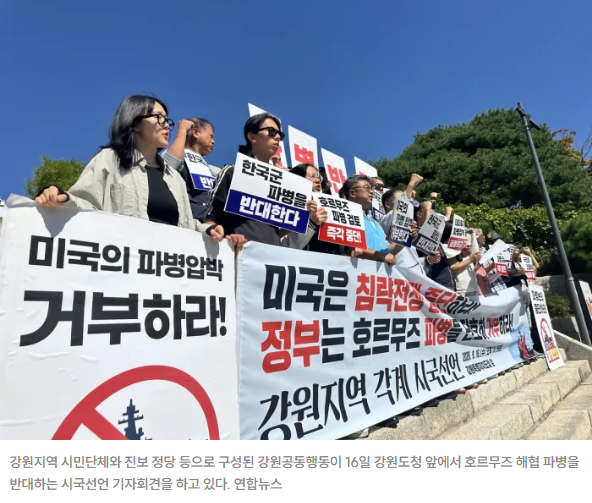
강원지역 시민단체와 진보 정당 등으로 구성된 강원공동행동이 16일 강원도청 앞에서 호르무즈 해협 파병을 반대하는 시국선언 기자회견을 하고 있다. 연합뉴스
정부가 오는 17일 열릴 예정인 국가안전보장회의(NSC) 상임위원회에서 호르무즈 해협 파병에 관해 논의할 것으로 보인다. 다만 정부는 NSC에 파병안을 공식 논의 안건으로 상정하지 않고, 부처 간 의견 조율을 이어가며 파병 논의 속도 조절에 나설 것이라는 관측이 나온다. 조현 외교부 장관은 오는 18일(현지시간) 미국에서 마르코 루비오 미 국무부 장관을 만나 파병에 관한 정부 입장을 전달할 것으로 보인다.
16일 취재를 종합하면 정부는 17일 NSC 상임위를 열고 호르무즈 해협 파병에 관한 논의를 할 것으로 예상되지만, NSC 상임위 논의의 공식 안건으로 올리진 않을 것으로 보인다.
다만 공식 안건이 아니더라도 국방부 장관, 국가정보원장, 대통령비서실장 등 9명으로 구성된 NSC 상임위에선 파병에 관한 부처 간 의견 조율이 이뤄질 가능성이 크다. 복수의 정부 당국자는 “안건이 아니어도 중요 이슈인 파병 논의는 불가피한 측면이 있고 NSC 상임위에서 안건이 아닌 의제를 논의했던 적은 이전에도 많았다”고 말했다.
일각에선 정부가 파병에 부정적인 국내 여론을 감안해 NSC 공식 안건 상정을 유보한 것이라는 관측이 나온다. 한국사회여론연구소(KSOI)가 지난 14~15일 100% 자동응답(ARS) 방식으로 조사한 결과, 파병과 군사 지원을 반대하는 의견이 61%로 나타났다.
정부 고위 당국자는 “파병을 신중하게 검토한다는 입장”이라고 말했다. 정부는 다만 폭발물처리반(EOD), 무인장비 등 비전투 성격의 병력을 최소한으로 호르무즈 해협에 보내는 방안은 열어두고 있는 것으로 알려졌다.
앞서 도널드 트럼프 미국 대통령은 지난달 16일(현지시간) 트루스소셜에 “한국의 대통령에게 이란의 비핵화 노력에 동참할 의향이 있는지 물었으나 사양하겠다!(No thanks!)는 답을 받았다”고 올린 뒤 보름간 네 차례나 한국의 호르무즈 해협 파병을 직간접적으로 압박했다. 이달 초에는 국방부가 파병을 대비한 현지 작전 환경 파악 차원에서 아랍에미리트연합(UAE)에 현지 조사단을 파견한 사실이 알려졌다.
국회와 시민사회에서 정부의 파병 추진에 반발이 이어지는 점이 정부가 숨 고르기에 들어간 한 요인이라는 분석도 제기된다. 김준형 조국혁신당 원내대표는 지난 15일 CBS 라디오 <박재홍의 뉴스한판승부>에서 “(정부가) 결정해 놓고 시쳇말로 간을 보듯이 매우 구체적인 방식의 정보를 흘리고 있다고 의심된다”고 말했다. 참여연대는 이날 청와대 앞에서 기자회견을 열고 “파병은 그 어떤 명분도, 실리도 없는 위험천만한 선택”이라며 “이 대통령이 호르무즈 파병 거부를 직접 밝혀야 한다”고 했다.
이에 따라 이재명 대통령이 오는 18일 기자회견에서 호르무즈 해협 파병에 관해 어떤 입장을 밝힐지도 주목된다. 이 대통령은 파병 여부를 구체적으로 언급하기보단 경제·통상 등 한·미 관계 전반에 얽힌 정부의 고심을 설명할 것으로 관측된다.
조 장관이 또한 18일(현지시간) 루비오 장관과 미국 워싱턴 DC에서 외교장관 회담을 하며 파병에 관한 정부 입장과 국회 분위기 등을 전달할 것으로 보인다. 당초 양국 외교장관 만남은 트럼프 대통령이 지난달 북·미 정상회담 의향을 밝힌 뒤 추진됐으나, 이번 회담에선 파병 논의가 주로 이뤄질 가능성이 있다. 외교부는 이날 “한·미 관계, 한반도 문제, 지역 및 글로벌 이슈 등 폭넓은 주제에 대해 협의를 할 계획”이라고 밝혔다.


