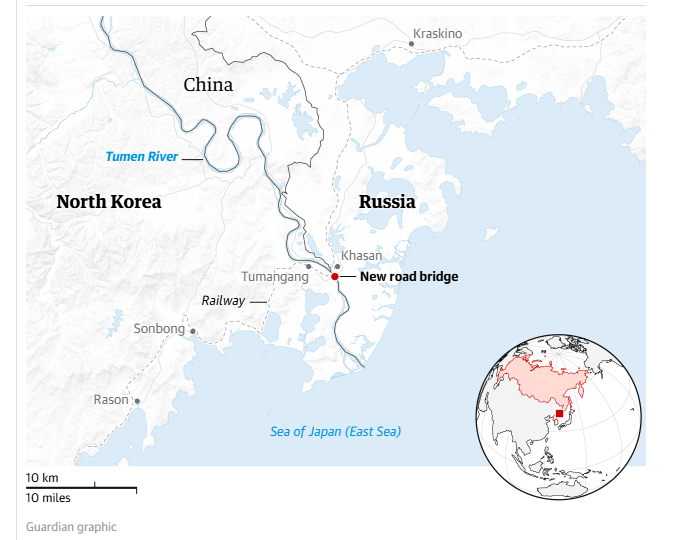
1. 러시아와 북한을 연결하는 최초의 '육로 다리'이다.
두만강을 러시아에서는 '투마나야'라고 부르고, 프리모스키 지역에 있다.
(9월 7일. 로이터 보도 요약)
다리의 1일 통행량은 300대
교량 건설은 2025년 4월 시작. 푸틴이 2024년 북한을 방문한 후, 정상 합의에 따름
러시아와 북한 사이에는 철도와 항공은 연결되어 있었지만, 육로 연결 다리는 없었다가 이번에 처음 교량을 개통했음.
1) 러시아와 북한을 연결하는 최초 육로 다리 이름은 '야코프 노비첸코', 다리의 1일 통행량은 300대, 러시아 화물 위주 통행, 연말에는 러시아 승객 통행 가능.관광, 무역, 경제 협력을 목표로 함. 장기적으로 블라스보스톡과 생테르스부르크까지 연결하는 시발점이 될 것으로 기대.
2) 교량 건설은 2025년 4월 시작. 푸틴이 2024년 북한을 방문한 후, 정상 합의에 따름
3) 러시아와 북한 사이에는 철도와 항공은 연결되어 있었지만, 육로 연결 다리는 없었다가 이번에 처음 교량을 개통했음.
두만강 사이 철도 다리 이름은 '우정의 다리'로, 1959년 개통함.
4) '야코프 노비첸코' 육로 다리 건설의 의미
- 2022년 러시아-우크라이나 전쟁 발발 이후, 북-러 '상호방위 협정(전략적 동맹)'에 따라, 북한이 러시아 쿠르스크 지역에 병력을 파병함으로써, 그 이전 소원했던 러시아와 북한과의 관계가 다시 군사적 경제적 동맹관계로 발전했음을 의미한다.
미슈틴 러시아 총리는 "영웅적인 북한 군인들이 러시아 군인들과 협력해 러시아 땅을 지켜냈다"고 북한 파병 군대를 칭송함
5) 임을출 (경남대) 평가. '야코프 노비첸코' 다리 건설로 인해, 북한에 대한 경제제재 효력이 약해질 것이다.
2. 2026년 7월 28일 가디언지 보도.
우크라이나 인권 단체 "진실 사냥개 Truth Hounds" 주장. 러시아와 북한을 연결하는 육로 다리는 경제와 관강 보다는, 군사 물자를 실어나르는 역할을 한다. 철도보다 도로를 이용하는 트럭 안에 물자를 확인하기 더 어렵다.
2024년 우크라이나가 러시아 쿠르스크를 공격하자, 러시아는 북한군 1만 4천명을 그 지역에 투입했고, 3천명을 더 확보하려고 하고 있다. 북한군 2천명이 러-우 전쟁에서 사망한 것으로 추정, 2명은 포로 수용소에 있음.
3. 참고.
다리 길이는 1km , 폭은 7 m , 2 차선 도로
러시아 수상과 북한 내각총리 사이 비디오 통화
러시아 수상 (마하일 미슈스틴 Mikhail Mishustin)
북한 내각 총리 ( 박태성 )
야코프 노비첸코 (Yakov Novichenko) 는 소련 '붉은 군대' 병사 이름, 1946년 김일성을 향해 떨어진 수류탄을 가로채, 그의 생명을 구한 바 있다.
North Korea and Russia open their first road bridge, a symbol of expanding ties By Andrew Osborn
September 7, 20263:33 AM
EDTUpdated September 8, 2026 Item
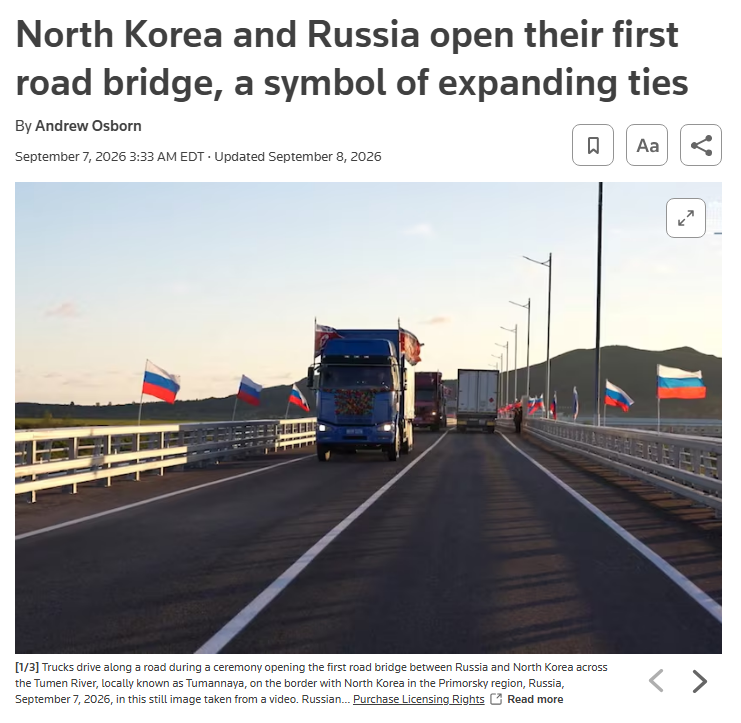
1 of 3 Trucks drive along a road during a ceremony opening the first road bridge between Russia and North Korea across the Tumen River, locally known as Tumannaya, on the border with North Korea in the Primorsky region, Russia,
September 7, 2026, in this still image taken from a video. Russian Government/Handout via REUTERS [1/3]
Summary
1) Bridge can handle up to 300 vehicles a day,
2) Mishustin says Construction began in April last year after Putin agreed project during 2024 North Korea visit
3) Moscow and Pyongyang previously had air and rail links but no proper road link MOSCOW,
Sept 7 (Reuters) - North Korea and Russia opened their first road bridge on Monday in a carefully choreographed display of friendship, a structure which spans the Tumen river and which both sides cast as an important milestone in their deepening strategic partnership.
The first flag-adorned trucks trundled across the 1 km (0.6 mile) long two-lane bridge as Russian Prime Minister Mikhail Mishustin and North Korea's Premier Pak Thae Song tuned in by video link to address workers and government officials from both countries. Make sense of global markets with the Trading Day newsletter.
Construction of the new bridge, which had been under discussion for years, began in April last year after the project was agreed during a visit by President Vladimir Putin to North Korea in 2024.
There are already direct air and rail links between Moscow and Pyongyang, but until Monday there had not been a proper road link. Instead, since 1959 and by special arrangement, planks had been placed on the nearby rail bridge - for decades the sole border crossing point - in order to move vehicles across the border between the two countries.
"I am convinced that the expansion of cross-border transport infrastructure will provide a powerful impetus for the further development of trade, economic, scientific, technological and cultural cooperation," said Mishustin, who said ties between Moscow and Pyongyang were "at an unprecedented high level" and called the opening of the bridge "a genuinely historic event.
The construction of the bridge was not merely an engineering project, he said, but "a new symbol of friendship". Mishustin said up to 300 vehicles would be able to cross every day and that the bridge would be linked to Russia's federal road network and have easy access to the transport corridor which runs from the far eastern city of Vladivostok to St Petersburg.
Trucks would begin to use the bridge immediately to transport cargo, the Russian government said. At the end of this year, the bridge would be fully operational and could be used for passenger traffic too.
The bridge was built near an existing "Friendship Bridge", a rail bridge which was commissioned in 1959 after the Korean war. Symbolically, the new bridge is named after Yakov Novichenko, a Red Army soldier who Pyongyang credits with protecting the life of North Korea's first leader Kim Il Sung in 1946 by intercepting a grenade thrown at him and others.
The bridge showed the allies had established key infrastructure to expand economic cooperation, including people-to-people exchanges, tourism and trade in goods, North Korea's state media KCNA reported on Tuesday. Ties between the two countries have grown stronger since the start of the war in Ukraine in 2022, with Pyongyang sending thousands of troops to Russia's Kursk region to help repel a 2024 Ukrainian incursion there.
Mishustin made a reference to that in his speech on Monday, referring to "the Korean heroes who, only recently, fought shoulder to shoulder with our soldiers and defended Russian soil".
The bridge underscores how economic sanctions against North Korea are becoming meaningless, said Lim Eul-chul, a professor at South Korea-based Kyungnam University's Institute for Far Eastern Studies.
"While North Korea is trying to maximise its own interests, Russia has secured a direct road route for the transport of military supplies, ammunition and manpower, including troops, for its prolonged war in Ukraine." Reporting by Reuters with additional reporting by Kyu-seok Shim and Heejin Kim in Seoul Writing by Andrew Osborn Editing by Ros Russell and Ed Davies Our Standards: The Thomson Reuters Trust Principles.
North Korea's Kim vows to expand ties with Russia, backs victory in 'sacred war'
By Reuters
September 14, 20266:39 PM EDTUpdated 6 hours ago
1948년 9월 9일, DPRK 북조선인민공화국 (북한) 탄생 78주년 기념일에, 북한과 러시아, 중국 사이의 축하 메시지.
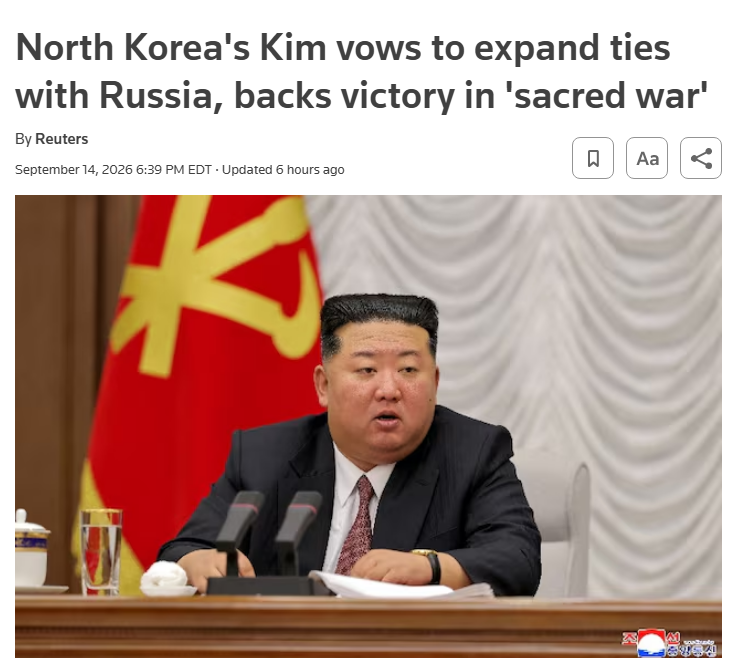
North Korean leader Kim Jong Un speaks during an enlarged meeting of the ruling Workers' Party's Central Military Commission
SEOUL, Sept 15 (Reuters) - North Korean leader Kim Jong Un said he would "expand and deepen" joint work with Russia in a message to Russian President Vladimir Putin, state media KCNA reported on Tuesday.
In a reply sent on Monday to Putin's congratulations for North Korea's 78th founding anniversary, Kim said Pyongyang's government had a firm will to broaden cooperation with Russia "in a comprehensive way" based on friendship, mutual assistance, and what he described as the countries' alliance relations.
Kim also said he was convinced of Russia's victory in the current "sacred war for defending the security interests of the country and international justice", language that appeared to refer to Russia's war in Ukraine.
He pledged his "invariable support" for Putin and the Russian people.
The remarks come as Moscow and Pyongyang have drawn markedly closer, with North Korea sending troops to fight alongside Russian forces in Ukraine in 2024 and deepening military cooperation under a mutual defence pact.
Kim delivered a similar message to Chinese President Xi Jinping in a reply published by KCNA on Sunday, saying North Korea would work with China to further develop their traditional friendship and advance their shared socialist cause.
Both messages were responses to congratulatory letters sent by Putin and Xi on September 9, when North Korea marked the 78th anniversary of its founding.
Reporting by Kyu-seok Shim; Editing by Stephen Coates
Our Standards: The Thomson Reuters Trust Principles.
2026년 7월 28일. 가디언 지 보도.
우크라이나 인권 단체 "진실 사냥개 Truth Hounds" 주장. 러시아와 북한을 연결하는 육로 다리는 경제와 관강 보다는, 군사 물자를 실어나르는 역할을 한다. 철도보다 도로를 이용하는 트럭 안에 물자를 확인하기 더 어렵다.
2024년 우크라이나가 러시아 쿠르스크를 공격하자, 러시아는 북한군 1만 4천명을 그 지역에 투입했고, 3천명을 더 확보하려고 하고 있다. 북한군 2천명이 러-우 전쟁에서 사망한 것으로 추정, 2명은 포로 수용소에 있음.
Russia and North Korea finalising first road crossing amid concerns it serves as Ukraine war supply route
This article is more than 1 month old
New bridge makes it easier to dodge satellite surveillance, investigation argues, as Ukrainian president warns Russia is to receive 30,000 more North Korean soldiers
Raphael Rashid and Luke Harding
Tue 28 Jul 2026 00.56 BST
Share
Prefer the Guardian on Google
Russia and North Korea are close to completing a bridge that will form the first road link ever built between them, amid concerns the two increasingly close allies are creating infrastructure to boost military cooperation in the Ukraine war.
The bridge spans the Tumen River, between Khasan in Russia’s far east and Tumangang in North Korea, a remote, thinly populated stretch of borderland where the river marks the final few miles of the frontier before it reaches the coast.
The crossing is now largely complete. North Korea finished its side of the project, including customs and quarantine facilities, ahead of a planned opening on 19 June, but Russia has fallen behind on its own side of the border, and no new opening date has been confirmed.
Russian and North Korean authorities have made no secret of the bridge project, saying it is intended to expand trade and tourism.
However, a new investigation by Ukrainian human rights group Truth Hounds and shared with the Guardian suggests it is intended more to provide a discreet military logistics corridor than to boost trade.
The bridge over the river
View image in fullscreen
A newly built bridge that spans the Tumen River, forming the first ever road crossing between North Korea and Russia. Photograph: Ministry of Transport of the Russian Federation
Nazar Myhun, who led the open-source research at Truth Hounds, said a key reason behind its conclusion was the fact that it is much easier to evade satellite monitoring – a surveillance method used by the west to understand Russian and North Korean activities – by using roads compared with a rail network.
The new crossing over the Tumen River runs alongside the Friendship Bridge, which is the only rail link between the two countries.
Russia and North Korea’s road network is far bigger than their rail network, he said, making it harder to watch in its entirety. Loading and unloading of trucks can also take place much more quickly than for railcars, which are exposed to satellite passes for a longer period of time.
“The type of railcar visible in an image reveals a great deal about the cargo, and certain categories of goods are transported in open railcars, which allows them to be identified,” Myhun told the Guardian.
“Trucks, by contrast, almost always look the same in satellite imagery.”
Road cargo can also be loaded anywhere, as opposed to trains, which rely on a handful of fixed rail hubs, Myhun said.
Russian officials have presented the project as a way to expand trade and tourism. Andrey Nikitin, Russia’s transport minister, said: “The opening of the new road bridge will increase mutual trade, optimise logistics, strengthen cultural ties, and transform border areas into dynamically developing economic hubs.”
North Korea’s state media news agency, KCNA, has similarly cast the bridge as a way to boost “travel of persons, tourism and circulation of commodities” between the two countries.
However, Truth Hounds argues that the bridge’s economic rationale is weak. The crossing is estimated to have cost more than $100m, versus bilateral trade that was reportedly worth just $34m in 2024. Tourism from Russia into North Korea remains tightly controlled and largely limited to escorted tours, with around 10,000 Russian visitors in 2025. Pyongyang, where most foreign tourists visit, lies over 500km from the crossing.
Instead, the investigation concludes that the crossing is better understood as strategic infrastructure: a corridor for moving North Korean troops, construction brigades and military officials into Russia, and for Russian technology and resources to move in the opposite direction.
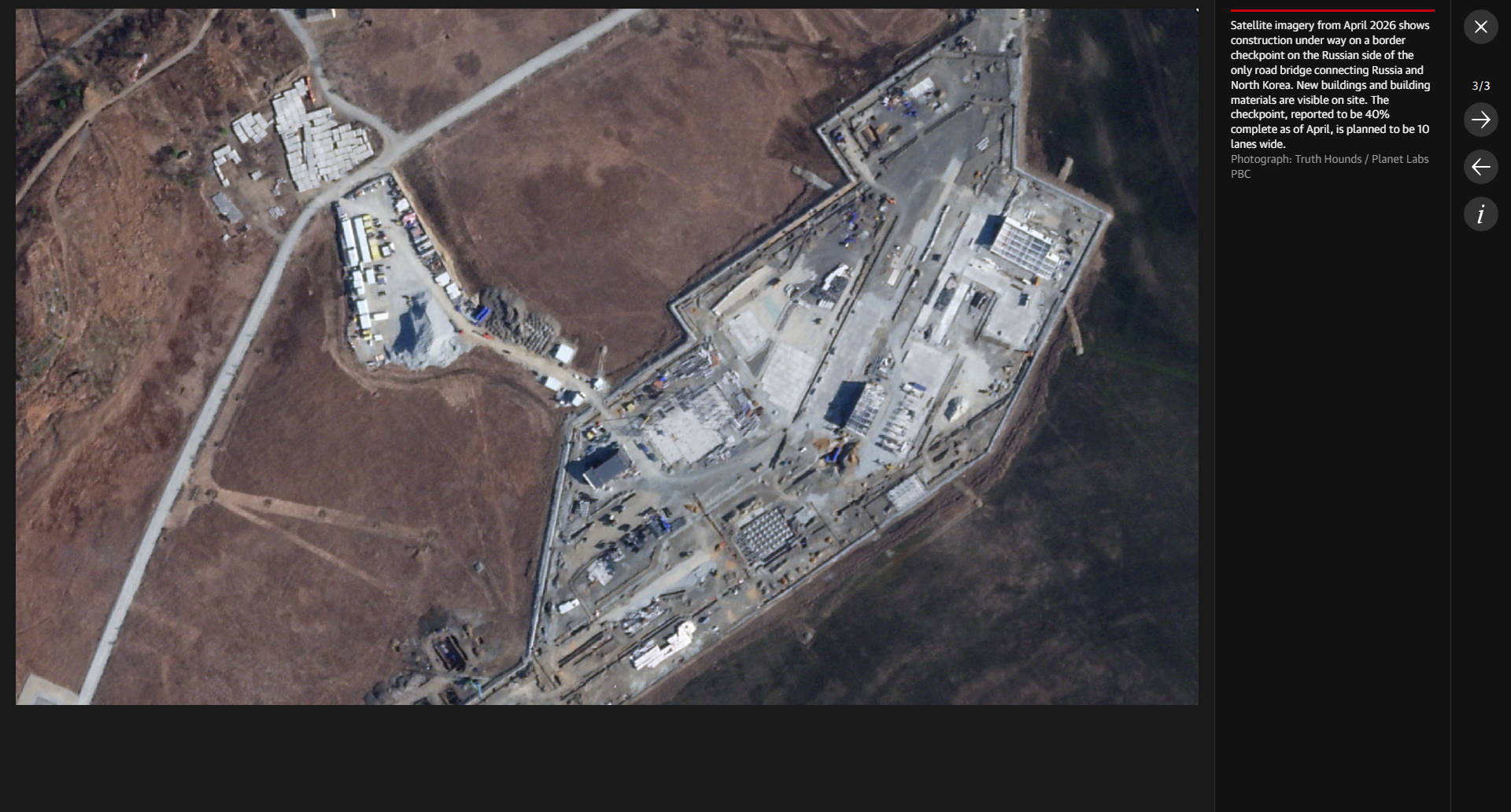
Satellite imagery from April 2026 shows construction under way on a border checkpoint on the Russian side of the only road bridge connecting Russia and North Korea. New buildings and building materials are visible on site. The checkpoint, reported to be 40% complete as of April, is planned to be 10 lanes wide.
View image in fullscreen
Satellite imagery from April 2026 shows construction under way on a border checkpoint on the Russian side of the only road bridge connecting Russia and North Korea. New buildings and building materials are visible on site. The checkpoint, reported to be 40% complete as of April, is planned to be 10 lanes wide. Photograph: Truth Hounds / Planet Labs PBC
Myhun said Truth Hounds monitors Russia-North Korea cooperation closely because it considers it “one of the key factors affecting Russia’s strength in this war” on Ukraine.
The deepening relationship has also made the two-way exchange of weapons and technology between the two countries “easier and less transparent”, he said, which also poses a threat to North Korea’s neighbours.
The Kremlin has been contacted about the claims made in the investigation but has yet to respond.
A growing military alliance
The bridge over the Tumen River is about 1km long and seven metres wide, with two lanes, part of a wider 4.7km crossing that includes approach roads. Satellite imagery also shows supporting infrastructure being built on the Russian side, including a helicopter landing pad.
However, the rail line is hobbled by a mismatch in rail gauge between Russia and North Korea, meaning wheelsets must be changed to allow trains to travel further into either country’s network, a limitation the new road bridge does not share.
Open-source researchers have previously relied on satellite imagery of the rail crossing to monitor suspected weapons transfers between the two countries.
Construction of the bridge began after Vladimir Putin and Kim Jong-un signed a comprehensive strategic partnership pact in June 2024, cementing military ties that have since seen North Korea provide troops, artillery ammunition and ballistic missiles to support Russia’s war in Ukraine.
It forms a small part of a much broader military relationship. More than 14,000 North Korean troops have fought alongside Russian forces in the Kursk region, after Ukraine staged a surprise counter-invasion in August 2024. Ukrainian president Volodymyr Zelenskyy has now warned that Russia is preparing to receive a further 30,000 soldiers. Moscow and Pyongyang have expanded cooperation on weapons, military technology and reconstruction.
In 2023, Reuters reported that satellite images showed an estimated 2,000 containers exported from the North Korean port of Rason to Russia, believed to have contained artillery shells and possibly short-range missiles.
Kim has praised North Korean soldiers who fought and died for Russia and unveiled housing for the families of those killed. At least 2,000 North Korean servicemen are believed to have died fighting in Russia’s war, with two badly wounded soldiers taken prisoner.
https://www.theguardian.com/world/2026/jul/28/russia-north-korea-road-bridge
Russia and North Korea finalising first road crossing amid concerns it serves as Ukraine war supply route
New bridge makes it easier to dodge satellite surveillance, investigation argues, as Ukrainian president warns Russia is to receive 30,000 more North Korean soldiers
www.theguardian.com

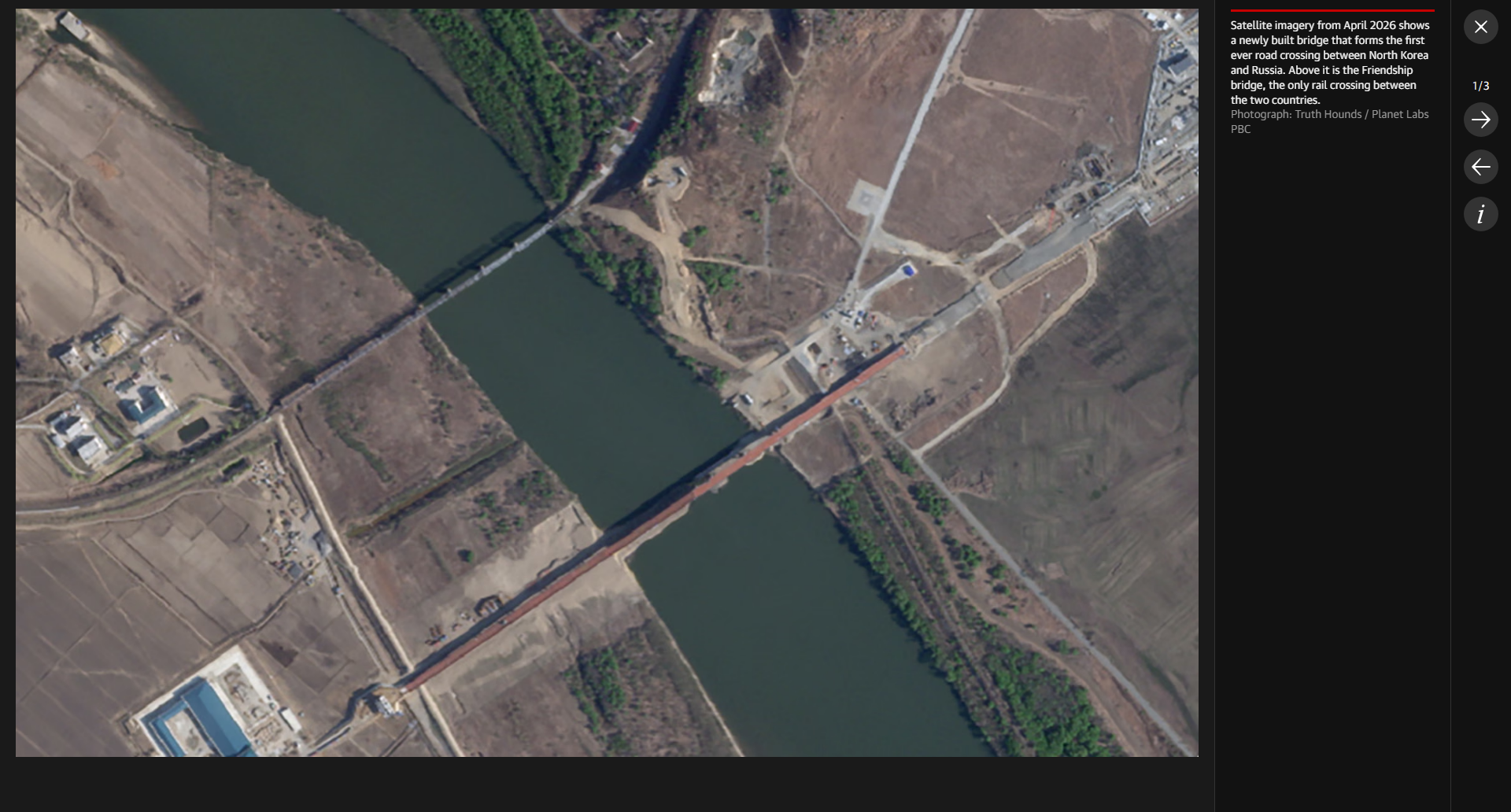
아래 사진. 인공위성 사진 2026년 4월. 신축 다리. 북한과 러시아 도로를 연결하는 최초의 다리.
위 사진은 , 러시아와 북한을 연결하는 유일한 철도 "우정의 다리"
Satellite imagery from April 2026 shows a newly built bridge that forms the first ever road crossing between North Korea and Russia.
Above it is the Friendship bridge, the only rail crossing between the two countries.
Photograph: Truth Hounds / Planet Labs PBC
2026년 9월 7일. 러시아와 북한을 연결하는 육로 다리의 위치.