북한이 러시아에 제공하는 것. 무기와 군대
러시아가 북한에게 제공하는 것. 1) 가스, 석유,
2) 군인 1인당 월급 2천 달러
3) 군사 기술 전수. 인공위성, 대륙간 탄도 미사일 기술 제공
추정치.
1. 러시아가 북한에 100만 배럴 원유 공급 (UN이 정한 연간 수입 한도 2배 초과)
2. 북한 유조선이 러시아 항구 왕복 횟수 43회.
3. 2017년 UN제재 이후,북한이 수입할 수 있는 연간 최대치 '정제유' 50만 배럴
4. 북한의 연간 실제 유류 소비량은, UN 한도보다 18배 많은, 900만 배럴
UN 제재를 받더라도, 다른 방법으로 석유를 수입.
Russia-Ukraine war
South Korea says Russia sent North Korea missiles in exchange for troops
South Korea’s national security adviser says North plans to use the weapons to defend its airspace over the capital.
02:39
North Korean troops enter battlefield against Ukraine
Published On 22 Nov 2024
Russia has provided North Korea with anti-air missiles and air defence equipment in return for sending soldiers to support its war against Ukraine, according to a top South Korean official.
Asked what the North stood to gain from dispatching an estimated 10,000 troops to Russia, South Korea’s national security adviser Shin Won-sik said Moscow had given Pyongyang economic and military technology support.
“It is understood that North Korea has been provided with related equipment and anti-aircraft missiles to strengthen Pyongyang’s weak air defence system,” Shin told South Korean broadcaster SBS in an interview aired on Friday.
At a military exhibition in the capital, Pyongyang, North Korean leader Kim Jong Un on Friday called for developing and upgrading “ultra-modern” versions of weaponry, and pledged to keep advancing defence capabilities, state media reported.
Russia this month ratified a landmark mutual defence pact with North Korea as Ukrainian officials reported clashes with Pyongyang’s soldiers on the front lines.
The treaty was signed in Pyongyang in June during a state visit by Russian President Vladimir Putin. It obligates both states to provide military assistance “without delay” in the case of an attack on the other and to cooperate internationally to oppose Western sanctions.
Asia's stocks surge after Trump says Iran war ‘over soon’
South Korea’s National Intelligence Service told lawmakers this week that the troops deployed to Russia are believed to have been assigned to an airborne brigade and marine corps on the ground, with some of the soldiers having already entered combat, the Yonhap news agency reported.
The intelligence agency also said recently that North Korea had sent more than 13,000 containers of artillery, missiles and other conventional arms to Russia since August 2023 to replenish its dwindling weapons stockpiles.
Experts say Pyongyang could be using Ukraine as a means of realigning foreign policy.
By sending soldiers, North Korea is positioning itself within the Russian war economy as a supplier of weapons, military support and labour – potentially bypassing its traditional ally, neighbour and main trading partner, China, according to analysts.
Russia can also provide North Korea access to its vast natural resources, such as oil and gas, they say.
North Korean Foreign Minister Choe Son Hui recently visited Moscow and said her country would “stand firmly by our Russian comrades until victory day“.
North Korea said last month that any troop deployment to Russia would be “an act conforming with the regulations of international law”, but stopped short of confirming that it had sent soldiers.
The deployment has led to a shift in tone from Seoul, which had so far resisted calls to send weapons to Kyiv. However, President Yoon Suk-yeol indicated South Korea might change its longstanding policy of not providing arms to countries in conflict.
South Korea says Russia sent North Korea missiles in exchange for troops
South Korea's national security adviser says North plans to use the weapons to defend its airspace over the capital.
www.aljazeera.com
2.

Satellite images show Russia giving N Korea oil, breaking sanctions
22 November 2024
Share
Save
Jean Mackenzie
Seoul correspondent, BBC News
BBC A satellite image shows a North Korean oil tanker docked at a Russian port. BBC
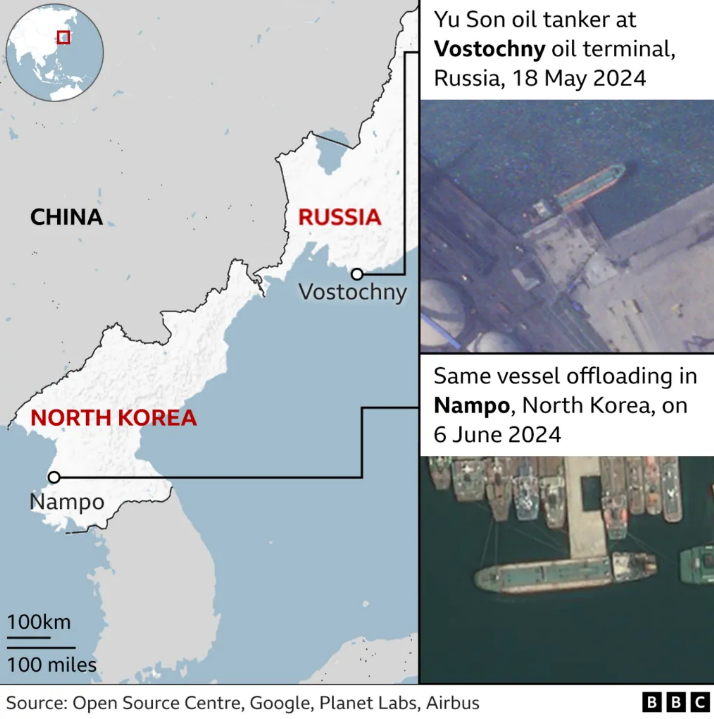
The latest of 43 journeys made by North Korean oil tankers to Russia since March 2024, documented by the Open Source Centre
Russia is estimated to have supplied North Korea with more than a million barrels of oil since March this year, according to satellite imagery analysis from the Open Source Centre, a non-profit research group based in the UK.
The oil is payment for the weapons and troops Pyongyang has sent Moscow to fuel its war in Ukraine, leading experts and UK Foreign Secretary, David Lammy, have told the BBC.
These transfers violate UN sanctions, which ban countries from selling oil to North Korea, except in small quantities, in an attempt to stifle its economy to prevent it from further developing nuclear weapons.
The satellite images, shared exclusively with the BBC, show more than a dozen different North Korean oil tankers arriving at an oil terminal in Russia’s Far East a total of 43 times over the past eight months.
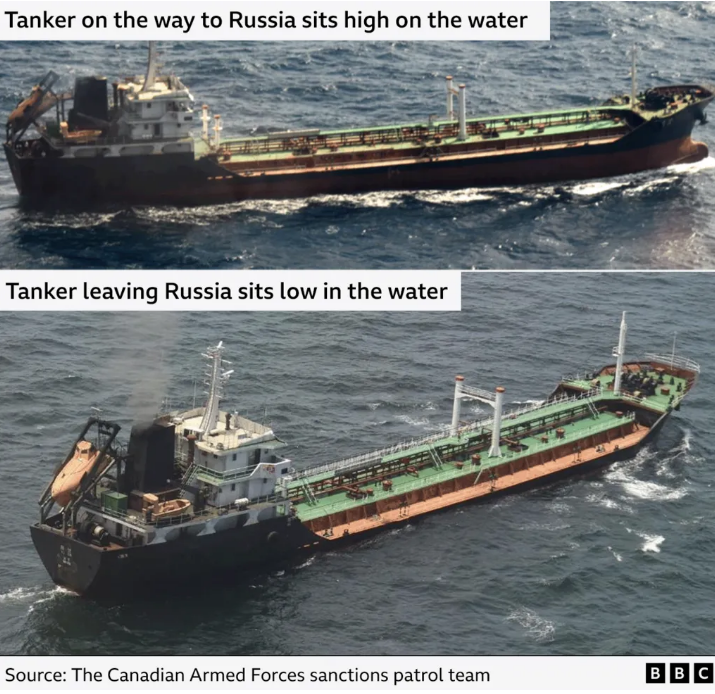
Further pictures, taken of the ships at sea, appear to show the tankers arriving empty, and leaving almost full.
North Korea is the only country in the world not allowed to buy oil on the open market. The number of barrels of refined petroleum it can receive is capped by the United Nations at 500,000 annually, well below the amount it needs.
Russia’s foreign ministry did not respond to our request for comment.
LIVE: Zelensky says world must respond to Russia's use of new type of missile in Ukraine
North Korean weapons are killing Ukrainians. The implications are far bigger
What we know about North Korean troops in Ukraine
The first oil transfer documented by the Open Source Centre in a new report, was on 7 March 2024, seven months after it first emerged Pyongyang was sending Moscow weapons.
The shipments have continued as thousands of North Korean troops are reported to have been sent to Russia to fight, with the last one recorded on 5 November.
“While Kim Jong Un is providing Vladimir Putin with a lifeline to continue his war, Russia is quietly providing North Korea with a lifeline of its own,” says Joe Byrne from the Open Source Centre.
“This steady flow of oil gives North Korea a level of stability it hasn’t had since these sanctions were introduced.”
Four former members of a UN panel responsible for tracking the sanctions on North Korea have told the BBC the transfers are a consequence of increasing ties between Moscow and Pyongyang.
“These transfers are fuelling Putin’s war machine – this is oil for missiles, oil for artillery and now oil for soldiers,” says Hugh Griffiths, who led the panel from 2014 to 2019.
UK Foreign Secretary David Lammy has told the BBC in a statement: “To keep fighting in Ukraine, Russia has become increasingly reliant on North Korea for troops and weapons in exchange for oil."
He added that this was “having a direct impact on security in the Korean peninsula, Europe and Indo-Pacific".
Graphic showing on a map the ports from where a North Korean tanker departed and where it docked
Easy and cheap oil supply
While most people in North Korea rely on coal for their daily lives, oil is essential for running the country’s military. Diesel and petrol are used to transport missile launchers and troops around the country, run munitions factories and fuel the cars of Pyongyang’s elite.
The 500,000 barrels North Korea is allowed to receive fall far short of the nine million it consumes – meaning that since the cap was introduced in 2017, the country has been forced to buy oil illicitly from criminal networks to make up this deficit.
This involves transferring the oil between ships out at sea – a risky, expensive and time-consuming business, according to Dr Go Myong-hyun, a senior research fellow at South Korea’s Institute for National Security Strategy, which is linked to the country’s spy agency.
“Now Kim Jong Un is getting oil directly, it’s likely better quality, and chances are he’s getting it for free, as quid pro quo for supplying munitions. What could be better than that?"
“A million barrels is nothing for a large oil producer like Russia to release, but it is a substantial amount for North Korea to receive,” Dr Go adds.
Tracking the ‘silent’ transfers
In all 43 of the journeys tracked by the Open Source Centre using satellite images, the North Korean-flagged tankers arrived at Russia’s Vostochny Port with their trackers switched off, concealing their movements.
The images show they then made their way back to one of four ports on North Korea’s east and west coast.
“The vessels appear silently, almost every week,” says Joe Byrne, the researcher from the Open Source Centre. “Since March there’s been a fairly constant flow.”
The team, which has been tracking these tankers since the oil sanctions were first introduced, used their knowledge of each ship’s capacity to calculate how many oil barrels they could carry.
Then they studied images of the ships entering and leaving Vostochny and, in most instances, could see how low they sat in the water and, therefore, how full they were.
The tankers, they assess, were loaded to 90% of their capacity.
“We can see from some of the images that if the ships were any fuller they would sink,” Mr Byrne says.
A comparison image showing a tanker sitting high in the water and then anothe rimage showing a tanker sitting low in the water.
Based on this, they calculate that, since March, Russia has given North Korea more than a million barrels of oil - more than double the annual cap, and around ten times the amount Moscow officially gave Pyongyang in 2023.
This follows an assessment by the US government in May that Moscow had already supplied more than 500,000 barrels’ worth of oil.
Cloud cover means the researchers cannot get a clear image of the port every day.
“The whole of August was cloudy, so we weren’t able to document a single trip,” Mr Byrne says, leading his team to believe that one million barrels is a “baseline” figure.
A chart showing the estimated amount of refined oil Russia gave North Korea each month, based on the tankers being 90% full
A ‘new level of contempt’ for sanctions
Not only do these oil deliveries breach UN sanctions on North Korea, that Russia, as a permanent member of the UN Security Council, signed off on – but also, more than half of the journeys tracked by the Open Source Centre were made by vessels that have been individually sanctioned by the UN.
This means they should have been impounded upon entering Russian waters.
But in March 2024, three weeks after the first oil transfer was documented, Russia disbanded the UN panel responsible for monitoring sanctions violations, by using its veto at the UN Security Council.
Ashley Hess, who was working on the panel up until its collapse, says they saw evidence the transfers had started.
“We were tracking some of the ships and companies involved, but our work was stopped, possibly after they had already breached the 500,000-barrel cap”.
Eric Penton-Voak, who led the group from 2021-2023, says the Russian members on the panel tried to censor its work.
“Now the panel is gone, they can simply ignore the rules,” he adds. “The fact that Russia is now encouraging these ships to visit its ports and load up with oil shows a new level of contempt for these sanctions.”
But Mr Penton-Voak, who is on the board of the Open Source Centre, thinks the problem runs much deeper.
“You now have these autocratic regimes increasingly working together to help one another achieve whatever it is they want, and ignoring the wishes of the international community.”
This is an “increasingly dangerous” playbook, he argues.
“The last thing you want is a North Korean tactical nuclear weapon turning up in Iran, for instance.”
Oil the tip of the iceberg?
As Kim Jong Un steps up his support for Vladimir Putin’s war, concern is growing over what else he will receive in return.
The US and South Korea estimate Pyongyang has now sent Moscow 16,000 shipping containers filled with artillery shells and rockets, while remnants of exploded North Korean ballistic missiles have been recovered on the battlefield in Ukraine.
Since the start of the invasion of Ukraine, Russia's President Vladimir Putin has strengthened ties with North Korea's Kim Jong Un
More recently, Putin and Kim signed a defence pact, leading to thousands of North Korean troops being sent to Russia’s Kursk region, where intelligence reports indicate they are now engaged in battle.
The South Korean government has told the BBC it would “sternly respond to the violation of the UN Security Council resolutions by Russia and North Korea”.
Its biggest worry is that Moscow will provide Pyongyang with technology to improve its spy satellites and ballistic missiles.
Last month, Seoul’s defence minister, Kim Yong-hyun, stated there was a “high chance” North Korea was asking for such help.
“If you’re sending your people to die in a foreign war, a million barrels of oil is just not sufficient reward,” Dr Go says.
Andrei Lankov, an expert in North Korea-Russia relations at Seoul’s Kookmin University, agrees.
“I used to think it was not in Russia’s interest to share military technology, but perhaps its calculus has changed. The Russians need these troops, and this gives the North Koreans more leverage.”
Additional reporting by Josh Cheetham in London and Jake Kwon in Seoul
https://www.bbc.com/news/articles/cjr4pr0gyyzo
Russia gives North Korea a million barrels of oil, report finds
Satellite image analysis shows several North Korean tankers visiting Russia dozens of times since March.
www.bbc.com


