사이먼 티스덜, 컬럼 내용 요지.
1. '복음주의 기독교 민족주의자들'이 도덕적인 세계질서를 파괴하고 있다.
트럼프와 신성모독적인 그의 부하들이 부활절에 전쟁을 멈추고 반성하기 바란다
2. 기독교를 정치와 군사에 이용하는 것은 '비열하고 불공정한' 미국의 관행이었다.
교황 '레오'의 메시지는, '기독교의 이름으로 전쟁을 정당화하지 말라'
헥세스는 이란인들을 '광신도'라고 욕하며, 자신의 '복음주의 기독교 민족주의 이름으로 이란과의 전쟁을 정당화하고 있다.
(트럼프는 2020년까지는 장로교 교회를 다녔다가, 그 이후, 비교파적 기독교인으로 바꾸는 전략적 노선을 취함. 그래서 복음주의 교파의 정치적 주장들, 이스라엘 지지, 낙태반대, 동성애 반대 등 노선에 적극 찬성함)
3. 2차 세계대전 이후, 국제 정치 질서의 파괴와 이에 대한 저항이 필요하다.
최근 독재자들은 2차 세계대전 이후 만들어진 '규칙-기반 세계 질서'를 깨부수려고 한다.
이러한 사례들은 다음과 같다. 지정학적, 경제적 질서의 파괴, 동맹의 균열, 우크라이나에 대한 침략, 가자지구에서 이스라엘의 집단학살 등과 같은 아무런 국제적인 처벌을 받지 않는 일방적 국제법 위반들이다.
국제 질서에서 도덕의 파괴와 잔혹함의 강화는 윤리의 문제로 심각하게 다뤄져야 한다.
행동 촉구. 불의와 국가의 무법성을 비판하고 최약자를 보호해야 한다.
4. 종교 지도자들의 반전 운동 촉구.
세속적인 민주정부와 민주주의가 작동하지 않고, 정치인들이 신뢰를 잃어버렸을 때, '상처받은 사회'는 '정신적 구원'을 간절히 갈망한다.
전쟁을 반대하는 '기독교 교파 통합운동 (에큐메니알리즘 Ecumenialism)'이 필요하다.
모든 종교 지도자들이 반전운동을 해야 하고 할 수 있다.
광신도 -religious fanatics
복음주의 기독교 민족주의 evangelical Christian nationalism'
트럼프의 기독교 교파는 '장로교' Presbyterian (2020년까지)
비교파 기독교인(Non-denominational Christian) 넌-디노미네이셔날 크리스천
As Team Trump wage unceasing war on Iran, evangelical nationalists are destroying any moral world order we once had
Simon Tisdall
The brutalisation of global norms by figures like Pete Hegseth must be seen as an ethical issue. It’s a fight against chaos, and all major religions must play a role
Sat 4 Apr 2026 06.00 BST
That combative old hymn, Onward Christian Soldiers, is not much heard these days, though it was once a favourite with church congregations and school assemblies. Written in 1865 by Sabine Baring-Gould, an English clergyman and religious scholar, its belligerent refrain urges the faithful on to battle, victory and conquest: “Onward, Christian soldiers / Marching as to war / With the cross of Jesus / Going on before!” Its martial tone suited the Victorian zeitgeist but it made succeeding generations uneasy (though it was still sung in my primary school in the early 1960s). Nowadays, this sort of triumphalism gives religion a bad name.
Pete Hegseth, US defence secretary, and a leading Christian soldier, would certainly disagree. He probably hums it on his way to work. At a recent Christian worship service in the Pentagon – an irregular event, given the constitution’s dislike of anything smacking of state religion – Hegseth, referencing Iran, prayed for “overwhelming violence of action against those who deserve no mercy”. Hegseth’s creed is killing. He describes Iranians as “religious fanatics”. And he should know. His intolerant brand of evangelical Christian nationalism is extreme even by US standards – yet has Donald Trump’s backing. Trump was a Presbyterian until 2020, when he abruptly declared he wasn’t. God knows what he is now.
Exploitation of Christian belief for political and military ends is a long-established, shabby US practice. Yet there’s a darkly obnoxious underside. Implicit in the official demonisation and dehumanisation of the Iranian nation is fear and loathing of otherness, in this case Shia Muslims. In one of his first acts as president in 2017, Trump banned immigrants from several Muslim-majority countries, and has continued in that hateful vein.
For most practising Christians, the misappropriation, distortion and weaponisation of faith to justify death and destruction, sow divisions, excuse war crimes and bomb Iran “back to the stone ages” is deeply saddening. Christians – who celebrate Easter on Sunday – believe Jesus was crucified for the sake of all mankind, for the forgiveness of sins, not for vindictive vengeance, pride and domination.
Pope Leo spoke for many beyond the Catholic church at a Palm Sunday mass in Rome in forcefully rejecting attempts by zealots such as Hegseth to conscript Christianity. “No one can use [Jesus] to justify war,” he said, quoting Isaiah. War-makers’ prayers would go unanswered. “Your hands are full of blood.”
Not all Christians oppose Trump’s and Benjamin Netanyahu’s war of choice in Iran. Yet Leo’s outrage is shared in Britain by, among others, Rowan Williams, a former archbishop of Canterbury, and is echoed across the Islamic world and by Jews around the world. It reflects a much bigger battle – over the way today’s authoritarian leaders ignore international law and encourage and exploit the disintegration of the post-1945 “global rules-based order”. The cost of this breakdown is usually counted in terms of geopolitical and economic disruption, fractured alliances and unilateral acts of impunity, such as the invasion of Ukraine and genocide in Gaza. But the brutalisation and demoralisation of the global order must be counted an ethical issue, too. Its collapse constitutes a fundamental, universal crisis of morality.
More than ever, perhaps, a conflicted world needs independent, apolitical voices willing, and sufficiently courageous, to speak truth to power, stand up to autocratic bullies, defend the weakest and most vulnerable, and call out injustice and state lawlessness. When temporal leadership fails, when trust and confidence in secular governments and politicians are lacking, when belief in democracy is fading and when people’s basic security, physical and financial, is threatened by forces beyond their control, who then will challenge tyranny? With growing desperation, nailed to a cross of their own making, broken societies cry out for spiritual rescue.
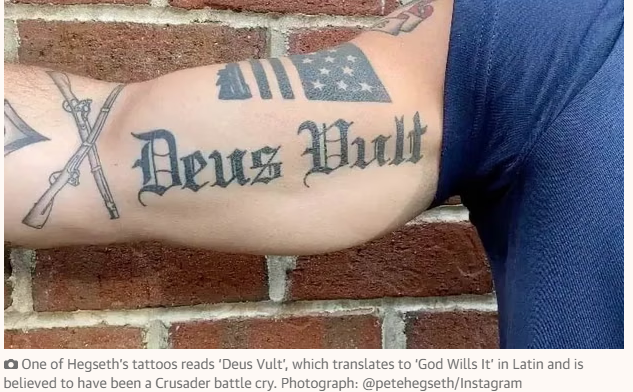
One of Hegseth’s tattoos reads ‘Deus Vult’, which translates to ‘God Wills It’ in Latin and is believed to have been a Crusader battle cry.
One of Hegseth’s tattoos reads ‘Deus Vult’, which translates to ‘God Wills It’ in Latin and is believed to have been a Crusader battle cry. Photograph: @petehegseth/Instagram
In this global struggle against chaos, all religions must play a role. Yet over Iran, its latest manifestation, the response has often seemed cautious and divided. In the UK, Sarah Mullally, installed last month as archbishop of Canterbury and head of the worldwide Anglican communion, sidestepped the war in her first sermon. In contrast, Guli Francis-Dehqani, the Iranian-born bishop of Chelmsford, denounced it as illegal, as neither moral nor just.
The assassination by Israel of Ayatollah Ali Khamenei, Iran’s supreme leader, who was also a senior clerical authority for Shia Muslims everywhere, was exceptionally provocative (and illegal). Yet regional reactions have divided along sectarian lines. In Syria, some Sunni Muslims celebrated his death. The war is popular among Jewish Israelis but a majority of Jewish Americans is opposed, with 77% saying Trump has no plan – according to a J Street poll. Similar divides exist over Ukraine, where religious organisations linked to the slavishly pro-Putin, pro-war Russian Orthodox church are banned by Kyiv.
Such schisms and splits are nothing new. Yet facing global geopolitical meltdown, Christian leaders of every stripe have a clearcut moral responsibility to unite in championing a more militant, voluble, specifically anti-war, pro-justice ecumenicalism. In truth, all faith leaders, not just Christians, could and should act together.
Mosque worshippers in Tehran, Beirut and Gaza, synagogue members in Tel Aviv, Jerusalem and north London, churchgoers from Canterbury to Cincinnati and their children – children like those incinerated by a Tomahawk missile in Minab – all share a common interest in upholding the basic human freedom to live, work and follow the god of their conscience without being blown up, terrorised, persecuted and cynically misled by reckless politicians.
Despite Trump’s apocalyptic rhetoric, and sensational online talk about “end times” and Armageddon, this immensely damaging, unjustified and shaming war may be forcing Americans to reassess their moral relationship with the world.
Is Trump solely to blame?
wondered the US columnist Lydia Polgreen.
Or is he “the fulfilment of what America has always been – a self-satisfied nation, granted license by its myths about providence and exceptionalism to do whatever it wants”.
Trump’s presidency, she argued, “has revealed a much older malady: America’s unshakable faith in its ability to shape the world to its liking, indifferent to what others might want and supremely confident that its plan is the right one. Beyond Trump, it’s this disfiguring mentality we Americans must face.”
Pray that this Easter, Trump and his blasphemous subordinates may join in this welcome introspection – and halt their Iran crusade. And scrub that old Victorian hymn, too. Hardline US evangelical nationalists are the modern equivalent of what a memorable 1964 book by Diana Dewar, an expert on children’s religious education, called “backward Christian soldiers”. As ever, the religious right, like the right in general, is marching furiously in the wrong direction.
Simon Tisdall is a Guardian foreign affairs commentator
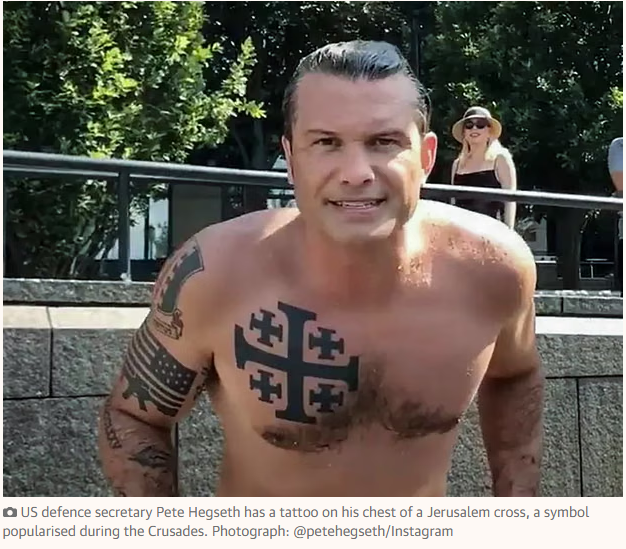
복음주의 Evangelicalism 의 역사.
1. 조지 화이트필드 (George Whitefield) 1714-1770. 칼뱅주의자. 야외 설교자. 순회 설교자 (광장, 시장, 들판). 홍보물 제작.
지적인 기독교 교리 공부보다는, '감성에 호소, 연극적 요소, 웅변, 연기 설교' 방식 채택.
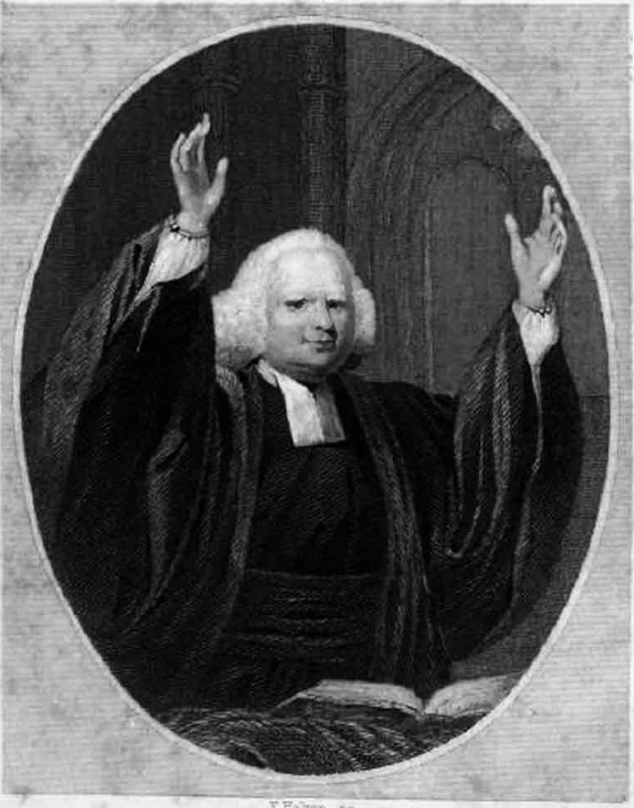
https://en.wikipedia.org/wiki/George_Whitefield
2. 찰스 피니 (1792-1875)
미국 변호사, 오벨린 대학 학장, 최초 (직업적 복음주의자) '전문,직업' 에반젤리스트
출발은 장로파였음.
1) 미국 노예제를 '거대한 국가적 범죄'로 규정, 노예제 폐지 주장함.
오벨린 대학에 흑인과 여성의 입학 허가.
켄터키 주에서 오하이오 강을 건너 오하이오 주로 흑인들을 탈출시키는 운동을 전개했음.
지하철도(Underground Railroad)라는 네트워크를 만들어서, 미국 노예들을 북부나 캐나다로 탈출할 수 있게 했음.
2) 교리를 설명하고 파고드는 하버드식 강단 교회가 아니라, 개인의 '결단'을 중시함.
대규모 부흥집회 방식 선택, 민중 중심 복음주의 형식을 갖춤.
(그러나 이후에 '복음주의' 교회가 과학적 지식을 부정하는 방향으로 퇴락해버림)
Charles Grandison Finney (born Aug. 29, 1792, Warren, Conn., U.S.—died Aug. 16, 1875, Oberlin, Ohio) was an American lawyer, president of Oberlin College, and a central figure in the religious revival movement of the early 19th century; he is sometimes called the first of the professional evangelists.
After teaching school briefly, Finney studied law privately and entered the law office of Benjamin Wright at Adams, N.Y. References in his law studies to Mosaic institutions drew him to Bible study, and in 1821 he underwent a religious conversion.
Finney dropped his law practice to become an evangelist and was licensed by the Presbyterians.
Addressing congregations in the manner he had used earlier in pleading with juries, he fomented spirited revivals in the villages of upstate New York. His methods, carried into the Congregational and Presbyterian churches of larger towns, were soon dubbed “new measures” and aroused intense criticism from men such as Lyman Beecher who had been educated in the sterner traditions of eastern schools. Such opposition lessened as Finney’s methods became more polished.
His revivals achieved spectacular success in large cities, and in 1832 he began an almost continuous revival in New York City as minister of the Second Free Presbyterian Church.
His disaffection with Presbyterian theology and discipline, however, led his supporters to build for him the Broadway Tabernacle in 1834.
The following year he became a professor of theology in a newly formed theological school in Oberlin, Ohio, dividing his time between that post and the tabernacle.
He left New York in 1837 to become minister of Oberlin’s First Congregational Church, closely related to Oberlin College, where he was president from 1851 to 1866.
Finney’s theological views, typically revivalist in their emphasis on common sense and humanity’s innate ability to reform itself, were given expression in his Lectures on Revivals (1835) and Lectures on Systematic Theology (1847).
3. 제임스 보이스 (James Petigru Boyce, 1827–1888)는 미국 남침례교 신학자, 남침례신학교(Southern Baptist Theological Seminary)의 설립자이자 초대 총장
1861-1865년 미국 남북 전쟁 시대.
1859년 남부 침례교 신학교 개교 - 미국에서 가장 오래되고 가장 큰 개신교 교파의 신학대학임.
남부 침례교의 인종주의와 노예제 옹호론과 백인우월주의.
노예제 폐지주장한 아브라함 링컨을 반대.
Southern Baptist Seminary Documents History of Racial Injustice
12.14.18
The Southern Baptist Theological Seminary, the first and oldest institution of the nation’s largest Protestant denomination, released a report this week documenting its history of support for slavery and white supremacy.
The seminary was founded in 1859 by slaveholding members of the Southern Baptist Convention, which broke away from northern Baptists in 1845 over its support for slavery. The denomination has 15 million members in the United States today.
“The founding fathers of this school — all four of them — were deeply involved in slavery and deeply complicit in the defense of slavery,” school President R. Albert Mohler Jr. wrote in a letter accompanying the report. “Many of their successors on this faculty, throughout the period of Reconstruction and well into the 20th century, advocated the inferiority of African-Americans and openly embraced the ideology of the Lost Cause of southern slavery.”
A year ago, President Mohler appointed a committee of six current and former seminary faculty members to research and write the report, which relies heavily on seminary archives, including correspondence among the four founders. He wrote that the “moral burden of history requires a more direct and far more candid acknowledgement of the legacy of this school in the horrifying realities of American slavery, Jim Crow segregation, racism, and even the avowal of white racial supremacy.”
The report acknowledges the leading role that the seminary’s early faculty and trustees played in creating and perpetuating the elaborate mythology of racial difference that was created to sustain slavery in America. “A number of the seminary’s prominent trustees advanced public defenses of slavery,” the report says. Seminary leaders argued that slavery was essential to civil society, “an institution of heaven,” that benefitted enslaved people, whose inferiority “indicated God’s providential will for their enslavement.”
All four of the school’s founders enslaved Black people, and in addition to providing moral and spiritual justifications for slavery, they also defended it in practice, “denying that abuses, violence, assault, and rape were in any way commonplace or systemic.”
Seminary leaders opposed the election of Abraham Lincoln and argued vigorously in favor of secession “as the only hope for preserving slavery.”
After emancipation, the seminary faculty opposed racial equality. They defended white rule and the disfranchisement of Black people based on the doctrine of white supremacy, arguing that white political control was essential to preserve order in the South. While serving in the South Carolina state constitutional convention in 1865, seminary founder James P. Boyce delivered a speech arguing that “this is a white man’s government,” and in an 1868 speech before the northern Baptists’ Home Mission Society, founder Basil Manly Jr. openly conceded, “We at the South do not recognize the social equality of the negro” and expressly condemned the idea of extending suffrage to Black Americans.
The seminary’s most important donor and chairman of its board from 1880 to 1894 earned much of his fortune by exploiting Black workers in his coal mines and iron furnaces through convict leasing. As the report explains, “The legal system entrapped thousands of Black men, often on trumped up charges and without any due process protections, and earned money for sheriffs and state treasuries by selling their labor. It was worse than slavery.” Investigations of Joseph E. Brown’s Dade Coal operation concluded that “if there is a hell on earth, it is the Dade coal mines.” Brown used his profits to save the seminary from financial collapse in 1880.
In the 19th and early 20th centuries, the seminary faculty advanced white supremacy by embracing pseudo-scientific studies that concluded that white people were the products of more advanced evolutionary processes.
In 1882, founder John Broadus wrote that Black moral inferiority was connected to biological inferiority. Seminary President 1899-1928 Edgar Y. Mullins said, “It is immoral and wrong to demand that negro civilization should be placed on par with white.” Professor Charles Gardner concluded that: “The negro should in some way be brought to the frank recognition of his racial inferiority.”
For much of the 20th century, seminary leaders continued to defend racial segregation throughout society and refused to admit Black students. “The seminary still largely insisted on the racial hierarchy of white superiority in broader American culture,” the report says. President Mullins supported Herbert Hoover’s 1928 presidential campaign because he reasoned that Hoover would provide better security for white rule in the South; Professor Gardner argued that Jim Crow laws were necessary given “the absolute demonstration of the political incapacity of the negro race, viewed as a whole.”
The report ends its detailed chronology in 1964. It concludes, without further explanation: “In the decades following the civil rights movement, the seminary continued to struggle with the legacy of slavery and racism.”
Alison Greene, a historian of U.S. religion at Emory University in Atlanta who was raised as a Southern Baptist, expressed disappointment that the report failed to acknowledge the implications of Southern Baptists’ support for conservative politicians and policies in the modern era.
“It papers over a generation of hand-in-glove cooperation with efforts to roll back every single social program that served African-Americans or promised to rectify, even in the smallest ways, the gross economic and social effects of enslavement and segregation and inequality on Black communities,” she told NPR.
The report acknowledges that the “racism that was fundamental to the defense of slavery in America endured long after the end of legal slavery” and that the “belief in white supremacy that undergirded slavery . . . also undergirded new forms of racial oppression.” In other words, because the myth of racial difference was not abolished, slavery did not end in 1865 — it evolved.
While the report is a welcome and necessary atonement for the institution’s “sinful absence of historical curiosity,” as President Mohler put it, it stops short of exploring fully the seminary’s and the denomination’s role in perpetuating the legacy of white supremacy, which can be seen today in the presumption of guilt and dangerousness assigned to African Americans, the racial profiling and mistreatment that presumption creates, and the racial dynamics of criminal justice practices and mass incarceration.
출처.
https://eji.org/news/southern-baptist-seminary-documents-history-of-racial-injustice/
4. 1925년 테네시 주 하원이 존 버틀러 의원 이름을 따서 '버틀러 법'을 제정. 버틀러 법은 '진화론' 교육 금지법이다. 찰스 다윈의 진화론을 학교에서 가르치거나, 성경의 창조론을 부정하면, 벌금 100달러~500달러를 내야 한다. 1967년에 와서야 '버틀러 법'은 폐지되었다.
Christian fundamentalism
Anti-evolution books on sale in Dayton, Tennessee, during the Scopes Trial, 1925.
5. 빌리 그래함 (Billy Graham, 1918-2018) - 노스캐롤라이나 민주당원이었지만 그의 행보는 정당을 초월함.
1950년 32세, 기독교냐 아니면 공산주의냐, 이분법 구도, communism 배격.
1953년 공화당 아이젠하워 대통령 취임식에서 처음으로 기도 도입.
미국은 '신의 아래 하나의 국가 one nation under God' 주창.
1960년대 미국의 베트남 전쟁 옹호.
1970년대 닉슨 옹호했다가, 워터 게이트 사건 이후, 정치로부터 물러나기도 함.
1980년대 레이건은 소련을 '악의 제국 evil Empire'로 불렀는데, 이는 복음주의적 반공주의의 산물이다.
1992년 그래함과 그의 아내, 루스 그램함이 평양 김일성을 방문, 봉수 교회에서 설교함. 당시 미 대통령 조지 부시의 친서를 전달, 핵문제를 해결하고자 함. 1994년 북한 핵문제 발생시, 지미 카터의 방북 주선 및 제네바 합의 (강석주 + 로버트 갈루치)에 기여.
그래함 부부는 북한에 식량과 의료품 지원.


