지진,화산폭발 때나 보던 ‘그을음 연기기둥’을 보면서.
핵발전소나 정유시설과 같은 위험한 시설을 폭격해서는 안된다. 그러나 이스라엘과 미국은 이미 도를 넘었고, 국제법이나 AIEA 제안은 이제 쉽게 무시된다.
테헤란은 1천만 도시이고, 교외 포함하면 1천 600만 대도시이다. 이런 인구밀집 지역에 대규모 정유시설이 있는 것도 보기 힘든 도시계획이고, 정유시설을 폭격하는 이스라엘과 미국의 잔혹함도 보기 드물다. 폭격후 여론이 좋지 않으니까, 미국이 이스라엘의 정유시설 폭격을 야단치듯이 했는데, 이는 대중 속임수이다. 이스라엘 전투기가 1000km 이상 날아오는데 기름주입뿐만 아니라 제공권을 주는 것은 미국측이었기 때문이다.
이번 정유시설 폭격으로 테헤란 정유시설에서 일하는 운전사 등 노동자 4명이 죽고, 20명이 다쳤다 한다.
비인간적이고 엄청난 환경적 재앙이기도 하다. 테헤란에 내린 검은비와 그을음은 폐암,백혀병,방광암,피부암의 원인이 된다. 정유소 폭파 후, 하늘에 솟구치는 강력한 연기기둥을 ‘에너지 플륨’이라고 한다. 시각적으로도 공포감을 준다.
그을음 기둥이 테헤란 북동쪽 110km 떨어진 자동차까지 시커멓게 뒤덮을 정도로 심각한 독성오염원이 되었다.
언론보도를 보기 전에는, ‘재부유 re-suspend’ 단어의 의미를 잘 몰랐다. 레스터 대학 환경 질병역학 교수, 애나 한셀에 따르면, 그을음은 호흡기 체계에 악영향을 주고, 암 발생 원인이 된다.
Bbc 기사에서, 비온 후에 그을음이 땅바닥에 말라붙었다가, 다시 공기 중으로 날아간다는 단어 ‘re-suspend’ 가 나온다. 그을음이 비가 오면, 땅,집,건물,나무,채소 등에 가라앉는다 (침강), 그 다음 건조 과정을 거쳐, 바람이 불면 다시 공기 중으로 날아가는데, 이를 리서스펜드 (재부유-再浮遊)라고 함. 전문가들은 이러한 미세화된 그을음이 수 주 동안 대기 중에 머무르니, 외출시 고성능 마스크를 착용해야 한다고 권고하고 있다.
분쟁과 환경 관측소장, 더그 위어(Doug Weir) 지적. “테헤란과 같은 인구밀도가 높은 곳에 공습 폭격을 하는 것을 관찰하지 못했다. 보통의 경우, 이러한 정유저장고나 정유공장은 시골에 위치해있다. 테헤란 시민들이 검정비의 (독성) 물질에 노출되어 있다.
3월7일 미국과 이스라엘이 테헤란의 정유시설 6군데를 폭격했고, 이란은 보복 조치로 이스라엘 하이파의 정유시설을 폭격했다.
순진한 생각이고 주장이 되어버렸지만, 어느 세력도 핵발전소, 정유시설 등은 폭격해서는 안된다.
참고
1. 이스라엘의 테헤란 정유시설 공습. 3월 7일 밤. 이스라엘의 F-35I(아디르)와 F-15I, F-16I 전투기의 테헤란 폭격
(1) 정유공장. 톤드구얀(Tondgouyan) 정유소 : 테헤란 남부 샤르 레이(Shahr Rey)에 위치한 이란 최대 정유소. 이란 에너지 수요의 15%생산.
(2) 레이(Rey) 테헤란 남쪽 위성 도시, 테헤란 주의 샤르 레이(Shahr-e-Rey)군에 속함. 톤드구얀은 생산 기지, 레이 지역은 송유관의 허브 역할, 배분 기지임.
(3) 정유 저장고. 테헤란 서쪽. 샤란(Shahran) 연료 저장고 - 테헤란 북서부 (제 5구), 폭격 후 정제되지 않은 기름이 거리로 흘러나와 '불의 강'이 됨.
(4) 코학(Kohak/Kuhak) 유류 저장 시설- 테헤란 북서부의 제22구(District 22)에 위치
(5) 악다시에(Aghdasieh) 유류 창고 : 테헤란 북동부 지역의 물류 거점으로, 시설 전체가 화염
테헤란 북동부의 타지리시(Tajrish) 및 소항크(Sohank) 인근에 위치
(6) 카라지(Karaj) 정유저장고: 테헤란 서쪽 인근 도시인 카라지의 시설
(bbc, al jazeera, 이란 석유장관 발언 등 종합)
2. 이스라엘의 230발 발사 무기. 이스라엘의 F-35I(아디르)와 F-15I, F-16I 전투기가 테헤란 정유시설 폭격
SPICE-2000 스파이스 2000. AI 기반 영상 인식 연기 속 정밀 타격, 대형 탱크 파괴
GBU-39 (SDB) : 고정밀 저위력
Rampage 람페이지. 초음속 비행 이란 방공망 회피 및 기습 타격
2-1 이란의 보복 공격. 이스라엘 하이파 정유시설 폭격
3. bbc 보도
검은 비의 원인. 그을음 (soot)과 대기오염원들의 결합.
음식, 물, 공기 오염원이 된다.
어린이, 노인, 환자들에게 치명적이다.
비가 온 후, 강으로 흘러가거나, 땅에서 말라도, 다시 공기 중에 남아있게 된다.
1.레스터 대학 환경 질병역학 교수, 애나 한셀에 따르면,
그을음은 호흡기 체계에 악영향을 주고, 암 발생 원인이 된다.
Bbc 기사에서, 비온 후에 그을음이 땅바닥에 말라붙었다가, 다시 공기 중으로 날아간다는 단어 ‘re-suspend’ 가 나온다.
그을음이 비가 오면, 땅,집,건물,나무,채소 등에 가라앉는다 (침강), 그 다음 건조 과정을 거쳐, 바람이 불면 다시 공기 중으로 날아가는데, 이를 리서스펜드 (재부유再浮遊)라고 함.
전문가들은 이러한 미세화된 그을음이 수 주 동안 대기 중에 머무르니, 외출시 고성능 마스크를 착용해야 한다고 권고함.
2. 분쟁과 환경 관측소장, 더그 위어(Doug Weir) 지적. “테헤란과 같은 인구밀도가 높은 곳에 공습 폭격을 하는 것을 관찰하지 못했다. (참고. 테헤란 도심 인구는 1천만에 가깝고, 교외까지 합치면 1천 600만임) 보통의 경우, 이러한 정유저장고나 정유공장은 시골에 위치해있다. 테헤란 시민들이 검정비의 (독성) 물질에 노출되어 있다. “
Why air strikes on Tehran oil facilities are causing black rain ?
Mark Poynting,Alex Murray,Kayleen DevlinandBarbara Metzler,BBC Verify
BBC An emergency worker in Tehran shields her face as black smoke rises behind her. She is wearing a red and white jacket and a face mask and standing in a sandy location. The image is imposed over the BBC Verify colours and branding. BBC
Smoke plumes caused by oil depot and refinery strikes drifted across Tehran on Monday, satellite images show, as the World Health Organization (WHO) warned that attacks on oil facilities could pose serious health risks to residents.
Since the US-Israeli attacks on Iran began on 28 February, we have confirmed strikes on at least four oil facilities around the capital.
Residents said smog and pollution have blocked out the Sun and left a strong smell of burning in parts of the city, while experts warn the scale of some of the pollutants released could be "unprecedented".
The spike in air pollution appears to focus near the damaged oil sites around the capital - a city with a population of nearly 10 million, with millions more in the surrounding areas.
A graphic showing the locations of the four oil facilities hit by strikes. Fardis oil depot, Shahran oil depot and Aghdasieh in the north and Tehran oil refinery in the south.
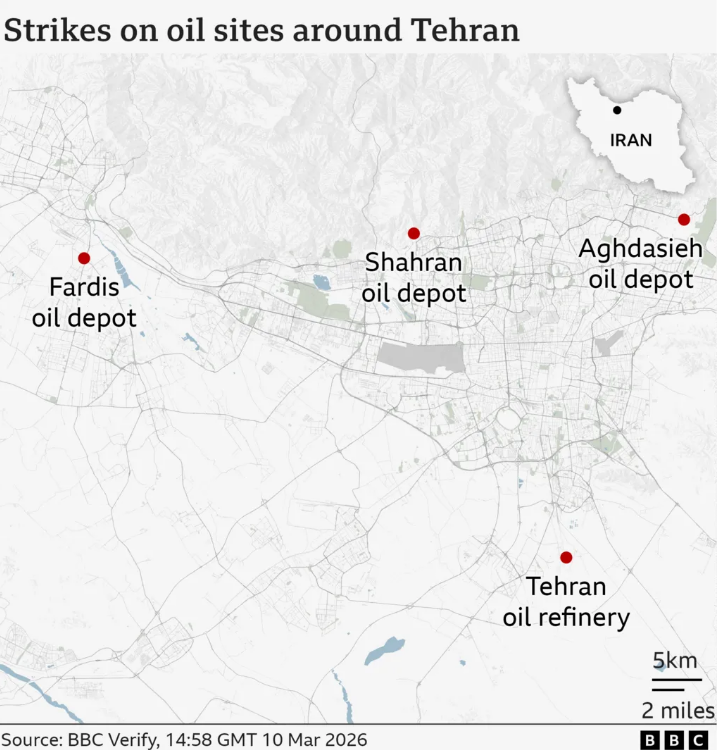

테헤란 북쪽 위치한, 파디스(Fardis), 샤란(Shahran) , 아그다시에(Aghdasieh) 정유저장소
테헤란 남쪽에 위치한 정유공장
검은 비의 원인. 그을음 (soot)과 대기오염원들의 결합.
The latest satellite pictures, captured on 9 March and reviewed by BBC Verify, show two major oil facilities in Tehran still on fire, following reported air strikes overnight on Saturday.
The images also show smoke coming from Shahran depot in the north-west of the Iranian capital and the Tehran oil refinery, in the south-east. Verified video of the moments after Saturday's strike showed huge fireballs illuminating the night sky at the refinery.
EPA Smoke rises from Tehran's oil refinery after airstrikes in Tehran, Iran, 07 March 2026. The skyline is illuminated by flames rising from the refinery. EPA
The combination of cloud and smoke plumes from the ongoing fires mean that we are unable to assess the extent of the damage at either oil facility hit over the weekend yet.
But images taken at Shahran on Sunday morning showed emergency workers inspecting burned out oil tankers, blackened buildings and blazing fires.
The Israel Defense Forces (IDF) said it hit "fuel depots" near Tehran in a post on X on 7 March, which included a photograph showing damage to the Tehran oil refinery. BBC Verify provided the coordinates of this facility, along with three other locations we identified, to the IDF and the Pentagon for comment. The Pentagon did not reply, while the IDF said there were "no IDF strikes at those sites". We have asked for clarification.
A satellite image showing smoke rising at the Shahran oil depot and the Tehran oil refinery.
Strikes at oil refineries have the potential to bring significant air pollution because they contain a huge variety of chemicals.
When there is incomplete burning of oil – when there is not enough oxygen - carbon monoxide and soot particles can be released instead of carbon dioxide and water.
Oil fires can also release sulphur and nitrogen oxides, which can form acids if they dissolve in rainwater, as well as other harmful hydrocarbons, metallic compounds and droplets of oil.
How bad is the air pollution?
A Tehran woman in her 20s said that she could "smell the burning" caused by the attacks on oil facilities.
"I can't see the Sun. There is a horrible smoke. It's still there. I'm very tired," she told BBC Persian on Saturday.
A precise assessment of air pollution is challenging because there are no ground-based measurements available - and satellite data is hard to interpret due to winds, clouds and other factors.
But given the mix of chemicals likely released from the damaged oil sites, scientists have little doubt that the pollution is harmful and extreme - and very different to the smog seen in cities like Beijing or Delhi.
"What has happened [in Iran] is definitely unprecedented because it's all coming in from missiles dropping in and airstrikes on oil refineries," said Dr Akshay Deoras, research scientist at the University of Reading.
Many conflicts cause high levels of dust and particle pollution - but the "basket" of different chemicals in this case is "definitely unusual", he added.
Eloise Marais, professor of atmospheric chemistry and air quality at University College London, agreed.
She said that in most circumstances this kind of pollution would only be seen from "a very, very severe industrial accident where an entire refinery explodes".
What is 'black rain' and what causes it?
On Sunday, Tehran residents reported downpours of "black rain".
Black rain is the informal term for rainfall contaminated with pollutants, turning it dark.
Getty Images Black rainwater flows down a drain in Tehran. Getty Images
It is normal for pollutants to be "washed out" of the air by rainfall, but black rain is rare and typically is the result of high levels of soot and other air pollutants, scientists have told BBC Verify.
"The raindrops acted like little sponges or magnets, collecting whatever was in the air as they fell, which is why residents observed what's being described as 'black rain'," explained Deoras.
It is also possible that some larger particles may have fallen out of the air without rain.
What might the impacts be?
The head of the WHO has already expressed "great concerns" for the impacts of the conflict on people's health.
Damage to oil facilities "risks contaminating food, water and air – hazards that can have severe health impacts especially on children, older people, and people with pre existing medical conditions", said Dr Tedros Adhanom Ghebreyesus.
"These very intense exposures of particulates have immediate impacts on the lungs," added Anna Hansell, professor of environmental epidemiology at the University of Leicester.
"But they can also have quite long lasting effects over many years afterwards, on both respiratory systems and increasing cancer risk."
Doug Weir, director of the Conflict and Environment Observatory, noted that "what's unusual about Tehran is we haven't observed these attacks in such a densely populated area before".
"Often these oil field sites are quite far out in the countryside. People in Tehran are exposed to a huge range of substances in this black rain - not just oil," he said.
BBC Weather forecasts suggest spells of rain on Tuesday and again from Thursday onwards, as well as a stronger breeze. That should help to disperse and wash pollutants away.
But that does not mean the risks of the pollutants disappear. They can enter rivers and other waterways, or if they settle and the ground dries then winds can pick them up and they can become resuspended in the air.
https://www.bbc.com/news/articles/cqxd1nv3re2o
Why air strikes on Tehran oil facilities are causing black rain
Air strikes have damaged at least four oil facilities since US-Israeli attacks on Iran began last month.
www.bbc.com
2. 알자지라. 보도.
Dark haze over Tehran as US-Israeli forces bomb oil storage facilities
Warplanes hit five oil facilities in overnight strikes in and around the Iranian capital, killing four people.
A dark haze hung over the city as Sunday morning broke and a smell of burning lingered in the air.
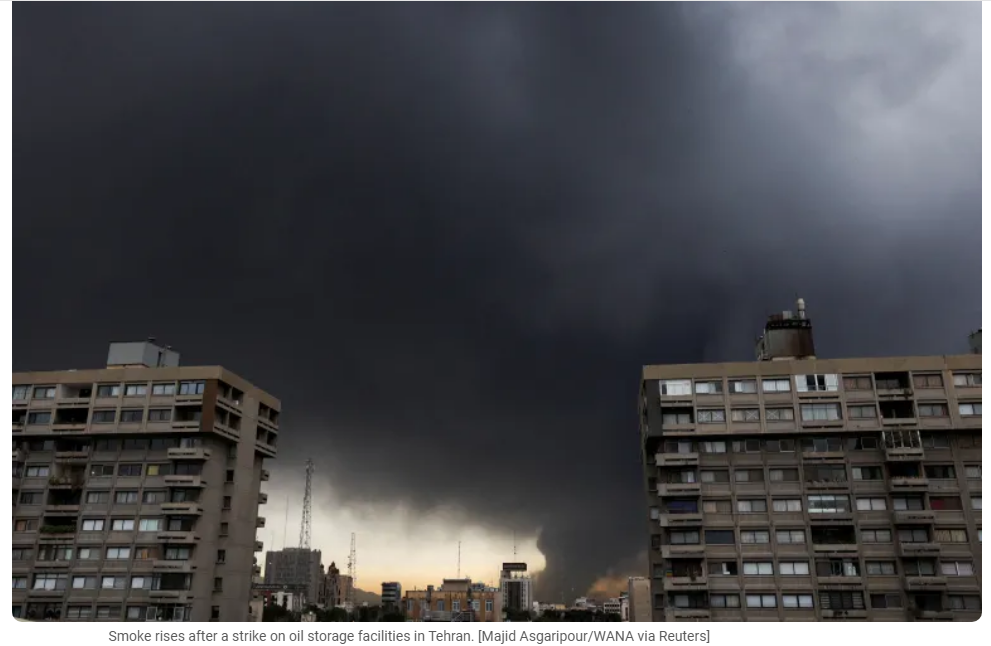
Smoke rises after a strike on oil storage facilities in Tehran. [Majid Asgaripour/WANA via Reuters]
By Anadolu, AP, EPA and Reuters
Published On 8 Mar 2026
Huge fireballs and thick plumes of smoke rose over Tehran after joint United States-Israeli air strikes hit fuel depots in the Iranian capital.
Iran’s oil distribution company said four of its employees were killed in the blitz, as a dark haze hung over the city on Sunday and the smell of burning oil lingered in the air.
Saturday’s strikes triggered large fires after hitting four oil storage facilities and an oil transfer and production centre in Tehran and neighbouring Alborz province, the Fars news agency reported. Iranian state media described the incident as an “attack from the US and the Zionist regime”.
The facilities targeted were the Aghdasieh oil warehouse in northeast Tehran, the Tehran refinery in the south, the Shahran oil depot in the west, and an oil depot in the city of Karaj. Witnesses said oil from the Shahran depot had leaked into nearby streets.
악다시에 (Aghdasieh) - 테헤란 북동쪽 정유 저장고
테헤란 남부 - 정유공장
테헤란 서쪽 - 샤흐란(Shahran) 정유 저장고 - 목격자. 정유가 거리까지 흘러내려.
카라지 시내 - 정유 저장고
Israel said it had struck “a number of fuel storage facilities in Tehran” that were used “to operate military infrastructure”.
Shortly after the attacks, which appeared to mark a new phase in the war, Israeli Prime Minister Benjamin Netanyahu said his government would press on with the assault and strike Iran’s rulers “without mercy”.
“We have an organised plan with many surprises to destabilise the regime and enable change,” he said in a video statement. “We have many more targets.”
Joint US-Israeli attacks on Iran have continued for a ninth day, killing more than 1,300 people in Iran and about 300 in Lebanon, according to officials. About a dozen people have been killed in Israel.
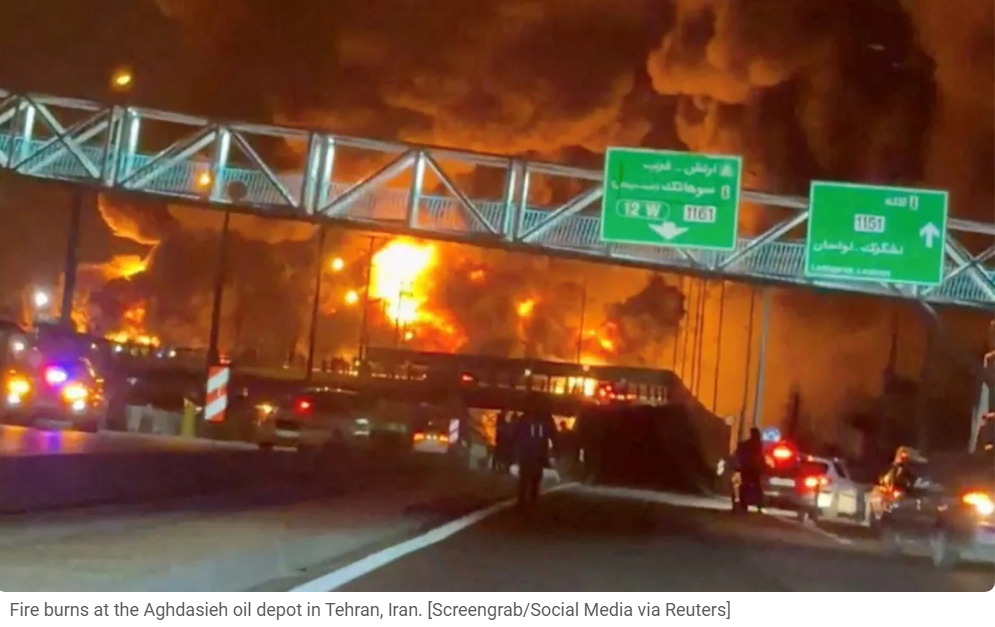
Fire burns and smoke rises from Aqdasieh Oil Depot after being reportedly hit by strike, amid the U.S.-Israeli conflict with Iran, in Tehran, Iran in this screengrab taken from a social media video released on March 8, 2026. SOCIAL MEDIA/via
REUTERS THIS IMAGE HAS BEEN SUPPLIED BY A THIRD PARTY. NO RESALES. NO ARCHIVES. VERIFICATION:
Reuters confirmed the location as Tehran by the road layout, utility poles and trees which match file and satellite imagery. The date of the video could not be verified, but no older version was found posted online before March 8.
Israeli military also wrote on Telegram that it had struck a number of fuel storage facilities in Tehran on March 8. Iran’s state agencies reported attacks on a number of oil depots on March 7.
NASA FIRMS detected thermal activity on coordinate 35.790649529257415, 51.539333520742645 at 1:50 a.m. on March 8 (10:20 p.m. UTC March 7).
The coordinates were tagged as Petrol Storage Aqdasieh on the online map.
Fire burns at the Aghdasieh oil depot in Tehran, Iran. [Screengrab/Social Media via Reuters]
Smoke rises following an explosion, amid the U.S.-Israeli conflict with Iran, in Tehran, Iran, March 7, 2026.
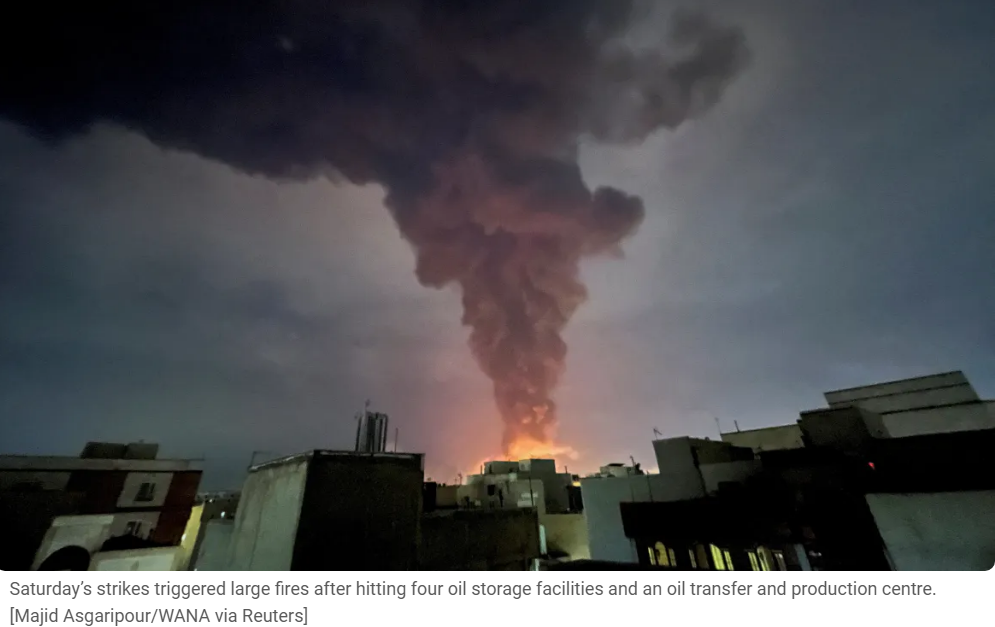
Saturday’s strikes triggered large fires after hitting four oil storage facilities and an oil transfer and production centre. [Majid Asgaripour/WANA via Reuters]
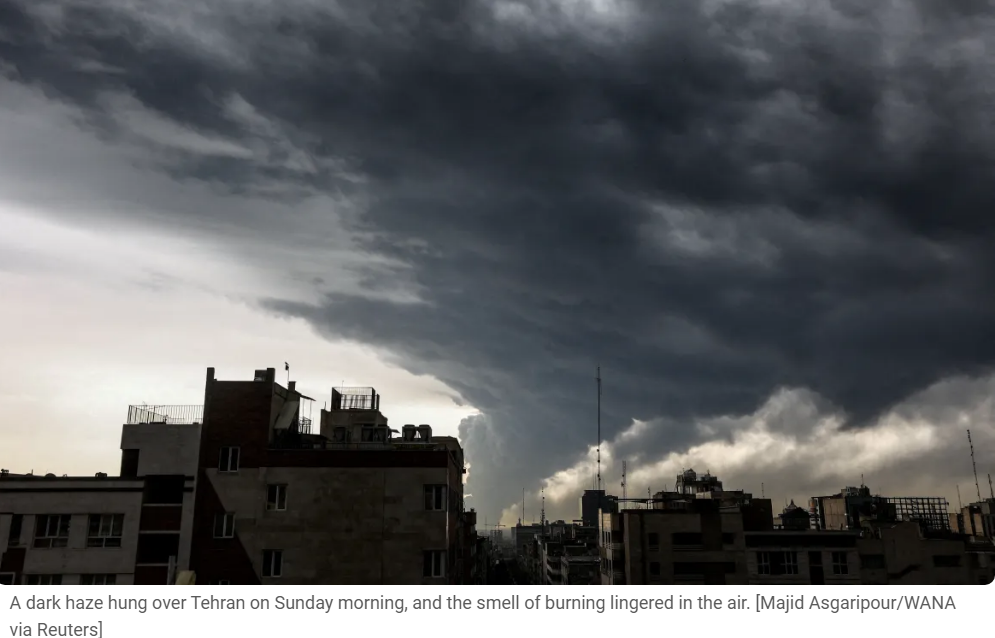
A dark haze hung over the city as Sunday morning broke and a smell of burning lingered in the air.
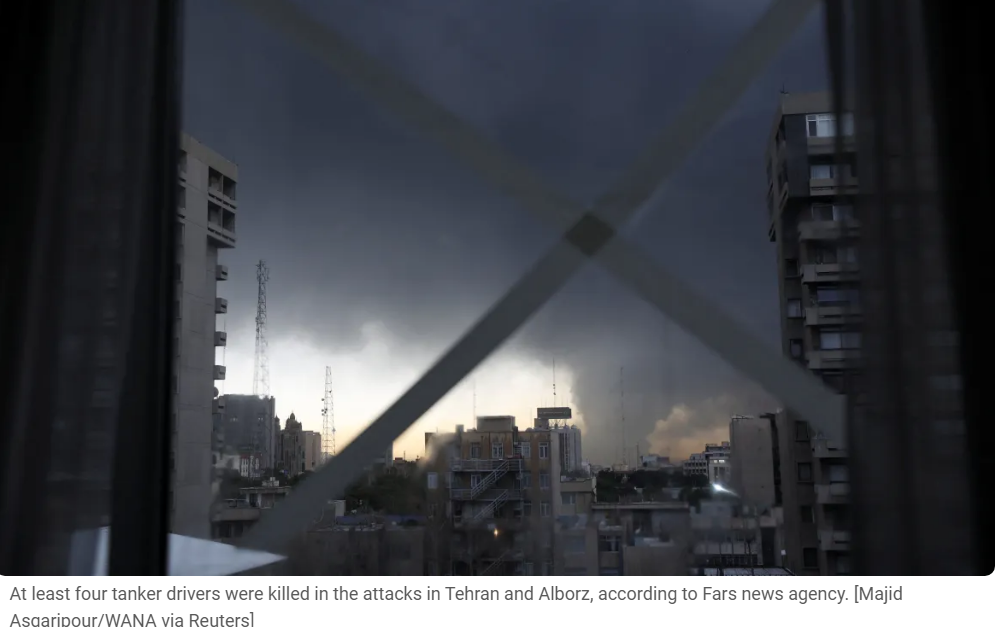
At least four tanker drivers were killed in the attacks in Tehran and Alborz, according to Fars news agency. [Majid Asgaripour/WANA via Reuters]

Plumes of smoke from an oil facility linger and merge with the cloudy sky over Tehran
A dark haze hung over Tehran on Sunday morning, and the smell of burning lingered in the air. [Majid Asgaripour/WANA via Reuters]
Plumes of smoke from a US-Israeli strike on an oil facility in Tehran. [Vahid Salemi/AP Photo]
A dark haze hung over the city as Sunday morning broke and a smell of burning lingered in the air.
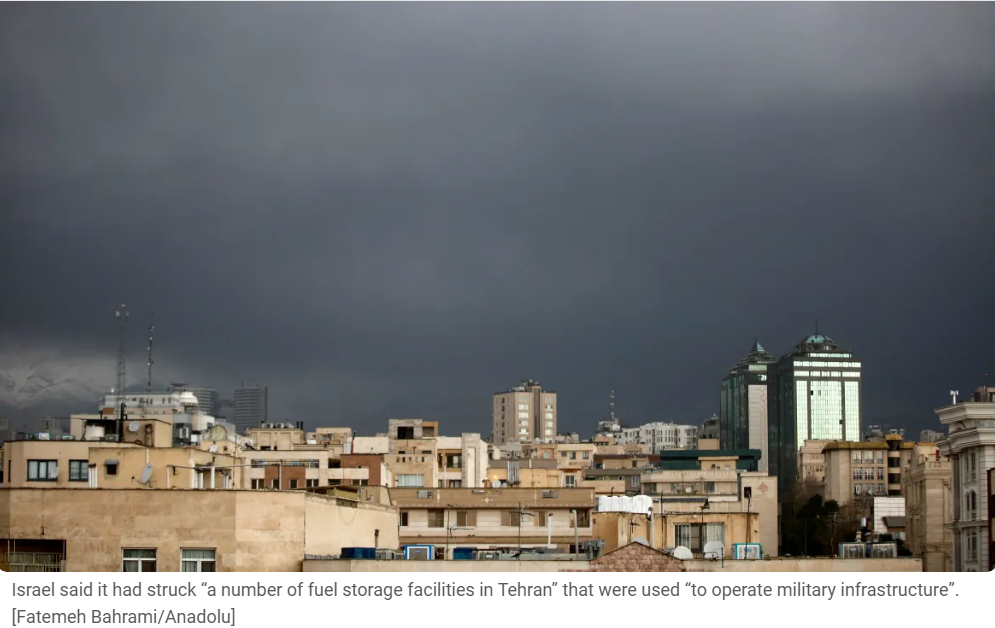
Israel said it had struck “a number of fuel storage facilities in Tehran” that were used “to operate military infrastructure”. [Fatemeh Bahrami/Anadolu]
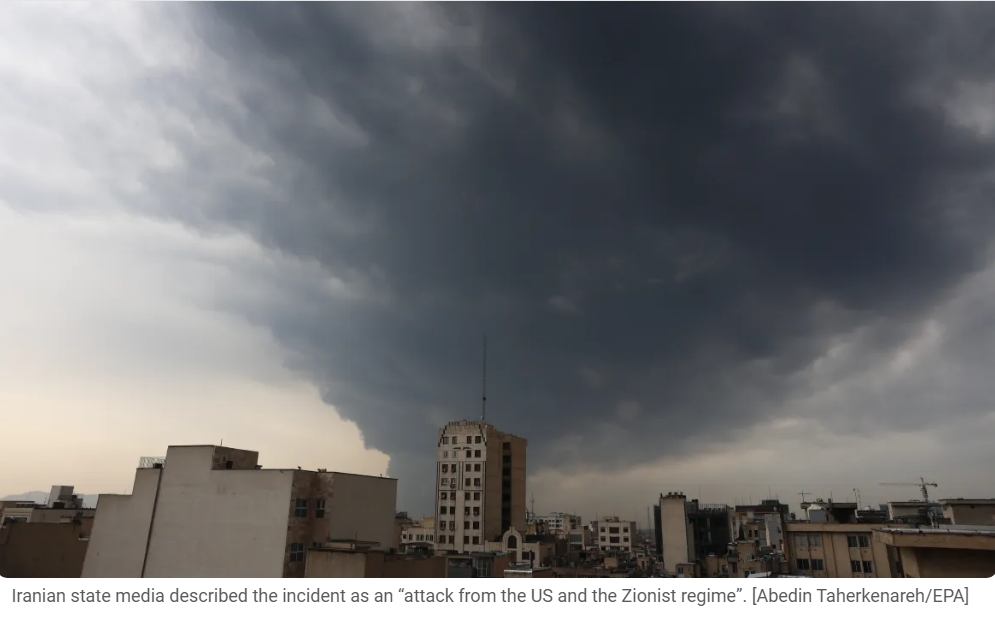
Iranian state media described the incident as an “attack from the US and the Zionist regime”. [Abedin Taherkenareh/EPA]
Photos: US-Israeli strikes on Iranian oil storage facilities
Warplanes hit five oil facilities in overnight strikes in and around the Iranian capital, killing four people.
www.aljazeera.com
3. 인터뷰
Doug Weir 소장이 있는 연구소.
https://ceobs.org/black-rain-the-health-and-environmental-risks-from-tehrans-oil-fires/
Black rain: the health and environmental risks from Tehran’s oil fires - CEOBS
Attacks on Tehran's oil facilities have exposed millions to harm, we explore the attacks and unpack their health and environmental risks.
ceobs.org
trajectories computed with Hysplit indicate north easterly advection in the free troposphere
정유소 화재로 발생한 그을음과 독성 물질이 지표면 근처에만 머무는 것이 아니라, 1~2km 상공 자유 대류권까지 솟구쳐 올라간 후에, 북동쪽 방향의 기류를 타고 멀리 퍼져나간다.
테헤란 북쪽으로 110 km 떨어진 곳에서, 자동차에 그을음이 내려앉을 정도 규모로 오염이 심함.
연구소 제공 그림은 4일간 강력한 연기구름 (에너지 플륨)이 테레한 북동쪽으로 이동하는 것을 보여줌.
그을음 (블랙 카본)이 고지대 빙하나 눈에 닿으면 빨리 녹게 만든다.
1) 그을음(Soot)과 독성 물질
2) 하이스플릿. Hysplit (Hybrid Single-Particle Lagrangian Integrated Trajectory):
미국 해양대기청(NOAA)에서 개발한 모델로, 대기 중 오염물질이나 입자가 어디로 흘러가는지 이동 궤적을 추적하는 데 쓰입니다.
Lagrangian(라그랑지안)은 물리학과 수학, 특히 유체역학에서 움직이는 입자 하나를 끝까지 쫓아가며 관찰하는 방식
3) 이류 (advection) 현상 1~2km 상공 자유 대류권(free troposphere) 까지 솟구쳐 올라간 후에, 북동쪽 방향의 기류를 타고 멀리 퍼져나간다. (이류, advection)
4) 강력한 연기 기둥 , 고에너지 플륨 (energetic plume) - 강한 상승력을 가진 오염구름.

Lagrangian(라그랑지안)은 물리학과 수학, 특히 유체역학에서 움직이는 입자 하나를 끝까지 쫓아가며 관찰하는 방식
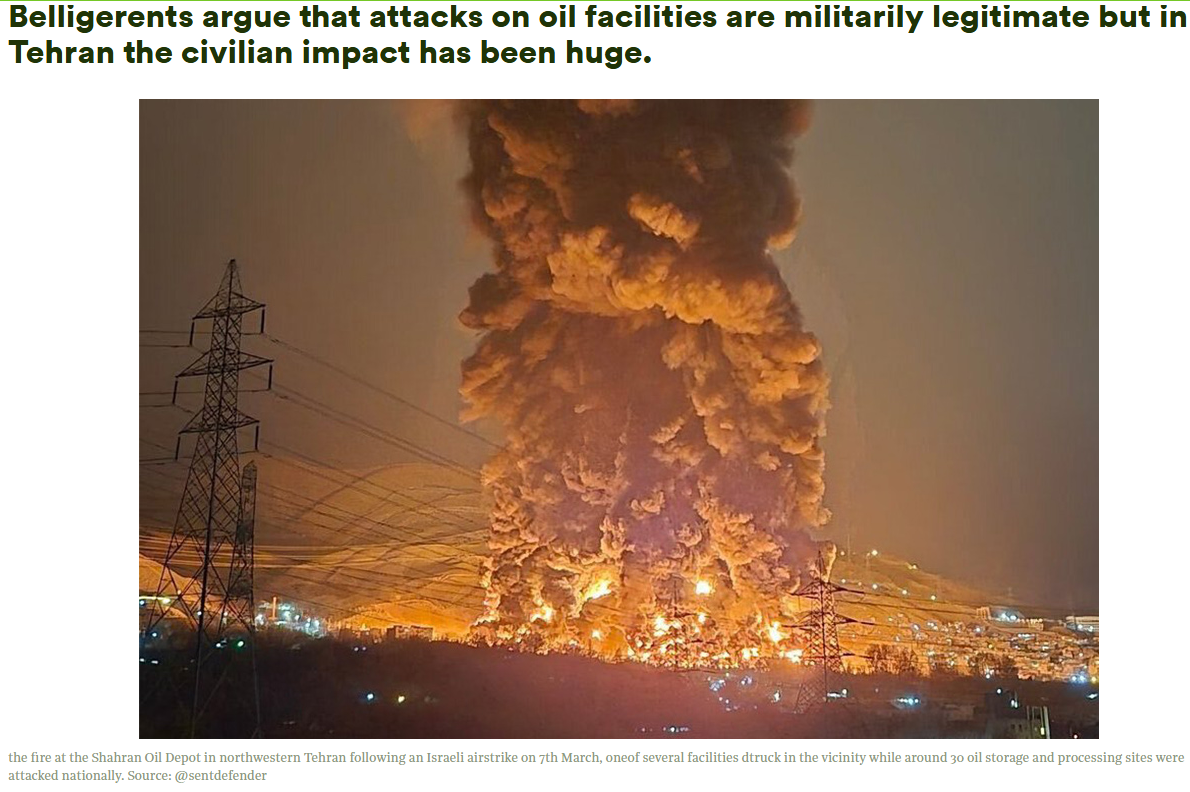
테헤란 북서부, 샤흐란 (Shahran) 정유 저장고 폭격 후, 화재
Black rain: the health and environmental risks from Tehran’s oil fires
Category: Blog
March 9, 2026
Belligerents argue that attacks on oil facilities are militarily legitimate but in Tehran the civilian impact has been huge.
Nighttime image, a huge fire a smoke plume can be seen, glowing orange as a column of black smoke rises into the sky.
the fire at the Shahran Oil Depot in northwestern Tehran following an Israeli airstrike on 7th March, oneof several facilities dtruck in the vicinity while around 30 oil storage and processing sites were attacked nationally. Source: @sentdefender
Israeli attacks on four oil facilities in Tehran have exposed millions of Iranians to harm. In this post we explore the attacks and unpack the health and environmental risks faced by the civilian population.
Introduction
Overnight on the 7-8th of March, the Israeli-US war against Iran saw a significant escalation as Israel targeted Iran’s oil infrastructure. Israel reportedly attacked more than 30 oil facilities, which it claimed were being used for “military purposes.” The US subsequently distanced itself from the strikes, questioning both their scale and strategic rationale.
Tehran was heavily affected, resulting in a major environmental incident. Footage showed thick plumes of black toxic smoke and large fires burning at several facilities. This toxic mix of pollutants subsequently rained out over the city and entered drainage systems, raising concerns about possible surface and groundwater contamination. With a population of more than nine million, the incident raises serious acute and long-term health concerns for Tehran’s residents.
Four sites were targeted in and around Tehran, including the Aqdasieh oil depot in Tehran’s northeast, the Shahran oil facility in the north of the city, and the Karaj oil depot in the city of Karaj to the west of Tehran. The Tehran oil refinery was also targeted. The refinery has the capacity to process approximately 225,000 barrels of oil per day and is among the larger refining facilities in Iran. It produces a range of products, with its main focus on LPG and gasoline, but it also specialises in sulphur recovery and vacuum bottoms, a heavy material used in tarmac.
Map showing the location of the oil facilities in Tehran that were struck overnight on 7/8th March. Insets displaying a panoramic view of darkened skies from smoke pollution, a flaming storm drain and a satellite image of the smoke plume from MODIS on the morning of 9th March.
Due to the ongoing war, it is unlikely that the fires will be extinguished quickly: 72 hours later only the Karaj oil depot fire appears to be extinguished.1 The Tehran attacks were just some of the sites targeted nationwide over the weekend, which marked the most significant attack on Iran’s civilian industrial and energy infrastructure since the beginning of the conflict.
Acute health risks
Iranians on social media described the ensuing oil fires as ‘hellscapes’, ‘a black monster’, and ‘apocalyptic’; a mark of their psychological impact. But what of their acute physical health impact? While the health impacts of long-term exposure to air pollution are relatively well established, the literature on acute exposure for similar events is limited. Even less so on the compound effects of such exposures and those from other conflict pollutants such as pulverised building materials dispersed by blasts. Nonetheless, health impacts will be informed by the smoke composition, concentration, exposure pathways and comorbidities, which we explore below.
Smoke composition
Smoke from oil or refinery fires is a complex mixture of gases and particles produced by incomplete combustion of hydrocarbons and industrial materials.2 Typical pollutants include carbon monoxide, sulphur dioxide, nitrogen oxides and volatile organic compounds (VOCs), alongside particles composed of soot, organic material and trace metals.
It is often difficult to attribute symptoms in a specific event to any one component of the smoke mixture with confidence, but we know one particle of particular concern is black carbon, a near-pure carbonaceous component of soot produced during incomplete combustion. Acute exposure can lead to respiratory disorders, particularly for high-risk groups like those with asthma and the elderly. The very small black carbon particles can penetrate deep into the lungs and can also carry other toxic pollutants on their surfaces, including polycyclic aromatic hydrocarbons (PAHs). Trace metals that occur naturally in crude oils are also of concern, such as nickel and vanadium, which cause respiratory irritation and inflammatory effects.
Reports out of Tehran describe “toxic acid rain”. This phenomenon is caused by the combustion of sulphur rich “sour” crude oil when sulphur dioxide gas is emitted into the atmosphere, turning into sulphuric acid in raindrops. Depending on concentration, sulphuric acid exposure can irritate the eyes and respiratory tract, but in practice it is often difficult to separate those effects from the wider impacts of soot, acidic gases and other potential combustion products like dioxins and furans, which act together rather than in isolation.
Smoke concentration
People in Tehran will have exposure to different pollutant concentrations based on their proximity to the fires, their local built environment, their building construction, how long they spent outside, and the weather.
In the early stages of the oil fires, large energetic plumes thrust the majority of the pollution up high, and away from people near the ground. These towering plumes punctured the planetary boundary layer,3 with smoke exported away (see below). However, as the fires lost energy, the plumes lowered and all smoke was within the boundary layer. This is particularly problematic in Tehran, owing to the local geography.
Tehran lies on the southern foothills of the Alborz Mountains in a semi-enclosed basin where surrounding peaks rise to 2-4 km, strongly restricting air circulation over the city. In winter and early spring the daytime boundary layer typically reaches only around 1-1.5 km, far below the surrounding mountain crest heights, forming a temperature inversion that acts as a cap to trap pollutants. What’s more, after sunset the boundary layer collapses to a few hundred metres, which concentrates pollutants near the ground. This effect produces the highest pollution levels overnight and in the early morning, until the boundary later starts to rise as the sun warms the ground.
At the street scale, Tehran’s dense urban fabric creates numerous “urban canyons” where rows of mid- and high-rise buildings can restrict airflow, creating concentration hotspots. Modelling studies show that these can generate recirculating vortices that trap pollutants at pedestrian level, further reducing ventilation even when air above the rooftops is moving.
Given its slack winds, Tehran needs significant rain to ‘clean’ the air to remove the particles and gases most hazardous to human health. No direct observations are available due to the black-out, while weather forecast models indicate the rainfall so far has been limited, satellite observations do suggest some rainfall – the so called “acid rain”. However, the fires still burn – and so the toxic smoke has continued to accumulate within the boundary layer.
Staying inside doesn’t fully eliminate exposure. One study in Tehran showed that outdoor particulate pollution readily infiltrated residential buildings — which often rely on natural ventilation and have relatively leaky building envelopes — meaning indoor particle concentrations frequently track outdoor levels during severe pollution episodes. This indoor pollution will persist for hours or days, with fine particles deposited on furnishings, potentially prolonging exposure, especially if cleaning is not possible due to the war and water availability.
Elements of the smoke pollution will have been deposited onto Tehran’s urban fabric — its roads, roofs, soils and croplands — where they can accumulate. This can act as a source of secondary exposure, for example when winds resuspended the pollution back into the air. This may be a particular issue in the dry summer months when Tehran experiences dust storms.
Population vulnerability
Acute air pollution episodes disproportionately affect people with existing health conditions. Individuals with asthma, chronic obstructive pulmonary disease (COPD), cardiovascular disease and diabetes are consistently identified as being at greater risk during short-term spikes in particulate pollution. Studies of wildfire smoke — a useful analogue — show same-day increases in respiratory emergency visits, hospital admissions and mortality, particularly among older adults and those with underlying respiratory or cardiovascular disease.
In Tehran these risks may be compounded by the city’s high baseline pollution, where average PM₂.₅ levels exceed WHO guidelines by up to 4.5 times. Chronic exposure can leave residents with airway or cardiovascular stress, increasing the likelihood that acute smoke exposure triggers exacerbations of asthma, COPD and cardiac events.
Reverberating environmental impacts
Water pollution
There are reports that spillages from the Shahran oil storage site entered the storm drains in Tehran and explosively ignited. Tehran has a large and complex network of storm drains to carry runoff from rainfall and snowmelt off the surrounding mountains. It is difficult to forecast exactly where spilled oil products — or the deposited contaminates that were later washed into the storm drains — may be discharged. However, it would be expected to follow Tehran’s north-to-south slope and may enter natural water bodies or agricultural soils, where in turn shallow groundwater could become contaminated.
Long-range transport of smoke
As well as exposing the people of Tehran to harm, the smoke has also been transported and deposited more widely. This may affect urban areas, crops, and ecology far from the city, and of course tens of other sites have also been targeted. We can track this through media reports — such as a citizen about 70 miles north of Tehran reporting black soot on his recently washed car — but also by simulating the pollution transport with models.
Using the HYSPLIT atmospheric model we can track where smoke released above the boundary layer may end up, based on the forecast winds and atmospheric motions. The trajectories indicate the airmass will travel in a north-easterly direction: one high-altitude area at risk of deposited soot may be the Golden Mountains of Altai in Siberia, home to several glaciers. HYSPLIT is a simple representation of the atmosphere; more complex models — such as those with chemistry, street canyon effects, or exposure/inhalation dose — can and should be used to better understand the environmental harms and public health risks.
Lagrangian(라그랑지안)은 물리학과 수학, 특히 유체역학에서 움직이는 입자 하나를 끝까지 쫓아가며 관찰하는 방식
Figure showing an energetic black smoke plume rising into the free troposphere next to a map showing forecast trajectories of where this smoke is likely to be transported - generally to the north west towards Kazakhstan, Russia and China.
Climate
Fires at oil storage or refinery infrastructure release carbon primarily as carbon dioxide — though this would have been emitted eventually anyway when oil products were burned. However, uncontrolled combustion — especially when smouldering — may lead to relatively more emissions of methane, whilst ground-level ozone (another greenhouse gas) may be produced downwind.
Furthermore, oil burnt in this way produces relatively more emissions of short-lived climate forcers: black carbon absorbs and warms the atmosphere, whereas organic and sulphate aerosols scatter and cool. This may be particularly important when these particulates are injected into the upper atmosphere, where they persist longer. Here, they can exert stronger short-term climate effects, or be transported to glaciers where black carbon can accelerate warming, as happened with the Kuwait oil fires of 1991. Alterernatively, these particulates may interact with clouds, changing their lifetime and structure – thus their instantaneous climate forcing. If the number of oil fires in the region increases, then cumulatively these effects may have an appreciable effect on climate meaning that observation and tracking is important.
Law and the acceptability of attacks on oil sites
Attacks on oil infrastructure are commonplace in conflicts and usually justified by belligerents on the basis that facilities contribute to the war effort through the provision of fuel, as well as economically. Facilities are also a common target of non-state armed groups: in Iraq Daesh targeted oil wells because of their psychological effect on the local community, effectively using the fires as a weapon of war. Major incidents affecting oil facilities have also proved a trigger for the development of international policies seeking to enhance the protection of the environment in relation to armed conflicts.
Israel’s decision to attack around 30 oil facilities over the weekend appears to have alarmed the US, with concerns expressed over the political impact of oil price rises. While these were not production sites, the US was concerned about the optics; oil fires grab the media attention. Iran’s attack on a refinery in Bahrain on the 9th will have done little to quell fears that the sector will not become collateral damage as the war continues.
Beyond the global markets, the nationwide attacks will have an impact on civilian lives and wellbeing, as well as on the environment, public health and climate. Notably, and as discussed above, major fires can impact the environment over substantial geographic areas and cause long-lasting harm, be it soil and water pollution, or greenhouse gas emissions. In the specific case of the Tehran facilities, it is highly unusual for this many sites to be attacked in such a densely populated area that is so geographically vulnerable to poor air quality, leading to so many people being exposed to a dangerous mixture of pollutants. These factors should have influenced Israel’s legal and military calculus, if the protection of civilians was being viewed as a priority.
This post was researched and written by the CEOBS team. If you find our work useful, please consider a donation so that we can continue it.
Fire detections using FIRMS, the Fire Information for Resource Management System.
Many compounds are also semi-volatile, meaning they can move between gas and particle phases as the plume cools and reacts chemically while travelling downwind.
The planetary boundary layer is the lowest part of the atmosphere where air is directly influenced by the Earth’s surface, and its height changes through the day as sunlight warms the ground and drives convection and mixing (raising it), while night-time cooling stabilises the air and causes it to shrink.


