Oil prices have risen, reaching $100 a barrel at one point, as three more cargo ships are attacked in the Gulf
The price rise comes despite 32 countries agreeing on Wednesday to release 400m barrels of oil reserves, in an effort to calm markets
In the latest attacks on shipping, two tankers were hit by an "unknown projectile" near Iraq, while a container ship was struck by an "unknown projectile" near the UAE
On Wednesday evening, US President Donald Trump said the oil price would come down: "It's going to come down more than we, than anybody understands"
New Israeli strikes have killed several people in Lebanon, including at least eight in Beirut's seafront area, while Israel is also carrying out "wide-scale" attacks on Iran
Apparent Iranian attacks have been reported across the region, including in Iraq and Kuwait, while a Dubai high-rise was hit by an apparent drone attack.
Analysis
US-Israeli forces zeroing in on banks and militia checkpoints
published at 07:37
07:37
Lyse Doucet
Chief international correspondent
In the past 24 hours there’s been a sharper focus in US-Israeli targeting. They’ve been zeroing in on national infrastructure and security forces.
Yesterday, Iran's oldest bank, Bank Sepah, was struck by an air strike in Tehran. It’s said to play a key role paying the salaries of Iran's military and the Islamic Revolutionary Guard Corps.
And it’s the crucial run-up to the Persian New Year on 21 March - when salaries and bonuses are paid. That matters to the families of security forces but also for Iranians preparing for this important holiday.
The Foreign Minister Abbas Araghchi warned of retaliation; major international banks in the Gulf states, including Citibank and HSBC, temporarily closed their offices.
And in Tehran last night there were more drone strikes on small street checkpoints of the Basij, a volunteer militia which has played a key role in brutally suppressing protests.
There have been repeated US-Israeli pledges that they'd “create the conditions” for Iranians to take to the streets.
Some would welcome that possibility. But we're hearing from residents that it's also amplifying their anxiety and fear as this war intensifies all around them.
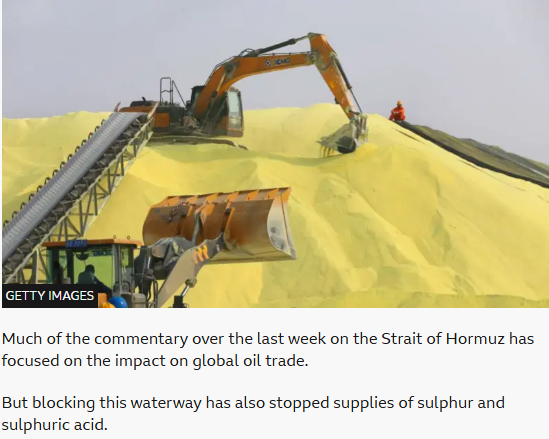
The war is choking supplies of a niche yellow powder critical to global tech
황 (Sulfur)공급 차질 이유: 원유와 가스 정제 과정에서 나오는 부산물인 황은 전 세계 공급의 절반(50%) 정도가 호르무즈 해협 물동량에 묶여 있음.
published at 07:26
07:26
Esme Stallard
Climate and science reporter
Much of the commentary over the last week on the Strait of Hormuz has focused on the impact on global oil trade.
But blocking this waterway has also stopped supplies of sulphur and sulphuric acid.
It's probably not an element you've thought about before, but it's used in fertiliser, semiconductors - the computer chips used in all electronic tech from mobile phones to electric vehicles - nickel refining, and copper smelting (one of the most-used metals in the world).
1. 구리의 용도, 구리 제련에 필수적인 황산
구리가 왜 중요한가? 세계에서 가장 많이 쓰는 금속이 '구리'임.
(1) 내연기관 자동차에 비해, 전기자동차에 구리는 4배 더 필요(배터리,모터,배선)
(2) 반도체와 모든 전자제품의 기판 미세 회로 연결 재료
(3) 태양광 패널과 풍력 발전기에 필수적인 구리 전선
2. 황의 용도. 황의 세계 공급의 50%가 호르무즈 해협 통과.
(1) 황 생산 과정.
황은 걸프 지역에서 생산된 특정 한 원유, 신맛 나는 원유의 부산물이다. (sour crude oil- 황 함유 0.5%이상)
탈황 시설을 통해 원유와 천연가스에서 황을 제거하는 과정에서 엄청난 양의 원소 황(Elemental Sulfur)이 부산물로 나옴.
(2) 황은 인산 비료 원료.
(3) 황산은 반도체 세정, 컴퓨터 칩 (전화기, 전기자동차 배터리), 니켈 정련, 세계에서 소비량이 가장 많은 금속인 구리 제련에 필수.
(4) 황 공급 차질로 중국에서 황 가격이 15% 급등
3. 황산과 구리 제련
습식제련 공정에서, '황산'의 역할은, 구리 원석에서 구리를 추출할 때 '황산'이 필수적임.
(1) 구리 원석에는 철과 아연과 같은 불순물이 섞여있음
(2) 구리 원석에 황산을 뿌려, 고농축 구리 용액만 뽑아냄
(3) 구리용역에 전기자극을 줘, 구리를 생산함.
About half of global sulphur that is transported by ship goes through the Strait of Hormuz. The Gulf region is one of the largest global manufacturers because sulphur is a byproduct of a particular type of oil, known as sour crude oil.
Last week, prices in China - which takes a lot of global sulphur supply - jumped by 15%, according to commodity analysts Argus.
Iranians receive text messages warning them against protests and urging unity
published at 07:07
07:07
Ghoncheh Habibiazad
Senior reporter, BBC Persian
이슬람 혁명 수비대 (IRGC)가 이란 사람들에게, 어떤 시위에도 참가하지 말라는 메시지를 보냄. 미국,이스라엘과 전쟁 상황에서 시위는 적을 이롭게 하는 행위라고 규정.
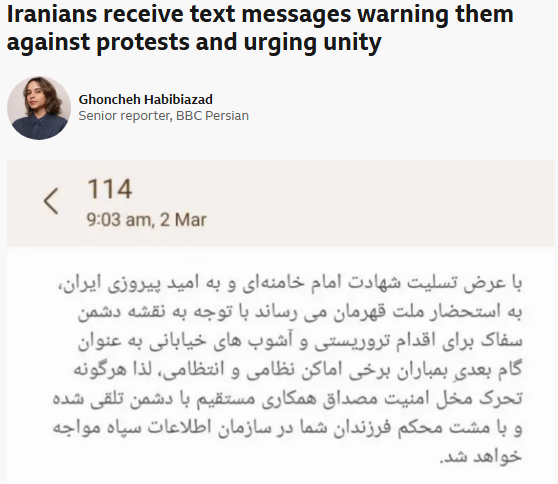
A message sent to Iranians, warning them that disrupting "security" will be regarded as co-operation with the "enemy"
BBC Persian has seen several screenshots of mass text messages sent to people inside Iran since the start of the war on 28 February.
The messages vary, but include warnings against any upcoming protests and calls for people to unite against the “enemy”. Some were signed by organisations such as the IRGC - Iran’s Islamic Revolutionary Guard Corps.
One message, signed by the IRGC’s Intelligence Unit on 2 March, says that “considering the enemy’s plan for street riots… any movement that disrupts security will be regarded as an example of direct cooperation with the enemy.”
A man in Karaj, a city near Tehran, says: “I don’t watch state TV that often and every time I watch it I hear the same things. The worst thing is that you can’t block some of these numbers to stop receiving texts from them."
Iran earlier this year saw a wave of nationwide anti-establishment protests, that started in late December, prompting the deadliest crackdown in the Islamic Republic's history. The US-based Human Rights Activists News Agency (Hrana) said it had confirmed the killing of at least 7,000 people during that wave.
Iran Police Chief Ahmadreza Radan warned two days ago on state TV that Iranians who might protest on the streets against the establishment are doing so “at enemy’s bidding” and they will be treated as the “enemy”.
His comments came after Israeli Prime Minister Benjamin Netanyahu issued a direct message to the Iranian people, urging them to stand up against the establishment.
What equipment are US and Israeli forces using for strikes?
published at 06:59
06:59
Chris Partridge
BBC News weapons analyst
The US and Israeli military have released dozens of videos of strikes on Iranian equipment and facilities in this war.
Many of the weapons used include GBU-31 JDAMs - 2,000lb penetrating munitions better known as 'bunker-busters'.
Often these are delivered using satellite guidance, but on Wednesday night we saw evidence of how the US military also use laser-designation for placing bombs on target.
This morning US Central Command (Centcom) released a video of strikes on Iranian aircraft at an airbase.
In the video we clearly see the laser hitting the top of the targets. The laser sits in a pod on the attacking aircraft and is pointed at the target by the pilot(s).
Black and white footage showing target aiming at plane on tarmac. The plane is in flames with smoke rising above it. The word 'unclassified' is at the top
Image source,Centcom
The munitions - likely GBU-24s / GBU-54s - once released from the attacking jet, home in on the laser spots by moving control surfaces on the weapon. With the bomb dropped from many thousands of feet, accuracy here is within one or two metres.
Laser-designation is also useful as it can track moving targets. But it is not always best.
Cloud and other atmospheric conditions can greatly degrade the targeting effectiveness, which is where GPS guidance comes in. There are weapons which have both laser and GPS targeting too, so the most appropriate targeting method can be used.

Iranian site was used to 'advance critical capabilities' for nuclear weapons - IDF
published at 06:50
06:50
More now from the Israel Defense Forces (IDF), which says it has struck a "nuclear weapon development compound" during strikes in the "past days in Tehran".
It says: "The ‘Taleghan’ compound was utilized by the regime to advance critical capabilities for developing nuclear weapons."
The site was used to develop explosives and conduct experiments for a "covert nuclear weapon development programme" in the 2000s, the IDF says.
In a statement on Telegram, the IDF says previous strikes on Iran's nuclear facilities in June 2025 had caused "significant damage" to the programme.
"As such, the IDF has recently identified that the regime has taken steps to rehabilitate the compound after it was struck in October 2024", it says.
For context: Iran has repeatedly denied it is seeking to produce a nuclear weapon and says its programme is only for peaceful purposes, though the country is the only non-nuclear-armed state to have enriched uranium at near weapons-grade level.
06:29
Breaking
The Israeli military says it has struck a "nuclear weapon development compound" in Tehran, Iran, during attacks in "the past days".
We'll bring you more on this in a moment.
Sixteen reports of attacks on vessels since war began - UKMTO
published at 05:03
05:03
Black smoke rises from a large container ship
Image source,Royal Thai Navy
Image caption,

A Thai-flagged vessel was struck yesterday
As we've been reporting, three more cargo ships were attacked in the region overnight, according to the UK Maritime Trade Operations (UKMTO) Centre.
Since the war began on 28 February, there have now been 16 reported attacks on vessels in the Gulf, Strait of Hormuz and Gulf of Oman, according to its latest update.
There have also been four reports of "suspicious activity" during the conflict, the UKMTO says.
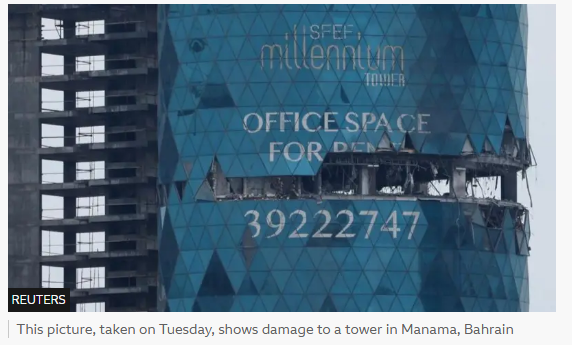
Alarms sound in Bahrain, interior ministry says
published at 04:37
04:37
The Bahrain interior ministry says alarms in the country have been activated.
In a post on X it says: "We urge citizens and residents to remain calm, head to the nearest safe place, and follow the news through official channels."
It is not clear what area the siren is being sounded in or why. In our previous post we shared a picture of smoke rising over the country's capital, Manama - while a picture earlier this week showed damage to a high-rise tower.


