1. 미국과 이란의 전쟁이 미국 경제에 미치는 영향. (배럴당 10달러 인상시, 0.1%, 0.2% )
(1) 미국의 경제 규모를 30조 달러로 봤을 때 , 원유가격이 배럴당 10달러 인상시, GDP 는 0.1% 감소한다. (석유와 연관된, 비닐, 플라스틱, 비료 등 모든 제조업의 원료이끼 때문에, 유가 상승은 생산비 증가의 원인이 됨)
원유가격이 배럴당 10달러 인상시, 소비자 물가는 0.2% 상승한다. (택배, 항공, 트럭 등 운송비용 증가)로 상품 가격에 이전됨.
(1배럴은 약 150리터=42갤런 : 1갤런 =3.79리터)
한국의 경우, 배럴당 10달러 인상시, GDP 는 0.2%~0.4% 감소하고, 소비자 물가는 0.5%씩 증가할 것으로 예상.
(2) 미국 경제 악화 조건은, 유가가 배럴당 125달러, 갤런당 4.25달러에 육박할 때이다. GDP는 최소한 0.8% 감소, 소비자 물가는 4% 인상될 것이라고 봄. 조셉 브루수엘라스(Joseph Brusuelas, RSM 경제평론가) 전망.
2. 미국의 이란 공격 이전 갤런당 가솔린 (휘발유) 가격.
(1) 이란 공습전, 2월 말 가격, 2.98달러
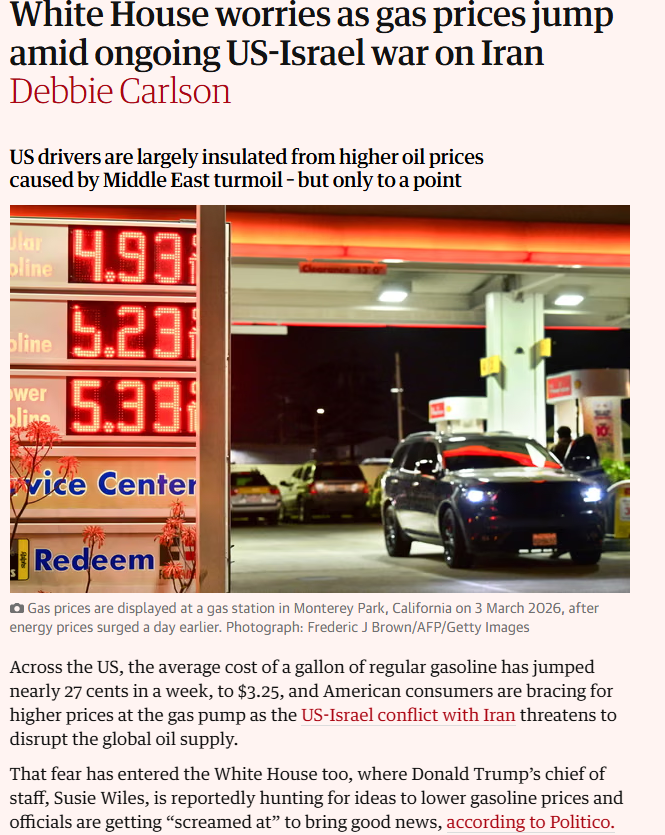
(2) 3월 8일 현재, 27센트 급등, 3.25달러 (9% 증가함)
(3) 향후 20~25센트 인상 전망.
(4) 경제 타격 임계점, 갤런당 4.25 달러.
패트릭 데 한 (Patrick De Haan) Gas Buddy 석유 분석 연구위원,
[참고] 미국 운전자들이 갤런 당 4.25달러를 타격가격을 보는 이유는, 15~20갤런(약 60~75리터) 채울 때, 80달러 초과시, 너무 비싸다고 판단함.
3. 그렇다면 미국의 자체 원유, 미국의 셰일 석유 생산량을 늘리는 임계점은 무엇인가? 원유 배럴당 가격이 70달러를 초과할 때, 셰일 오일의 생산량을 1일 50만 배럴로 증산할 것이라고 봄. 롭 썸멜(Rob Thummel, Tortoise Capital 포트폴리오 수석 매니저) 전망.
4. 참고 통계.
(1) 미국 원유 생산량. 1일 1360만 배럴 생산.
(2) 사우디 아라비아. 1일 987만 배럴 생산 (IEA 국제에너지기구 통계)
미국, 사우디에 이어, 3위 러시아 920만 배럴, 4위 캐나다 480만 배럴, 5위 이라크 중국 430만 배럴
(3) 이란은 전 세계 원유 공급의 3% 차지(1일 300만 배럴)
Debbie Carlson 데비 칼슨 기사, 요약 정리함.
White House worries as gas prices jump amid ongoing US-Israel war on Iran
Debbie Carlson
US drivers are largely insulated from higher oil prices caused by Middle East turmoil – but only to a point
Sun 8 Mar 2026 12.00 GMT
Share
Across the US, the average cost of a gallon of regular gasoline has jumped nearly 27 cents in a week, to $3.25, and American consumers are bracing for higher prices at the gas pump as the US-Israel conflict with Iran threatens to disrupt the global oil supply.
That fear has entered the White House too, where Donald Trump’s chief of staff, Susie Wiles, is reportedly hunting for ideas to lower gasoline prices and officials are getting “screamed at” to bring good news, according to Politico.
War in oil-rich countries used to cause panic at US gas stations. Those fears have subsided somewhat as the US has become the world’s largest crude oil producer. And, despite this week’s price hikes, American consumers are somewhat insulated from the global energy shock. The supply cushion has its limits, but those limits are high: US producers can ramp up production quickly if high oil prices are sustained, and the White House is under immense pressure to keep prices low as the conflict continues.
The US is forecast to pump a near-record 13.6m barrels of crude oil per day in 2026, according to the US Energy Information Administration (EIA). Saudi Arabia is the next biggest producer at 9.87m barrels, according to the International Energy Agency. Iran produces 3% of global oil supplies.
High American production means that US consumers may be partially insulated from energy shocks, though they’re not completely immune.
Oil is a globally traded market, and prices are influenced by global events. After the US-Israel strikes, Iran effectively shut down traffic through the strait of Hormuz, a key shipping area for energy to Europe and Asia where about 20% of the world’s oil and natural gas flows through.
After Trump announced on Tuesday that the US will provide insurance guarantees and naval escorts for oil tankers through the strait, oil prices were pulled off their peaks. They pushed higher on Friday with Brent crude oil, the global benchmark, passing $90 after Trump said there would “be no deal with Iran except UNCONDITIONAL SURRENDER!”
Higher US crude oil prices have already flowed to pump prices. Even if oil prices stayed at current levels, Patrick De Haan, head of petroleum analysis at Gas Buddy, expects retail prices could gain another 20 to 25 cents a gallon, which could push the nationwide average to $3.40.
As hard as that is to swallow for US drivers, Joseph Brusuelas, chief economist for RSM, a middle-market assurance, tax and consulting firm, said the resilience of the US economy suggests US oil prices need to hit $125 a barrel, or $4.25 a gallon for gasoline, to inflict economic damage.
“The US economy is a dynamic and resilient, $30tn beast. It’s got a lot of runway here, in terms of how much pain it can absorb from oil prices and volatility across the energy complex,” Brusuelas said. “But even that $30tn beast has its pain points.”
If US oil prices rise to $125 barrel, US gross domestic product (GDP) could drop at least 0.8% and consumer inflation could go up to 4%, he said. Every $10 increase in the price of a barrel of oil can lead to a 0.1% drop in overall growth and 0.2% increase in price levels.
The last time gas prices jumped high enough to cause consumers to cut back on spending was in June 2022, Brusuelas said, following Russia’s invasion of Ukraine. At that time, US gasoline prices averaged $5.01 a gallon.
It’s possible that oil prices will not reach that level. Higher prices could entice shale-oil producers to increase output. Though the EIA forecast of 13.6m barrels produced per day in the US is a near-record, it is largely unchanged from 2025’s output.
“Recent history does provide some comfort that this could happen,” Brusuelas said, referring to the US response to oil shocks after Russia invaded Ukraine.
The US could step up output if the strait of Hormuz remains closed. The US has been a net energy exporter since 2019 and could expand oil production to meet demand, industry experts say, and it would likely head to Europe. That could lower global oil prices.
But prices would need to stay above $70 a barrel for a while before shale oil producers would start considering upping production, said Rob Thummel, senior portfolio manager at Tortoise Capital.
“They could gradually add half a million barrels a day, start with that and see what demand does, but there is potential for the US to continue to grow production from shale,” he said.