금 가격 상승 원인. 2025
Bullion bonanza: why is gold hitting record highs?
Interest rates, inflation and geopolitical crises are providing the metal with its strongest annual performance since 1979
Graeme Wearden
Mon 29 Sep 2025 10.33 BST
Share
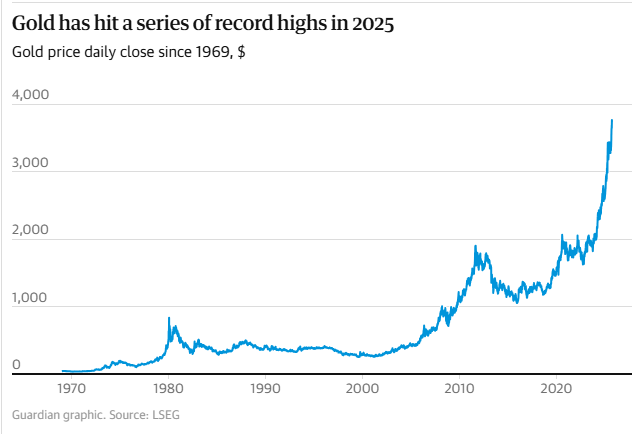
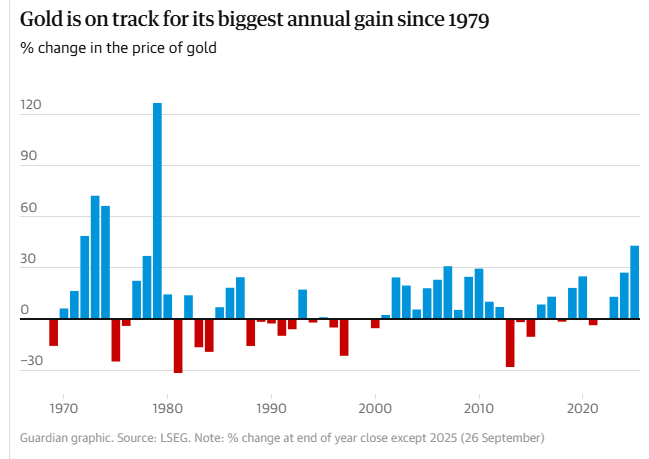
It is turning into gold’s best year in decades. Bullion has hit a series of record highs in 2025, putting it firmly on track for its strongest annual performance since 1979, when revolution in Tehran rocked the global economy.
Why is gold in such demand?
The short answer is that gold is acting as a haven and a store of value, a role it’s played for thousands of years, since the kingdom of Lydia started churning out gold coins in the sixth century BC. Investors can be a jumpy lot, and there are plenty of reasons to shift money out of riskier assets today – from fears of economic slowdown to rising geopolitical tensions between Russia and Nato.
As well as traditional valuation drivers such as interest rates, the dollar and inflation, concerns over Donald Trump’s attacks on the US central bank, his trade war, and his tax and spending plans are also pushing gold higher, analysts say.
Why can’t other precious metals play the same role as gold?
Gold’s role as a store of value comes, in part, from its scarcity. According to the World Gold Council, if all the gold ever mined was gathered into a single cube, it would measure approximately 22 metres on each side.
Total supplies are rising by an estimated 1.7% a year. That means “no policy, no discovery, no quantitative easing of geology” can debase gold, says Stephen Innes, managing partner at SPI Asset Management.
That makes it attractive when investors worry that governments are losing their grip on the public finances – finding it politically unpalatable to raise taxes, and impossible to cut spending.
Copper, in contrast, can’t operate as a store of value as huge quantities are used, and consumed, each year, with demand set by the health of the global economy.
Platinum and palladium fail this test too, despite an ounce costing over a thousand dollars as new supplies are quickly swallowed up by industry.
How much has the precious metal risen by – and are we at peak gold?
Since 1 January, the spot price of gold has risen by a blistering 45% to a record high of $3,831 per ounce on Monday. That outpaces all other leading asset classes this year.
Gold hasn’t had such as strong year since 1979, when it jumped by 126% as Iran’s revolution led to a surge in the oil price, crushing investors’ hopes that inflation could be tamed.
Data from Bank of America (BofA) on Friday shows that $5.6bn flowed into gold last week. Over the past four weeks, the bank says there were record inflows of $17.6bn.
BofA cautions that gold is tactically “overbought”, but structurally “under owned” – as it only represents 0.4% of private client assets under management. It is maintaining a long position on gold, indicating it expects the price to keep rising.
Gold has further to rise, analysts predict. Arnab Das, global macro strategist at Invesco, for example, says the gold rally still “has legs”.
“We see no true alternative to gold as a hedge against US risks and expect central banks to keep buying gold … In my view, central banks are buying gold because they see no fiat alternative to the dollar,” Das says.
Who is buying it, and why?
The World Gold Council says western investors and speculators have been the drivers of the recent price gains.
They cite two reasons. First, evidence that a slowing US economy will allow the US Federal Reserve to lower interest rates further. That means the interest on cash reserves will be lower, making it less attractive compared with gold (which doesn’t provide a yield).
Second, increased rhetoric against the Fed and its independence from the Trump administration is leading to concerns about the stability of the US dollar and the Treasuries market.
Central banks have also been adding to their gold reserves in recent years. Notably China. Bloomberg reported this week that China aims to become custodian of foreign sovereign gold reserves in an attempt to strengthen its standing in the global bullion market, and become less dependent on the dollar and western centres like the US, the UK and Switzerland.
What about the Trump effect?
Overall, markets have not been badly hit by the jump in US tariffs this year to the highest level since the 1930s. But the most obvious vehicle of trade war worry has been the US dollar.
M&G fund manager Eva Sun-Wai told M&G’s Bond Vigilantes forum last week that this has led to a “broader de-dollarization trend, which has caused angst in markets”.
“And I think it’s a big reason why gold, for example, has become the safe haven choice,” Sun-Wai added, as investors go for gold when they don’t want to buy the dollar or expose themselves to the risk of interest rate moves by holding bonds.
The greenback is enduring a bruising 2025 – down more than 9% so far this year, amid concerns about Fed independence and those trade war concerns. That mechanistically lifts the value of gold in dollar terms.
Should I buy gold?
“Caveat emptor” certainly applies, given the edginess among investors that asset prices might generally have risen too high. But some experts do see more value in gold – earlier this month, Deutsche Bank raised its gold price forecast for 2026 by $300, to $4,000 per ounce.
You can buy physical gold, perhaps from the Royal Mint, which sells gold coins and bars. The bulk buying chain Costco even stocks gold bars, which often sell out, perhaps because of the precious metal’s popularity with doomsday preppers. But “such investments come with extra costs and complications, however, like insurance and storage,” says Jemma Slingo of Fidelity International.
Alternatively, you could put money into a gold exchange traded fund (ETF), which closely mirror movements in the gold price.
Another option is to buy shares in gold miners, such as Fresnillo, whose share price is up 250% so far this year.
There is a risk, though, of a pullback in gold after such strong gains, or a more sizeable drop, perhaps if inflation falls back towards central bank targets, or geopolitical crises ease.
https://www.theguardian.com/business/2025/sep/28/bullion-bonanza-why-is-gold-hitting-record-highs
Bullion bonanza: why is gold hitting record highs?
Interest rates, inflation and geopolitical crises are providing the metal with its strongest annual performance since 1979
www.theguardian.com
“나만 놓칠까 봐…트럼프 불안해서” 이유 있는 금의 질주
김지은기자
수정 2025-10-08 21:00
미국 연방정부가 셧다운에 돌입한 1일(현지시간) 금 선물 종가는 온스당 3897.5달러로 전장 대비 0.6% 오르며 종가 기준 최고치 기록을 세웠다. 연합뉴스
국제 금값이 또다시 사상 최고치를 경신해 현물과 선물 모두 온스당 4000달러를 넘어섰다. 미국 연방준비제도이사회(Fed)가 추가 금리 인하에 나설 것이라는 예상과 더불어 미국 연방정부 셧다운 등 불확실성에 대한 우려로 투자자들이 안전자산으로 몰린 영향이라는 분석이다.
8일(현지시각) 로이터·블룸버그 통신에 따르면 금 현물 가격은 한국 시각 오전 11시 13분 기준 온스당 4002.53달러를 기록했다. 12월 인도분 미국 금 선물 가격도 온스당 4025달러로 0.5% 올랐다. 현물 금값은 지난해 27% 상승한 데 이어 올해 초 대비 52% 오르며 계속 최고치를 경신 중이다.
전통적으로 금은 불안정한 시기에 안전 자산으로 여겨진다. 올해 초 시작된 도널드 트럼프 미국 행정부의 관세·무역 전쟁을 비롯해 계속되는 국제 분쟁 등 경제적·지정학적 위기가 금값 상승을 부추겼다. 여기에 중앙은행들이 계속해 금 대량 매수에 나서고, 금 상장지수펀드(ETF)로의 자금 유입, 달러 약세 등 여러 요인이 복합적으로 작용한 결과라고 로이터는 짚었다. 게다가 이달 들어 미국 행정부 셧다운으로 투자자들이 잠재적 시장 충격을 피하기 위해 몰리면서 금 가격 상승이 더 가팔라졌다고 블룸버그는 분석했다. 프랑스의 연이은 총리 사임과 새 자민당 총재 선출을 둘러싼 일본의 정치적 혼란으로 인해 안전 자산인 금에 대한 수요도 증가에 영향을 미치고 있다는 분석이 나온다.
삭소 캐피탈 마켓츠 싱가포르의 차루 차나나는 “금이 4000달러를 돌파한 것은 단순히 두려움 때문만은 아니다. (자산) 재배분 때문”이라고 말했다. 이어 “(셧다운으로) 경제 지표 발표가 중단되고 금리 인하가 임박하면서 실질 수익률은 하락하고 있는 반면 인공지능(AI) 관련 주식은 부진한 모습을 보이고 있다. 중앙은행들이 이번 상승세의 기반을 마련했지만 이제 소매 및 상장지수펀드(ETF)가 다음 상승세를 주도하고 있다”고 했다.
블룸버그는 금값 급등은 일반적으로 이보다 광범위한 경제적 혹은 정치적 스트레스와 맞물려 나타난다고 짚었다. 2008년 글로벌 금융위기 당시 금값은 온스당 1000달러를 돌파했고, 코로나19 팬데믹 시기였던 2020년 2000달러를 넘어섰다. 지난 3월에는 전 세계를 상대로 한 트럼프 행정부 관세 정책의 여파로 금값이 온스당 3000달러선을 기록했다. 이번 금값 상승 배경의 가장 직접적인 원인으로는 트럼프 행정부의 지속적인 연준 공격을 꼽았다. 맥쿼리은행 애널리스트들도 지난달 30일 발표한 보고서에서 “연준의 독립성에 대한 시장의 우려가 가장 커질 때 금값이 순환적 고점에 도달할 것”이라고 내다봤다.
분석가들은 “놓치는 것에 대한 두려움”도 랠리를 부추기고 있다고 본다고 로이터가 전했다. 스위스 글로벌 금융기업 유비에스(UBS)의 분석가 조반니 스타우노보는 외신에 “투자자들은 가격이 높음에도 불구하고 금을 매수하고 있다 (…) 이러한 움직임은 더욱 확대되고 있다”며 “금 변동성이 10~15%에 달한단 점을 투자자들은 인지해야 한다”라고 말했다.
이날 은 현물은 온스당 0.5% 상승해 48.03달러에, 플래티넘은 2.2% 올라 1653.21달러에 거래됐다. 팔라듐은 1.3% 상승해 1355.32달러에 거래됐다.
김지은 기자 mirae@hani.co.kr

금 1㎏이면 일본 소도시 집 한 채 산다? 골드만삭스 ‘금값 5천달러’ 전망
이코노미 인사이트 _ Economy insight
정남구의 경제톡
수정 2025-10-06 09:12
▶이코노미 인사이트 구독하기 http://www.economyinsight.co.kr/com/com-spk4.html
금값 강세론을 펴고 있는 미국 투자은행 골드만삭스가 2025년 9월4일 ‘금값이 트로이온스(31.1g)당 5천달러(약 690만원)까지도 오를 수 있다’고 전망했다. 일주일 뒤 일본의 니혼게이자이신문은 이를 받아 “온스당 5천달러는 1㎏당 2360만엔(약 2억2250만원)”이라며 “이는 야마가타현 신축 단독주택 평균 가격 2168만엔을 넘어서는 수준”이라고 보도했다. 금값 폭등이 이어지면서 많은 이야기가 또 생겨나고 있다.
금은 희귀하고 변하지 않는 속성 때문에 예로부터 귀한 대접을 받았다. 왕관 같은 장식품을 만들고 큰 가치를 지닌 화폐로 쓰이기도 했다.
제2차 세계대전 이후 국제사회는 달러를 기축통화로 하고, 달러 가치를 금으로 보장하는 국제통화체제에 합의했다. 달러를 보유한 외국인은 미국에서 35달러를 1온스의 금으로 교환할 수 있었다. 그런데 미국이 보유 금보다 더 많은 달러를 발행하자 달러에 대한 신용이 점차 떨어졌다. 외국 중앙은행들은 미국에서 35달러에 금을 인출해 시장에서 더 비싼 값에 팔았다. 시장 금값은 1971년 초 44달러까지 상승했다. 결국 리처드 닉슨 미국 전 대통령이 1971년 8월15일 “달러화의 금태환(금으로 바꿔줌)을 90일간 잠정 중단한다”고 선언했다.
최근 상승세 3차 급등기
‘닉슨 쇼크’ 이후 달러가치가 떨어지고 금값은 뛰었다. 달러지수는 1971년 120에서 1978년 83까지 떨어졌다. 금값은 물가상승과 함께 급등해 2차 오일쇼크 뒤인 1980년 1월21일 온스당 850달러까지 올랐다. 이 기간에 달러가치는 30% 정도 떨어졌을 뿐인데, 금값은 스무 배나 뛰었다.
그 뒤 금값은 다시 하락해 2005년 말까지는 온스당 500달러를 밑돌았다. 금값의 2차 급등은 2005년 5월 말 421.9달러에서 2011년 9월 말 1771.9달러까지 약 6년4개월간 이어졌다. 3.2배로 올라, 연평균 상승률이 20.2%에 이르렀다.
3차 급등기라 할 수 있는 최근의 상승세는 그때보다 더 가파르다. 2022년 10월 말 1664.5달러에서 2025년 9월12일 3642달러까지 2년10개월여 사이에 2.2배로 올랐는데, 연평균 상승률로 계산하면 31.5%나 된다.
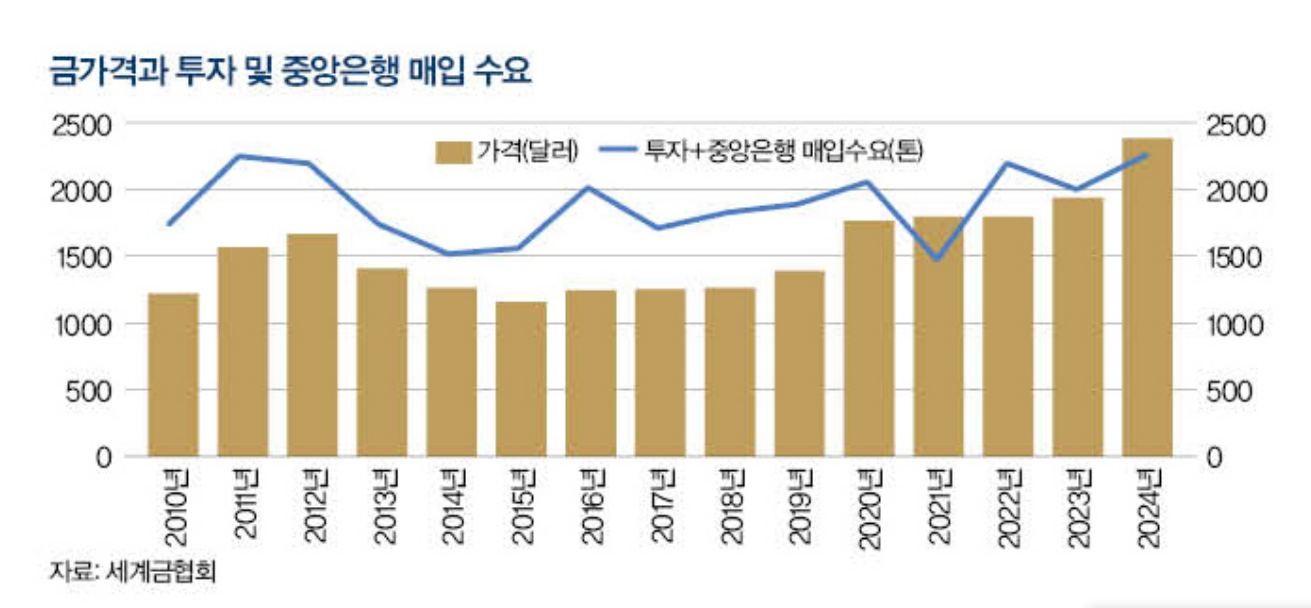
금은 공급량의 약 70%를 채굴로 하는데, 채굴량은 2010~2014년 연평균 3005t(톤)에서 2020~2024년 3598t으로 늘었다. 그것만으론 수요를 감당하지 못해 30% 정도는 재활용으로 공급한다. 세계금협회(World Gold Council) 자료를 보면, 금 생산비는 2022년 온스당 1272달러에서 2024년 1428달러로 올랐지만 최근 금값의 절반을 밑도는 수준이다.
2011~2020년 금 수요는 연평균 4386t이었다. 수요의 절반이 장신구용이고, 산업용이 8%, 투자와 중앙은행의 매입 수요가 합해서 42.6%를 차지했다. 장신구용 수요는 꾸준한 편이고, 산업용 수요는 완만하게 감소해왔다. 통계분석 기법을 활용해 따져보면, 투자와 중앙은행 매입 수요만이 금값에 통계적으로 유의미한 영향을 미친 것으로 나타난다.
특히 주목되는 것이 세계 각국 중앙은행들의 금 매입이다. 2011~2021년 연평균 459t 매입하던 것을 2022년 1080t, 2023년 1051t, 2024년 1089t을 매입했다. 중앙은행들은 2025년 상반기에도 415t의 금을 사들였다.
왜 ‘투자와 중앙은행 매입’ 수요가 늘어났을까? 흔히들 물가상승률이 높아질 때, 달러가치가 떨어질 때 금값이 상승한다고 말한다. 그러나 이런 변수들은 금값 변동을 일관성 있게, 엄밀하게 설명하지 못한다. 최근 물가상승률이 낮아지고 있음에도 금값이 오르고, 달러 아닌 다른 통화로 평가한 금값도 폭등 중이다.
한 가지 분명한 것은 세계 각국에서 국가부채가 계속 증가하면서 미국(2011년, 2023년), 프랑스(2012년), 영국(2013년, 2016년) 등의 국채 신용등급이 하락해왔다는 사실이다. 중앙은행들의 금 보유 확대를 달러와 다른 주요국 통화에 대한 신뢰 약화로 해석할 수 있는 대목이다. 금을 더 ‘안전자산’으로 본다는 것이다.
적정 수준 제시 어려워
금의 수요가 커지고 가격이 오를 것이라는 데 동의한다고 해도, 골칫거리는 적정 수준이 얼마인지를 제시하기 어렵다는 데 있다. 버크셔해서웨이의 워런 버핏 회장은 2012년 투자자들에게 보내는 서한에서 “금 1온스를 사들인 뒤 영원히 보유하더라도, 마지막 순간에도 금은 여전히 1온스다”라고 썼다. 금에 투자하지 않는 이유를 설명한 것인데, 금은 아무런 생산적 가치를 제공하지 못하므로 주식처럼 ‘이익’을 근거로 가치를 평가할 수 없다는 뜻도 된다.
골드만삭스는 2026년 중반까지 금값이 온스당 4천달러로 오를 것이란 전망을 기본값으로 제시했다. 금값이 5천달러까지 오를 수도 있다는 전망에는 여러 꼬리표를 달았다. 우선 도널드 트럼프 미국 대통령의 간섭으로 연방준비제도(Fed·연준)의 통화정책 독립성이 손상을 입는 것이다. 이는 연준의 통화 완화로 이어져, 장기적으로 물가상승률을 끌어올릴 것이고, 주식과 채권 가격의 하락으로 이어질 것이다. 또 달러에 대한 신뢰를 훼손할 것이다. 골드만삭스는 이런 상황에서 개인 소유 미국 국채의 1%에 해당하는 자금이 금으로 이동하면 금값이 5천달러로 오를 수 있다고 했다.
그런데, 그 ‘난리’가 벌어진다면 금값이 과연 5천달러에서 스르르 브레이크가 걸릴까? 이른바 ‘닉슨 쇼크’ 이후 9년 뒤인 1980년 1월21일의 금값 최고치는 온스당 850달러였다. 물가상승을 고려하면 현재가치로 3600달러라고 한다. 그렇다면 최근 금값은 45년이 지나서야 그때 수준에 막 도달한 셈이다. 그리고 사람들은 지금 또 금에 미쳐가고 있다. 한바탕 투기가 벌어질 때 거품이 얼마나 커질지, 언제 터질지는 사실 아무도 모른다.
정남구 한겨레 선임기자 jeje@hani.co.kr


