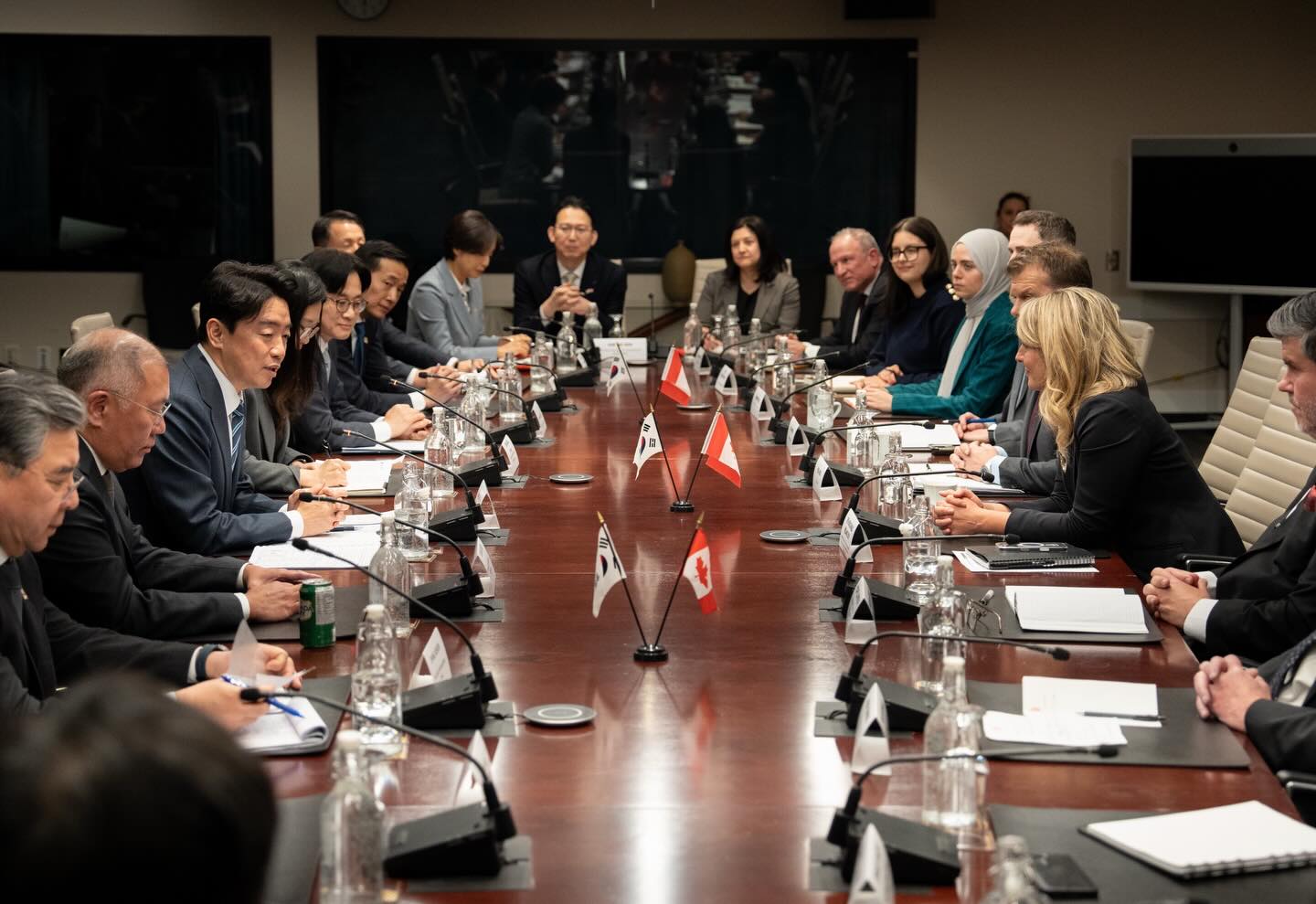
강훈식 대통령 비서실장과, 멜라니 졸리(Mélanie Joly) 캐나다 산업부 장관
Canada and Republic of Korea strengthen ties in key industrial sectors
From: Innovation, Science and Economic Development Canada
News release
Ministers sign memorandum of understanding on strengthening bilateral cooperation
January 29, 2026 – Ottawa, Ontario
Earlier this week, the Honourable Mélanie Joly, Minister of Industry and Minister responsible for Canada Economic Development for Quebec Regions, met with the delegation led by the Presidential Special Envoy for Strategic Economic Cooperation and Chief of Staff to the President of the Republic of Korea, Hoon-Sik Kang. They discussed key areas of collaboration for the two countries and ways to foster momentum for expanded bilateral industrial cooperation in strategic sectors—in particular, auto and battery manufacturing, critical minerals and artificial intelligence—and trade opportunities.
Minister Joly and her counterpart, Jung-Kwan Kim, Minister of Trade, Industry and Resources of the Republic of Korea, signed a memorandum of understanding (MOU) on strengthening Canada–Korea industrial collaboration on future mobility and establishing the Canada–Korea Industrial Cooperation Committee.
The MOU deepens the Canada-Korea Comprehensive Strategic Partnership, with its focus on economic prosperity and supply chain resilience. To support increased industrial growth, a forum will be established on Canada–Korea industrial collaboration for future mobility. This includes the intention to cooperate on advancing a Korean automotive industrial footprint in Canada and advancing domestic electric vehicle (EV) manufacturing opportunities. The Government of Canada is attracting new investments in the automotive sector that reinforce Canada’s battery supply chain by supporting investment and cooperation in battery production, battery‑materials processing and the refinement, processing and recycling of Canadian critical minerals. When it comes to critical minerals and auto manufacturing excellence, Canada has what the world wants and needs.
This MOU enhances the partnership between our two countries and will strengthen the automotive supply chain and enhance cooperation on critical mineral supply chains, clean energy transition and energy security. Through the expansion of this collaboration, our government is diversifying Canada’s economy, attracting new investments that will create opportunities and well-paying jobs for Canadians, and securing economic resilience for years to come.
Canada is an auto nation—today, tomorrow and in the future—so our government is making strategic investments to protect jobs and strengthen the auto sector across the country.
Quotes
“Canada is an auto nation and home to world‑class workers, cutting‑edge innovation and some of the best vehicles manufactured anywhere in the world. This new memorandum of understanding with Korea strengthens that legacy and positions Canada to lead in the next generation of automotive excellence. By deepening cooperation in EV and hydrogen mobility, expanding battery and critical mineral partnerships, and attracting high‑value investment into Canadian communities, this agreement will grow our auto sector, create good jobs and reinforce Canada’s position as a global leader in future‑ready vehicle manufacturing.”
– The Honourable Mélanie Joly, Minister of Industry and Minister responsible for Canada Economic Development for Quebec Regions
“This memorandum of understanding reflects Canada’s strategic approach to building a secure, competitive and sustainable energy future. Canada and the Republic of Korea are trusted partners, and by deepening cooperation on critical minerals, clean energy technologies and energy security, we are diversifying our exports and strengthening resilience on both sides of the Pacific. This collaboration supports good Canadian jobs, attracts long-term investment, and positions Canada as a reliable supplier for the global clean energy transition.”
– The Honourable Tim Hodgson, Minister of Energy and National Resources
“This memorandum of understanding strengthens Canada’s economic partnership with the Republic of Korea and delivers real economic benefits for Canadians. Our automotive industry contributes $16.8 billion to Canada’s GDP and supports more than 550,000 jobs, and deeper industrial collaboration will help keep the sector competitive as advancements in electric vehicle and battery technologies continue to accelerate. Korean companies have committed billions of dollars in investment into Canada’s battery ecosystem, supporting around 250 companies across the supply chain. I look forward to building on this momentum by leading a Team Canada Trade Mission to the Republic of Korea this spring.”
– The Honourable Maninder Sidhu, Minister of International Trade
Quick facts
Canada and the Republic of Korea (commonly known as South Korea) share a mature and multi-faceted relationship built on decades of cooperation, shared democratic values and growing strategic alignment, underpinned by the Canada–Korea Comprehensive Strategic Partnership launched in 2022.
Canada and South Korea maintain a strong and diversified trade relationship, anchored by the Canada–Korea Free Trade Agreement, which came into force in 2015. Bilateral merchandise trade reached $24.5 billion in 2024, making South Korea Canada’s seventh-largest trading partner.
Canada’s automotive industry plays a key role in the economy. With a $16.8 billion contribution to GDP in 2024, it is one of Canada’s largest manufacturing sectors.
In 2024, the industry directly employed more than 125,000 people and indirectly supported approximately 427,000 jobs, including through aftermarket services and dealership networks.
South Korea’s automotive industry is a major global player, ranking in the world’s top ten for vehicle production, with over 4 million vehicles produced in 2024.
In 2024, 12% of all cars sold in Canada, or 228,257 vehicles, were made by South Korean automotive companies.
Since 2020, South Korean companies have committed billions of dollars in investments in Canada’s emerging battery ecosystem, a key segment of the EV manufacturing supply chain, including LG Energy Solution, POSCO Future M, EcoPro BM and Volta Energy Solutions.
The Canadian battery ecosystem is composed of around 250 companies along the battery processing, component, cell, pack, application, and reuse and recycling segments of the value chain.
Canada and Republic of Korea strengthen ties in key industrial sectors - Canada.ca
Ministers sign memorandum of understanding on strengthening bilateral cooperation January 29, 2026 – Ottawa, Ontario Earlier this week, the Honourable Mélanie Joly, Minister of Industry and Minister responsible for Canada Economic Development for Quebec
www.canada.ca


2.
Canada and Republic of Korea strengthen ties in key industrial sectors
From: Innovation, Science and Economic Development Canada
News release
Ministers sign memorandum of understanding on strengthening bilateral cooperation
January 29, 2026 – Ottawa, Ontario
Earlier this week, the Honourable Mélanie Joly, Minister of Industry and Minister responsible for Canada Economic Development for Quebec Regions, met with the delegation led by the Presidential Special Envoy for Strategic Economic Cooperation and Chief of Staff to the President of the Republic of Korea, Hoon-Sik Kang. They discussed key areas of collaboration for the two countries and ways to foster momentum for expanded bilateral industrial cooperation in strategic sectors—in particular, auto and battery manufacturing, critical minerals and artificial intelligence—and trade opportunities.
Minister Joly and her counterpart, Jung-Kwan Kim, Minister of Trade, Industry and Resources of the Republic of Korea, signed a memorandum of understanding (MOU) on strengthening Canada–Korea industrial collaboration on future mobility and establishing the Canada–Korea Industrial Cooperation Committee.
The MOU deepens the Canada-Korea Comprehensive Strategic Partnership, with its focus on economic prosperity and supply chain resilience. To support increased industrial growth, a forum will be established on Canada–Korea industrial collaboration for future mobility. This includes the intention to cooperate on advancing a Korean automotive industrial footprint in Canada and advancing domestic electric vehicle (EV) manufacturing opportunities. The Government of Canada is attracting new investments in the automotive sector that reinforce Canada’s battery supply chain by supporting investment and cooperation in battery production, battery‑materials processing and the refinement, processing and recycling of Canadian critical minerals. When it comes to critical minerals and auto manufacturing excellence, Canada has what the world wants and needs.
This MOU enhances the partnership between our two countries and will strengthen the automotive supply chain and enhance cooperation on critical mineral supply chains, clean energy transition and energy security. Through the expansion of this collaboration, our government is diversifying Canada’s economy, attracting new investments that will create opportunities and well-paying jobs for Canadians, and securing economic resilience for years to come.
Canada is an auto nation—today, tomorrow and in the future—so our government is making strategic investments to protect jobs and strengthen the auto sector across the country.
Quotes
“Canada is an auto nation and home to world‑class workers, cutting‑edge innovation and some of the best vehicles manufactured anywhere in the world. This new memorandum of understanding with Korea strengthens that legacy and positions Canada to lead in the next generation of automotive excellence. By deepening cooperation in EV and hydrogen mobility, expanding battery and critical mineral partnerships, and attracting high‑value investment into Canadian communities, this agreement will grow our auto sector, create good jobs and reinforce Canada’s position as a global leader in future‑ready vehicle manufacturing.”
– The Honourable Mélanie Joly, Minister of Industry and Minister responsible for Canada Economic Development for Quebec Regions
“This memorandum of understanding reflects Canada’s strategic approach to building a secure, competitive and sustainable energy future. Canada and the Republic of Korea are trusted partners, and by deepening cooperation on critical minerals, clean energy technologies and energy security, we are diversifying our exports and strengthening resilience on both sides of the Pacific. This collaboration supports good Canadian jobs, attracts long-term investment, and positions Canada as a reliable supplier for the global clean energy transition.”
– The Honourable Tim Hodgson, Minister of Energy and National Resources
“This memorandum of understanding strengthens Canada’s economic partnership with the Republic of Korea and delivers real economic benefits for Canadians. Our automotive industry contributes $16.8 billion to Canada’s GDP and supports more than 550,000 jobs, and deeper industrial collaboration will help keep the sector competitive as advancements in electric vehicle and battery technologies continue to accelerate. Korean companies have committed billions of dollars in investment into Canada’s battery ecosystem, supporting around 250 companies across the supply chain. I look forward to building on this momentum by leading a Team Canada Trade Mission to the Republic of Korea this spring.”
– The Honourable Maninder Sidhu, Minister of International Trade
Quick facts
Canada and the Republic of Korea (commonly known as South Korea) share a mature and multi-faceted relationship built on decades of cooperation, shared democratic values and growing strategic alignment, underpinned by the Canada–Korea Comprehensive Strategic Partnership launched in 2022.
Canada and South Korea maintain a strong and diversified trade relationship, anchored by the Canada–Korea Free Trade Agreement, which came into force in 2015. Bilateral merchandise trade reached $24.5 billion in 2024, making South Korea Canada’s seventh-largest trading partner.
Canada’s automotive industry plays a key role in the economy. With a $16.8 billion contribution to GDP in 2024, it is one of Canada’s largest manufacturing sectors.
In 2024, the industry directly employed more than 125,000 people and indirectly supported approximately 427,000 jobs, including through aftermarket services and dealership networks.
South Korea’s automotive industry is a major global player, ranking in the world’s top ten for vehicle production, with over 4 million vehicles produced in 2024.
In 2024, 12% of all cars sold in Canada, or 228,257 vehicles, were made by South Korean automotive companies.
Since 2020, South Korean companies have committed billions of dollars in investments in Canada’s emerging battery ecosystem, a key segment of the EV manufacturing supply chain, including LG Energy Solution, POSCO Future M, EcoPro BM and Volta Energy Solutions.
The Canadian battery ecosystem is composed of around 250 companies along the battery processing, component, cell, pack, application, and reuse and recycling segments of the value chain.
https://www.cbc.ca/news/business/hyundai-hydrogen-energy-canada-9.7068353
Why Hyundai wants to work with the Canadian hydrogen energy sector | CBC Accessibility
Hyundai is exploring a "potential collaboration" with the Canadian hydrogen energy sector, it told CBC News on Thursday, as the South Korean automaker bets on decarbonized cars to be the future of the automotive industry.
www.cbc.ca
3. 글로벌 뉴스
Canada and Korea sign MOU for more trade, including autos and minerals
By Ariel Rabinovitch Global News
Posted January 29, 2026 11:10 am
Canadian Industry Minister Mélanie Joly said Friday that it is important for the country to be part of the critical mineral supply chain, adding that despite geopolitical tensions production cannot be limited to one country – Jul 11, 2025
Canada and South Korea have taken new steps to strengthen trade ties that are expected to boost several industrial sectors in Canada, including automotive and critical minerals.
This comes amid the global trade war and U.S. tariffs, which have impacted Canada’s economic growth and job market, forcing the federal government to seek alternative trading partners and work to remove interprovincial trade barriers to reduce reliance on the U.S.
On Tuesday, Canada’s Industry Minister Melanie Joly met in Ottawa with counterparts from the Republic of Korea and signed a memorandum of understanding (MOU) between the two nations.
Details of the agreement were outlined in a press release, sent on Wednesday, which includes establishing the Canada-Korea Industrial Cooperation Committee to work together on what it calls “future mobility.”
Areas the committee will focus on, according to the release, include creating a footprint for Korean automotive production in Canada, with electric vehicle manufacturing opportunities among the investments, although no specific amounts were mentioned.
Artificial intelligence was also one of the “strategic sectors” mentioned as part of the agreement, but no other details were provided.
In addition to the auto manufacturing sector, the release says the agreement means further co-operation with South Korea on Canada’s battery supply chain. This means battery production, materials processing and refinement, as well as critical minerals processing and recycling.
Get the day's top stories from Toronto and surrounding communities, delivered to your inbox once a day.
Get daily Toronto news
Be the first to know the latest Toronto news with reliable daily email alerts.
Sign up for daily Toronto newsletter
Email address
Get started
By providing your email address, you have read and agree to Global News' Terms and Conditions and Privacy Policy.
Canada may also be increasing some exports to South Korea as part of this agreement, according to Tim Hodgson, Canada’s minister of energy and natural resources, who was quoted in the release saying the MOU means “we are diversifying our exports,” but no other specifics were provided.
“This memorandum of understanding reflects Canada’s strategic approach to building a secure, competitive and sustainable energy future,” said Hodgson in the release.
“Canada and the Republic of Korea are trusted partners, and by deepening cooperation on critical minerals, clean energy technologies and energy security, we are diversifying our exports and strengthening resilience on both sides of the Pacific.”
Critical minerals are one of the key economic projects of national interest outlined under Ottawa’s Budget 2025, with Canada’s vastness in minerals like nickel, cobalt, graphite and lithium, which are needed for battery production, energy storage, wind turbines and many other applications as part of the transition to green energy.
According to the International Energy Agency, the global transition away from fossil fuels means demand for critical minerals could increase up to sixfold by 2040.
The release says by working with South Korean partners, Canada “will strengthen the automotive supply chain and enhance cooperation on critical mineral supply chains, clean energy transition and energy security.”
It adds that through this collaboration, Canada “will create opportunities and well-paying jobs for Canadians,” although no further details were provided on the number or types of jobs that could be created.
More on Canada
More videos
Toronto Stock Exchange plunges due to massive precious metals sell-off
Bombardier warns of ‘significant impact’ to travellers from Trump’s threat
Can Trump decertify aircraft? What experts say amid Bombardier threat
Jeffrey Epstein denied permission to visit Canada in 2018, documents show
“Canada is an auto nation and home to world-class workers, cutting edge innovation and some of the best vehicles manufactured anywhere in the world. This new memorandum of understanding with Korea strengthens that legacy and positions Canada to lead in the next generation of automotive excellence,” said Joly in the release.
“By deepening cooperation in EV and hydrogen mobility, expanding battery and critical mineral partnerships, and attracting high-value investment into Canadian communities, this agreement will grow our auto sector, create good jobs and reinforce Canada’s position as a global leader in future-ready vehicle manufacturing.”
No specifics on companies involved were provided, but some of the largest global automotive brands based in South Korea include Hyundai Motor Group, which is also behind the Kia and Genesis brands.
— With a file from Global News’ Bryan Mullan.
조선일보 보도.
강훈식, 방산특사로 캐나다 출국 "60조 잠수함 수주, 韓정부 의지 전할 것"
캐나다, 디젤 잠수함 12척 도입 추진
한화오션 등, 독일과 경쟁...정부차원 총력전
박상기 기자
입력 2026.01.26. 11:16
업데이트 2026.01.26. 16:48
33
강훈식 대통령비서실장, 김정관 산업통상부 장관, 이용철 방위사업청장이 26일 오전 인천공항에서 잠수함 사업 등 방산협력 논의를 위해 캐나다로 출국에 앞서 인터뷰를 하고 있다. 2026.1.26/뉴스1 ⓒ News1 김명섭 기자
강훈식 대통령비서실장이 26일 오전 인천공항에서 캐나다 출국에 앞서 인터뷰를 하고 있다. 오른쪽은 김정관 산업통상부 장관, 왼쪽은 이용철 방위사업청장./뉴스1
강훈식 대통령 비서실장이 26일 캐나다의 차세대 잠수함 도입 사업 수주를 지원하기 위해 이재명 대통령의 전략경제 협력 특사 자격으로 캐나다로 출국했다.
캐나다는 최대 12척의 디젤 배터리 추진 잠수함을 도입하는 총 60조원 규모 차세대 잠수함 도입 사업을 추진 중이다. 한화오션과 HD현대가 팀을 이뤄 수주에 응찰했고 현재 최종 후보에 올라 독일 업체와 경쟁하고 있다. 오는 3월 최종 제안서를 접수하고, 올해 상반기 중 우선협상대상자가 선정될 예정이다.
강 실장은 이날 오전 인천공항에서 기자들과 만나 “이번 수주 건은 최근 진행된 방산 사업 중 가장 큰 규모로, 국내 생산 유발 효과만도 최소 40조원 이상으로 추정하고 있다”며 “수주에 성공하면 300개 이상의 협력 업체 일거리가 주어지고 2만개 이상의 일자리가 창출될 것으로 기대한다”고 했다.
강 실장은 “현재 해당 잠수함 사업의 수주 대상이 대한민국과 독일 양국으로 압축됐다”며 “독일은 제조업 강국인 데다 우리에게도 잠수함 개발 기술을 전수한 나라여서 녹록지 않은 상황”이라고 했다.
한화오션이 건조한 장보고 III Batch-2 잠수함. (한화오션 제공) /뉴스1 DB
한화오션이 건조한 장보고 III Batch-2 잠수함./한화오션 제공
강 실장은 “이런 대규모 방산 사업은 무기의 성능이나 개별 기업의 역량만을 앞세워 도전하기에는 한계가 있다”며 “캐나다 정부 최고위급 인사들을 만나 양국 간 산업·안보 협력을 확대하겠다는 우리 정부의 의지를 직접 전할 것”이라고 했다. 이어 “캐나다에는 ‘진짜 친구는 겨울에 찾아온다’는 말이 있다는데, 이번 주 캐나다가 영하 30도를 넘나드는 혹한이라고 한다”며 “대한민국의 진심을 전달해 수주 가능성을 조금이라도 높일 수 있다면 그 역할에 최선을 다하겠다”고 했다.
김정관 산업통상부 장관, 이용철 방위사업청장 등도 이번 특사단에 동행한다.
정부는 우리 업체의 잠수함 기술력이 독일에 밀리지 않지만, 캐나다와 독일 모두 나토(NATO) 회원국으로 안보 협력을 지속해온 점은 불리한 요소로 보고 있다.
정부 관계자는 “최근 방산 수출은 기업 간 기술·가격 경쟁 차원을 넘어 국가 간 경제·안보 협력의 일환으로 여겨지고, 그에 따라 수주가 결정되고 있다”며 “강 실장이 직접 가는 것도 한국의 협력 의지가 그만큼 강하다는 것을 보여주기 위한 것”이라고 했다. 강 실장은 캐나다 출국에 앞서, 하루 전날 서울 용산의 전쟁기념관을 찾아 6·25 전쟁에서 숨진 캐나다 참전 용사를 추모하기도 했다.
강 실장은 캐나다 방문 뒤 노르웨이도 찾아 방산 협력을 논의할 예정이다. 노르웨이는 다연장 로켓 조달 사업을 추진 중이며, 한화에어로스페이스의 ‘천무’ 수주 가능성이 거론된다.


