[의문점들]
트럼프가 베네수엘라 석유 유전을 장악하면 돈을 벌 수 있는 것일까? 석유 전쟁의 가치 비중이 얼마인가 생각하게 되다.
존 볼튼과 루비오가 말한 미국의 안보를 해치는 '독재자 삼두 체제 , 베네수엘라, 니카라과, 쿠바'에 대한 실질적인 '공격'을 가했다.
외과적 수술을 행한 셈이다.
마두로 체포후, 트럼프의 연설은 거의 다 거짓말로 짜여져 있었다. 베네수엘라의 낙후된 유전시설을 미국기업들이 고친 후에, 베네수엘라인들에게 혜택을 준다고 발표했다. 그런데 트럼프의 계획, 베네수엘라 유전의 미국독점이 현실화될 가능성도 크지 않지만, 만약 그렇게 된다고 해도, 석유회사의 투자자와 주주들이 돈을 벌지, 베네수엘라인들에게 혜택은 가지 않을 것이다.
1. 1970년대에는 석유 고갈을 걱정하는 '석유 공급 정점'에서 , 2026년 현재는 석유 생산량이 늘어나도 소비량이 줄어드는 '석유 소유 정점' 시대로 이전이다.
트럼프는 베네수엘라에서 마두로 정권을 타도하고, 친미 정권을 수립이나, 권력이양을 통해서, 석유 유전을 재개발하겠다는 원대한 꿈을 발표했다.
2. 그러나 AP 뉴스 조쉬 펑크 기자가 잘 지적했듯이, 트럼프의 장밋빛 계획에는 여러가지 장벽들이 있다.
(1) 석유 회사 입장. 2007년 차베스의 국유화 조치 이후, 엑손 모빌과 더불어 베네수엘라에서 철수했던 코노코필립스 대변인은, "아직 때가 아니다"는 입장을 발표했다. 코노코필립스의 경우 재산을 차베스에게 몰수당한 경험이 있어서, 투자 안전 보장을 중요하게 고려한다.
(2) 프란시스 모날디 (라이스 대학, 라틴 아메리카 에너지 프로그램)는, 현재 베네수엘라 1일 석유 생산량은 100만 배럴인데, 400만 배럴로 생산량을 증가시키기 위해서는, 향후 10년 이상이 더 필요하고, 수천억 달러의 투자 비용이 발생한다는 것을 지적.
(3) 매쑤 왝스먼 (컬럼비아 대 법대교수)은 트럼프가 국제법을 무시하고 있다고 지적함. 트럼프가 군사력으로 베네수엘라를 점령한다고 해도, 유전의 소유권은 여전히 베네수엘라에 있음.
(4) 미국의 셰일 오일은 경질유이고, 베네수엘라와 러시아는 '중질유'를 생산하고 있음. 중질유 원유 사용처는 아스팔트, 디이젤 연료, 중장비 연료로 사용됨. 미국산 경질유 (lighter crude oil)가 중질류를 대체할 순 없는 상황임. 유럽국가들이 러시아로부터 중질유 수입했는데, 가격 경쟁을 위해서는 베네수엘라산 중질류 수입을 원한다.
베네수엘라가 지난 10년 이상 중질유 생산량이 감소해서, 러시아가 상당한 이득을 보게되었다. 만약 미국이 베네수엘라에서 중질유 생산량을 증가시키는데 성공한다면, 러시아와 경쟁하게 될 것이다.
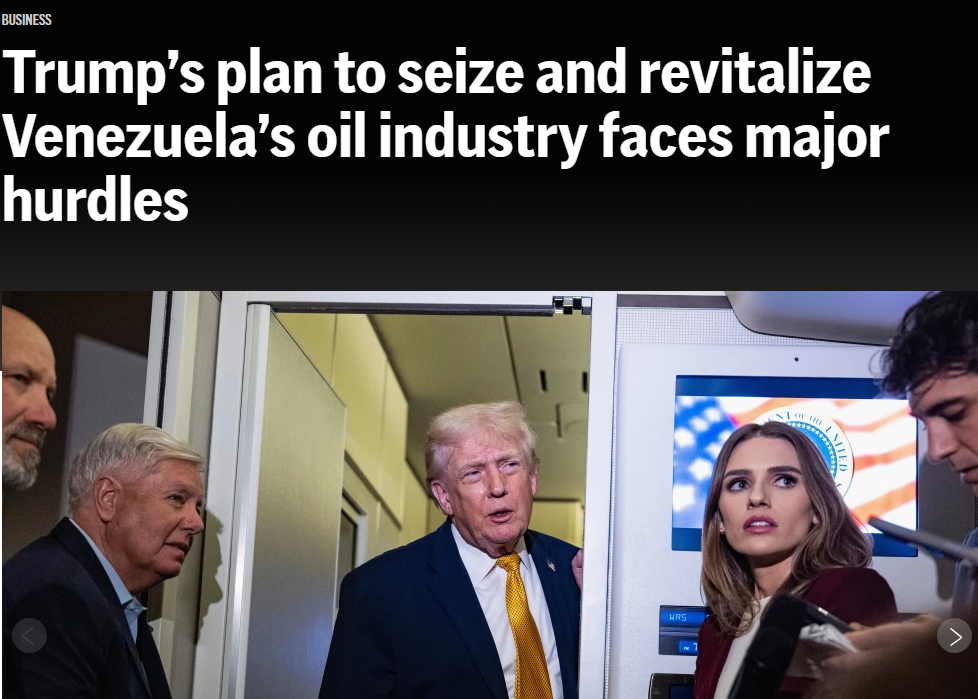
Trump's plan to seize and revitalize Venezuela's oil industry faces major hurdles
President Donald Trump's plan to take control of Venezuela's oil industry and ask American companies to revitalize it after capturing President Nicolás Maduro in a raid isn't likely to have a significant immediate impact on oil prices.
Posted 6:13 AM yesterday Updated 12:38 AM today
Vehicles drive past the El Palito refinery in Puerto Cabello, Venezuela, Sunday, Dec. 21, 2025. (AP Photo/Matias Delacroix)
By JOSH FUNK — AP Business Writer
President Donald Trump's plan to take control of Venezuela's oil industry and ask American companies to revitalize it after capturing President Nicolás Maduro in a raid isn't likely to have a significant immediate impact on oil prices.
Venezuela's oil industry is in disrepair after years of neglect and international sanctions, so it could take years and major investments before production can increase dramatically. But some analysts are optimistic that Venezuela could double or triple its current output of about 1.1 million barrels of oil a day to return to historic levels fairly quickly.
Other WRAL Top Stories
“While many are reporting Venezuela’s oil infrastructure was unharmed by U.S. military actions, it has been decaying for many many years and will take time to rebuild,” said Patrick De Haan, who is the lead petroleum analyst at gasoline price tracker GasBuddy.
American oil companies will want a stable regime in the country before they are willing to invest heavily, and the political picture remained uncertain Saturday with Trump saying that the United States is in charge — while the current Venezuelan vice president argued, before Venezuela’s high court ordered her to assume the role of interim president, that Maduro should be restored to power.
“But if it seems like the U.S. is successful in running the country for the next 24 hours, I would say there would be a lot of optimism that U.S. energy companies could come in and revitalize the Venezuelan oil industry fairly quickly,” said Phil Flynn, a senior market analyst at the Price Futures Group.
And if Venezuela can grow into an oil production powerhouse, Flynn said “that could cement lower prices for the longer term” and put more pressure on Russia.
Speaking to reporters on Air Force One on Sunday, Trump said oil companies are “going to go in and rebuild this system.”
The price of U.S. crude oil was up less than a percentage point Sunday to $57.39 per barrel at 7:45 p.m EST. A major shift in oil prices wasn't expected because Venezuela is a member of OPEC, so its production is already accounted for there. And there is currently a surplus of oil on the global market.
Proven reserves
Venezuela is known to have the world's largest proven crude oil reserves of approximately 303 billion barrels, according to the U.S. Energy Information Administration. That accounts for roughly 17% of all global oil reserves.
So international oil companies have reason to be interested in Venezuela. Exxon Mobil didn’t immediately respond to a request for comment Saturday. ConocoPhillips spokesperson Dennis Nuss said by email that the company “is monitoring developments in Venezuela and their potential implications for global energy supply and stability. It would be premature to speculate on any future business activities or investments.”
Chevron is the only one with significant operations in Venezuela, where it produces about 250,000 barrels a day. Chevron, which first invested in Venezuela in the 1920s, does business in the country through joint ventures with the state-owned company Petróleos de Venezuela S.A., commonly known as PDVSA.
“Chevron remains focused on the safety and wellbeing of our employees, as well as the integrity of our assets. We continue to operate in full compliance with all relevant laws and regulations,” Chevron spokesman Bill Turenne said.
But even with those massive reserves, Venezuela has been producing less than 1% of the world's crude oil supply. Corruption, mismanagement and U.S. economic sanctions saw production steadily decline from the 3.5 million barrels per day pumped in 1999 to today's levels.
The problem isn't finding the oil. It's a question of the political environment and whether companies can count on the government to live up to their contracts. Back in 2007, then President Hugo Chávez nationalized much of the oil production and forced major players like ExxonMobil and ConocoPhillips out.
“The issue is not just that the infrastructure is in bad shape, but it’s mostly about how do you get foreign companies to start pouring money in before they have a clear perspective on the political stability, the contract situation and the like,” said Francisco Monaldi, who is the director of the Latin American energy program at Rice University.
But the infrastructure does need significant investment.
“The estimate is that in order for Venezuela to increase from one million barrels per day — that is what it produces today — to four million barrels, it will take about a decade and about a hundred billion dollars of investment,” Monaldi said.
Strong demand
Venezuela produces the kind of heavy crude oil that's needed for diesel fuel, asphalt and other fuels for heavy equipment. Diesel is in short supply around the world because of the sanctions on oil from Venezuela and Russia and because America's lighter crude oil can't easily replace it.
Years ago, American refineries on the Gulf Coast were optimized to handle that kind of heavy crude at a time when U.S. oil production was falling and Venezuelan and Mexican crude was plentiful. So refineries would love to have more access to Venezuela's crude because it would help them operate more efficiently, and it tends to be a little cheaper.
Boosting Venezuelan production could also make it easier to put pressure on Russia because Europe and the rest of the world could get more of the diesel and heavy oil they need from Venezuela and stop buying from Russia.
“There’s been a big benefit for Russia to see Venezuela’s oil industry collapse. And the reason is because they were a competitor on the global stage for that oil market,” Flynn said.
Complicated legal picture
But Matthew Waxman, a Columbia University law professor who was a national security official in the George W. Bush administration, said seizing control of Venezuela’s resources opens up additional legal issues.
“For example, a big issue will be who really owns Venezuela’s oil?” Waxman wrote in an email. “An occupying military power can’t enrich itself by taking another state’s resources, but the Trump administration will probably claim that the Venezuelan government never rightfully held them.”
But Waxman, who served in the State and Defense departments and on the National Security Council under Bush, noted that “we’ve seen the administration talk very dismissively about international law when it comes to Venezuela.”
https://apnews.com/article/venezuela-oil-prices-trump-0c2c6ede79d550af53e6d3ddb51bfa04
Trump's plan to seize and revitalize Venezuela's oil industry faces major hurdles
President Donald Trump's plan to take control of Venezuela's oil industry and ask American companies to revitalize it after capturing that country's president in a military raid isn't likely to have a significant immediate impact on oil prices.
apnews.com


