어떤 신선한 창의적인 메시지와 내용을 담아내는가? 결국 어떤 사람들이, 창작자들과 대중 예술가들이 나오는가 ,
이제 '정체 현상'에 이르렀다고 판단.
1) 영화. Jason Bechervaise (한양대 영화과 교수) 중저 예산 영화 감소. 새로운 감독 발굴 어려워졌다.
새로운 시도가 필요한 시점이다.
영화관에서 '스트리밍 플랫폼'으로 이동.(극장과, 스트리밍 플랫폼 2가지를 공존, 발전이냐?)
2) 음악
K-pop 앨범 판매량, 2024년에 전년 대비 19.5% 감소. 2025년에도 감소 예정.
글로벌 팬덤 위주, 해외 공연 투어 집중 -> 단기간 수익 증가 가능.
위기 시작. K-가수 음악가없이도 이제 K-pop 의 세계화 가능.
단기 수익 창출은 더이상 힘들 수도 있다.
소수 팬덤이 다량 구매, 세계 공연 투어 집중 이 현상이 지속가능하지 않다.
Almost collapsed’: behind the Korean film crisis and why K-pop isn’t immune
Both industries dominate the world but now face fundamental transformation and uncertainty at home
Raphael Rashid in Seoul
Sun 28 Dec 2025 08.00 GMT
Share
South Korea’s entertainment dominance appears unshakeable. From BTS conquering global charts to Parasite sweeping the Oscars in 2020 and Korean dramas topping Netflix, Korean popular culture has never been more visible. Exports driven by the country’s arts hit a record $15.18bn (£11bn) in 2024, cementing the country’s reputation as a cultural superpower.
But inside South Korea, the two industries that helped build the Korean Wave – cinema and K-pop – are now experiencing fundamental transformations, with their survival strategies potentially undermining the creative foundations of their success.
The decline in cinema is the most dramatic. Admissions – for Korean and international films – have fallen 45% since 2019, from about 226 million to 123 million, while box office revenue has dropped from $1.3bn to $812m.
With investment slowing sharply, Korean distributors that once released more than 40 locally produced films a year are expected to put out about only 20 in 2025, and warn that 2026 could be “even more serious” as the pandemic-era backlog runs out and new productions are not coming fast enough.
Kim Han-min, director of the Yi Sun-sin trilogy, delivered the bluntest warning when he told lawmakers last year that the sector had “almost collapsed”.
Scene from the film Parasite
A scene from Bong Joon-ho’s Oscar award-winning film Parasite. Photograph: BFA/Alamy
1) 영화. Jason Bechervaise (한양대 영화과 교수) 중저 예산 영화 감소. 새로운 감독 발굴 어려워졌다. 새로운 시도가 필요한 시점이다.
영화관에서 '스트리밍 플랫폼'으로 이동.
2) 음악
K-pop 앨범 판매량, 2024년에 전년 대비 19.5% 감소. 2025년에도 감소 예정.
Jason Bechervaise, a professor of Korean film at Hanyang University, sees not a short-term slump but a structural weakening. “Years of tightening margins and rising costs have thinned out the mid-budget productions where new directors once developed and established film-makers experimented,” he says. “Much of the talent pipeline is now moving toward streaming platforms, where investment is steadier and production schedules more predictable.”
A scene from Bong Joon-ho’s Oscar winning-film Parasite
Korean cinema in ‘precarious period’ due to Netflix, says Jang Joon-hwan
The theatrical “holdback window” – the period between a cinema release and a film’s arrival on streaming – has also shortened to just a few weeks for many titles, leaving audiences with little reason to buy a ticket. The strain has already triggered historic consolidation, with the operators of the Lotte Cinema and Megabox chains planning to merge their 1,682 screens.
Cinemas are investing heavily in premium formats such as Imax and Dolby, but without a reliable flow of domestic films, industry insiders say such upgrades cannot deliver a sustained recovery.
K-pop’s reckoning
K-pop 앨범 판매량, 2024년에 전년 대비 19.5% 감소. 2025년에도 감소 예정.
Cinema is not the only pillar under strain. K-pop, long considered one of South Korea’s strongest cultural exports, is also entering a period of uncertainty.
Physical album sales fell 19.5% in 2024 – the first decline in a decade – dropping from 115.2m units to 92.7m, with the drop projected to continue by the end of 2025. This includes international releases, but few make major inroads into the Korean charts.
Yet major agencies have found their salvation elsewhere, with concert revenues now surging past traditional album sales as they pivot to global touring.
Areum Jeong, a professor of Korean studies at Arizona State University, says companies have increasingly prioritised their most dedicated fans. “K-pop companies began catering mainly to the core fandom, and kind of forwent the idea of being widely known to the public,” she says. “When companies cater to the core fandom’s needs, the core fandom will spend and support.”
This narrow focus, she argues, has influenced how idols are recruited, trained and marketed, and the superfan-centred model is now being copied by industries outside Korea.
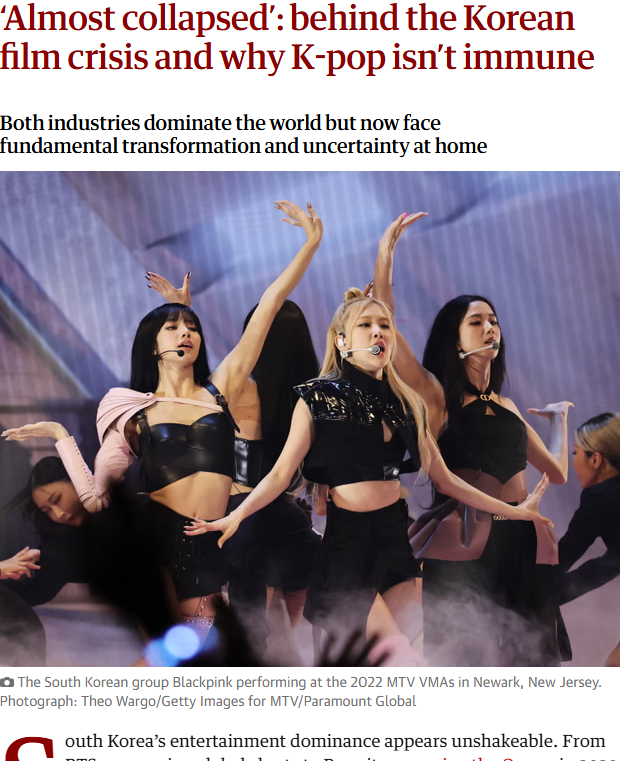
Yet questions remain about whether this approach can produce the kind of breakthrough global phenomena that defined K-pop’s golden era, such as BTS or Blackpink.
BTS performing in Busan, South Korea, in October 2022.
View image in fullscreen
BTS performing in Busan, South Korea, in October 2022. Photograph: Bighit Music/EPA
Meanwhile, smaller agencies, once vital for experimentation and diversity, have struggled to survive, squeezed by rising production costs and a shrinking share of fan spending.
At the same time, the global success of Korean cultural ideas no longer guarantees that Korean companies will be the ones profiting.
Composite of photographs showing K-pop artists Lisa, Aespa and Tomorrow X Together
‘It’s ended up being nothing to no one’: can K-pop overcome crisis?
Netflix’s animated hit KPop Demon Hunters became the platform’s most-watched animated film. The film was co-directed by the Korean-Canadian Maggie Kang, and included several Korean/Korean-American voice actors, but was an American production based on Korean aesthetics.
Jeong describes it as a “de-territorialised, hybrid idea of K-pop [rather] than an authentic K-pop product”, suggesting that Korean cultural concepts have become portable enough to be reproduced internationally without Korean participation. Similar groups trained in Korean methods are now emerging in Japan and south-east Asia, creating direct competition.
Yet she says audiences still seek real-world encounters with Korean culture. After the film’s release, museums, food brands and cosmetics companies experienced renewed interest in items featured onscreen.
Bechervaise notes how creative dynamics have shifted. As domestic productions became more formulaic, American studios and Korean-diaspora creators began drawing on Korean cultural elements in works such as Minari, Beef and Demon Hunters.
“Korea had beaten Hollywood at its own game,” he says, “but now it’s as though Hollywood’s beating Korea at its own game.”
Singers performing onstage
View image in fullscreen
The singing voices of HUNTR/X from KPop Demon Hunters performing onstage in Los Angeles, California, in December. Photograph: Kevin Winter/Getty Images for iHeartRadio
The government has responded with a sweeping five-year, 51.4tn won (£26bn) cultural investment plan, aimed at expanding South Korea’s global cultural footprint and strengthening broader cultural industries, from content exports to arts training, tourism and sports.
President Lee Jae Myung has also appointed the JYP Entertainment founder and K-pop mogul Park Jin-young to co-chair a new presidential cultural committee to promote the spread of Korean pop culture internationally.
Major agencies such as HYBE and SM Entertainment are opening new subsidiaries in south-east Asia, India and China. But critics say the focus on overseas expansion risks overlooking the infrastructure at home that once powered South Korea’s cultural ascent and eroding the cultural authenticity that originally attracted international audiences.
Jeong believes the industries will continue to earn money but warns that financial success alone cannot guarantee creative renewal. “The Korean entertainment industry will continue to profit this way,” she says, “but I think it will be difficult to create something like KPop Demon Hunters that has won over so many people worldwide.”
'정책비교 > 문화' 카테고리의 다른 글
| 배우 조진웅 '소년범' 논쟁점들. 한인섭 , 박경신 (1) | 2025.12.08 |
|---|---|
| 예술가들의 자유로운 창조성을 말살한 '블랙리스트' 조윤선 , 서울시립교향악단 비상임이사 자격없다. (5) | 2024.11.18 |
| 배우 김수미 75세 일기로 별세. 이웃들의 친근한 배우로 남을 김수미님의 명복을 빕니다. 명배우가 떠나가다. (3) | 2024.10.25 |
| 노벨문학상 한강 소설 '소년이온다' 독후감. (7) | 2024.10.18 |
| 한강 작가의 노벨문학상 수상 소감 발표문 요약. (16) | 2024.10.18 |
| 한강 노벨문학상 수상을, 작가 개인의 영예(31%), 국가(공동체)의 영예 (30%), 개인과 국가 둘다(35%). 20대는 개인(60%) 30대 (48%) (15) | 2024.10.18 |
| 노벨 문학상, 한강 소설 여론조사, 추천하고 싶은 소설. '채식주의자' '소년이온다' '흰' '작별하지 않는다' (10) | 2024.10.18 |


