Israel has committed genocide in Gaza, UN commission of inquiry says
David Gritten
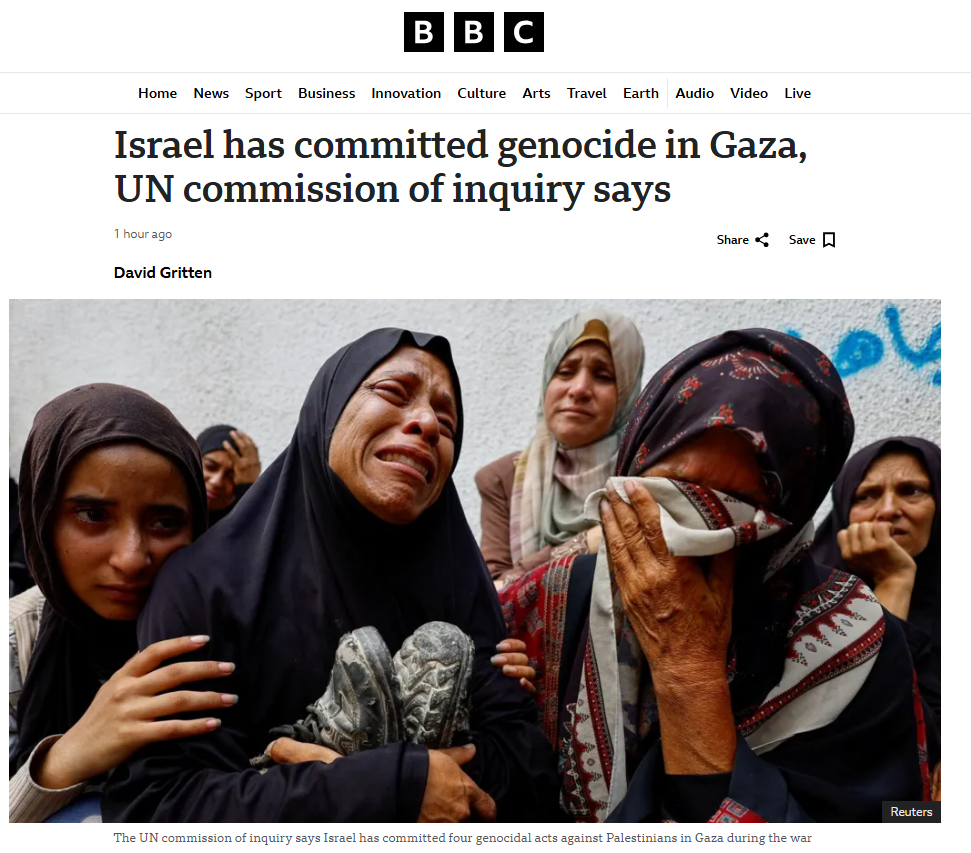
Reuters File photo showing the mother of Palestinian teenager Khaled al-Shinbari holds his shoes during his funeral at al-Shifa hospital, in Gaza City, northern Gaza (28 August 2025)Reuters
The UN commission of inquiry says Israel has committed four genocidal acts against Palestinians in Gaza during the war
A United Nations commission of inquiry says Israel has committed genocide against Palestinians in Gaza.
A new report says there are reasonable grounds to conclude that four of the five genocidal acts defined under international law have been carried out since the start of the war with Hamas in 2023: killing members of a group, causing them serious bodily and mental harm, deliberately inflicting conditions calculated to destroy the group, and preventing births.
It cites statements by Israeli leaders, and the pattern of conduct by Israeli forces, as evidence of genocidal intent.
Israel's foreign ministry said it categorically rejected the report, denouncing it as "distorted and false".
A spokesperson accused the three experts on the commission of serving as "Hamas proxies" and relying "entirely on Hamas falsehoods, laundered and repeated by others" that had "already been thoroughly debunked".
"In stark contrast to the lies in the report, Hamas is the party that attempted genocide in Israel - murdering 1,200 people, raping women, burning families alive, and openly declaring its goal of killing every Jew," they added.
The Israeli military launched a campaign in Gaza in response to the unprecedented Hamas-led attack on southern Israel on 7 October 2023, in which about 1,200 people were killed and 251 were taken hostage.
At least 64,905 people have been killed in Israeli attacks in Gaza since then, according to the territory's Hamas-run health ministry.
Most of the population has also been repeatedly displaced; more than 90% of homes are estimated to be damaged or destroyed; the healthcare, water, sanitation and hygiene systems have collapsed; and UN-backed food security experts have declared a famine in Gaza City.
Jeremy Bowen: UN report a blunt indictment of Israel's actions in Gaza
Latest updates: Israel escalates bombardment of Gaza City
Israel committing genocide in Gaza, world's leading experts say
Israeli rights groups accuse Israel of genocide in Gaza
The Independent International Commission of Inquiry on the Occupied Palestinian Territory was established by the UN Human Rights Council in 2021 to investigate all alleged violations of international humanitarian and human rights law.
The three-member expert panel is chaired by Navi Pillay, a South African former UN human rights chief who was president of the international tribunal on Rwanda's genocide.
The commission's latest report alleges that Israeli authorities and Israeli forces have committed four of the five acts of genocide defined under the 1948 Genocide Convention against a national, ethnic, racial or religious group - in this case, Palestinians in Gaza:
Killing members of the group through attacks on protected objects; targeting civilians and other protected persons; and the deliberate infliction of conditions causing deaths
Causing serious bodily or mental harm to members of the group through direct attacks on civilians and protected objects; severe mistreatment of detainees; forced displacement; and environmental destruction
Deliberately inflicting conditions of life calculated to bring about the destruction of the group in whole or in part through destruction of structures and land essential to Palestinians; destruction and denial of access to medical services; forced displacement; blocking essential aid, water, electricity and fuel from reaching Palestinians; reproductive violence; and specific conditions impacting children
Imposing measures intended to prevent births through the December 2023 attack on Gaza's largest fertility clinic, reportedly destroying around 4,000 embryos and 1,000 sperm samples and unfertilised eggs
Reuters Smoke rises from an Israeli strike as displaced Palestinians flee northern Gaza, in the central Gaza Strip (14 September 2025)Reuters
The Israeli military has ordered hundreds of thousands of Palestinians to evacuate Gaza City ahead a ground offensive to conquer it
To fulfil the legal definition of genocide under the Genocide Convention, it must also be established that the perpetrator committed any one of those acts with specific intent to destroy the group in whole or in part.
The commission says it analysed statements made by Israeli leaders and alleges that President Isaac Herzog, Prime Minister Benjamin Netanyahu and former Defence Minister Yoav Gallant have "incited the commission of genocide".
It also states that "genocidal intent was the only reasonable inference" that could be concluded from the pattern of conduct of Israeli authorities and security forces in Gaza.
The commission says the pattern of conduct includes intentionally killing and seriously harming an unprecedented number of Palestinians using heavy munitions; systematic and widespread attacks on religious, cultural and education sites; and imposing a siege on Gaza and starving its population.
Israel's government insists that its efforts are directed solely at dismantling Hamas's capabilities and not at the people of Gaza. It says its forces operate in accordance with international law and take all feasible measures to mitigate harm to civilians.
"As early as 7 October 2023, Prime Minister Netanyahu vowed to inflict… 'mighty vengeance' on 'all of the places where Hamas is deployed, hiding and operating in, that wicked city, we will turn them into rubble'," Pillay said in an interview with the BBC.
"His use of the phrase 'wicked city' in the same statement implied that he saw the whole city of Gaza [Gaza City] as responsible and a target for vengeance. And he told Palestinians to 'leave now because we will operate forcefully everywhere'."
She added: "It took us two years to gather all the actions and make factual findings, verify whether that had happened… It's only the facts that will direct you. And you can only bring it under the Genocide Convention if those acts were done with this intention."
The commission says the acts of Israeli political and military leaders are "attributable to the State of Israel", and that the state therefore "bears responsibility for the failure to prevent genocide, the commission of genocide and the failure to punish genocide".
It also warns all other countries have an immediate obligation under the Genocide Convention to "prevent and punish the crime of genocide", employing all measures at their disposal. If they do not, it says, they could be complicit.
"We have not gone so far as to name parties as co-conspirators, or being complicit in genocide. But that is the… ongoing work of this commission. They will get there," Pillay said.
A number of international and Israeli human rights organisations, independent UN experts, and scholars have also accused Israel of genocide against Palestinians in Gaza.
The International Court of Justice (ICJ) is meanwhile hearing a case brought by South Africa that accuses Israeli forces of genocide. Israel has called the case "wholly unfounded" and based on "biased and false claims".
Does Israel face a 'South Africa moment' over Gaza?
11 hours ago
Share
Save
Paul AdamsDiplomatic correspondent, Jerusalem
Reuters Benjamin Netanyahu looking down as he speaks on stageReuters
As the war in Gaza grinds on, Israel's international isolation appears to be deepening.
Is it approaching a "South Africa moment", when a combination of political pressure, economic, sporting and cultural boycotts helped to force Pretoria to abandon apartheid?
Or can the right-wing government of Israeli Prime Minister Benjamin Netanyahu weather the diplomatic storm, leaving Israel free to pursue its goals in Gaza and the occupied West Bank without causing permanent damage to its international standing?
Two former prime ministers, Ehud Barak and Ehud Olmert, have already accused Netanyahu of turning Israel into an international pariah.
Thanks to a warrant issued by the International Criminal Court, the number of countries Netanyahu can travel to without the risk of being arrested has shrunk dramatically.
At the UN, several countries, including Britain, France, Australia, Belgium and Canada, have said they are planning to recognise Palestine as a state next week.
And Gulf countries, reacting with fury to last Tuesday's Israeli attack on Hamas leaders in Qatar, have been meeting in Doha to discuss a unified response, with some calling on countries which enjoy relations with Israel to think again.
But with images of starvation emerging from Gaza over the summer and the Israeli army poised to invade - and quite possibly destroy - Gaza City, more and more European governments are showing their displeasure in ways that go beyond mere statements.
Even Netanyahu admitted on Monday that Israel is facing "a kind of" economic isolation on the world stage.
Speaking at a finance ministry conference in Jerusalem, he blamed the isolation on negative publicity abroad, and said Israel needed to invest in "influence operations" in traditional and social media to counteract it.
Reuters A tower in Gaza City collapses after it was hit by an Israeli missile Reuters
The Israeli military is continuing with its offensive in Gaza despite international condemnation
At the start of the month, Belgium announced a series of sanctions, including a ban on imports from illegal Jewish settlements in the West Bank, a review of procurement policies with Israeli companies and restrictions on consular assistance to Belgians living in settlements.
It also declared two hardline Israeli government ministers, Itamar Ben-Gvir and Bezalel Smotrich, persona non grata, along with Jewish settlers accused of violence against Palestinians in the West Bank.
Other countries, including Britain and France, had already taken similar steps. But sanctions on violent settlers imposed by the Biden administration last year were scrapped on Donald Trump's first day back in the White House.
A week after Belgium's move, Spain announced its own measures, turning an existing de facto arms embargo into law, announcing a partial import ban, barring entry to Spanish territory for anyone involved in genocide or war crimes in Gaza, and prohibiting Israel-bound ships and aircraft carrying weapons from docking at Spanish ports or entering its airspace.
Israel's combative foreign minister, Gideon Saar, accused Spain of advancing antisemitic policies and suggested that Spain would suffer more than Israel from the arms trade ban.
EPA Israeli lawmakers Itamar Ben Gvir and Bezalel Smotrich sitting in the Knesset during a parliamentary hearingEPA
Some countries have sought to target far-right Israeli lawmakers Itamar Ben-Gvir (l) and Bezalel Smotrich
But there are other alarming signs for Israel.
In August, Norway's vast $2tn (1.7tn euros; £1.6tn) sovereign wealth fund announced it would start divesting from companies listed in Israel. By the middle of the month, 23 companies had been removed and finance minister Jens Stoltenberg said more could follow.
Meanwhile, the EU, Israel's largest trading partner, plans to sanction far-right ministers and partly suspend trade elements of its association agreement with Israel.
In her 10 September State of the Union speech, EU Commission President Ursula von der Leyen said events in Gaza had "shaken the conscience of the world".
A day later, 314 former European diplomats and officials wrote to von der Leyen and EU foreign policy chief Kaja Kallas calling for tougher measures, including a full suspension of the association agreement.
One feature of the sanctions levelled at South Africa between the 1960s and the end of apartheid - a policy of racial segregation and discrimination that was enforced by the white minority government in South Africa against the country's black majority - in the 1990s was a series of cultural and sporting boycotts.
Again, there are signs of this starting to happen with Israel.
The Eurovision Song Contest might not sound like a significant event in this context, but Israel has a long and illustrious history with the competition, winning it four times since 1973.
For Israel, participation is symbolic of the Jewish state's acceptance among the family of nations.
But Ireland, Spain, the Netherlands and Slovenia have all said, or hinted, that they will withdraw in 2026 if Israel is allowed to compete, with a decision expected in December.
EPA Eden Golan representing Israel holds the flag of Israel on stage at the Eurovision Song Contest in 2024EPA
Israel has been a Eurovision regular since the 1970s but some countries have threatened to boycott next year's competition
In Hollywood, a letter calling for a boycott of Israeli production companies, festivals and broadcasters "that are implicated in genocide and apartheid against the Palestinian people" has attracted more than 4,000 signatures in a week, including household names like Emma Stone and Javier Bardem.
Tzvika Gottlieb, CEO of the Israeli Film and TV Producers Association, called the petition "profoundly misguided".
"By targeting us – the creators who give voice to diverse narratives and foster dialogue – these signatories are undermining their own cause and attempting to silence us," he said.
Then there is sport. The Vuelta de Espana cycling race was repeatedly disrupted by groups protesting the presence of the Israel-Premier Tech team, forcing a messy, premature end on Saturday and the cancellation of the podium ceremony.
Spanish Prime Minister Pedro Sánchez called the protests a source of "pride", but opposition politicians said government actions had caused international embarrassment.
Also in Spain, seven Israeli chess players withdrew from a tournament after being told they would not be able to compete under their flag.
The Israeli government's response to what the media have already dubbed a "diplomatic tsunami" has generally been defiant.
Netanyahu accused Spain of a "blatant genocidal threat" after its prime minister said his country, lacking nuclear bombs, aircraft carriers or large oil reserves, was not able to stop Israel's offensive in Gaza by itself.
After Belgium announced its sanctions, Gideon Saar wrote on X that it was "regrettable that even when Israel is fighting an existential threat, which is in Europe's vital interest, there are those who can't resist their anti-Israeli obsession".
On Monday, Netanuahu said that Israel should reduce the dependence of its industries on trade with other countries, including arms and other defence products.
"We might find ourselves blocked not only in R&D but also in actual industrial production," he said. "We must start developing our capabilities to rely more on ourselves."
Reuters Spectators holding Palestinian flags line the route of a cycling race as a rider for the Israel Premier Tech teams rolls byReuters
The Vuelta, one of cycling's major annual races, was repeatedly disrupted by pro-Palestinian protests
But among those who have represented Israel abroad, there is deep anxiety.
Jeremy Issacharoff, Israel's ambassador to Germany from 2017 to 2021, told me he could not recall a time when Israel's international standing was so "impaired", but said some measures were "highly objectionable" because they target all Israelis.
"Instead of singling out the policies of the government, this is alienating a lot of moderate Israelis in the middle ground," he said.
He said some steps, like recognising the state of Palestine, were likely to prove counterproductive, as it "gives ammunition to people like Smotrich and Ben Gvir and even enhances their argument to annex [the West Bank]".
Despite his fears, the former ambassador does not believe Israel's diplomatic isolation is irreversible.
"We're not in a South African moment, but we're in a possible preamble to a South African moment," he said.
Others believe more profound change is needed to halt Israel's slide towards pariah status.
"We have to regain our place in the family of nations," another former diplomat, Ilan Baruch, told me.
"We need to get back to our senses."
Baruch, who was ambassador in South Africa a decade after the end of apartheid, resigned from the diplomatic service in 2011, saying he was no longer able to defend Israel's occupation. Since retiring, he's been a vocal critic of the government and supporter of a two-state solution.
He believes recent sanctions are necessary, saying: "That's how South Africa was pushed to its knees."
Reuters US Secretary of State Marco Rubio and Israeli Prime Minister Benjamin Netanyahu visit the Western WallReuters
Israel maintains the backing of the US, whose Secretary of State Marco Rubio is visiting this week
Baruch continued: "I would say that assertive pressure on Israel in any way the Europeans believe is at their disposal should be welcome."
If necessary, he said, this should include changes to visa regimes and cultural boycotts, adding: "I'm prepared for the pain."
But for all the expressions of outrage and talk of pressure, some veteran observers doubt Israel is on the edge of a diplomatic precipice.
"Those who are willing to go down the Spanish route are still outliers," Daniel Levy, a former Israeli peace negotiator, told me.
He said efforts to take collective action within the EU – scrapping elements of the association agreement or even, as some have suggested, freezing Israel out of the EU's Horizon research and innovation programme – are unlikely to garner sufficient support, with Germany, Italy and Hungary among members resisting such moves.
Israel also still has the staunch backing of the US, with Secretary of State Marco Rubio saying Washington's "relationship with Israel is going to remain strong" as he departed for an official visit.
Levy still believes Israel's international isolation is "irreversible" but says the Trump administration's continued support means it has not yet reached the point where it can change the course of events in Gaza.
"Netanyahu is running out of road," Levy said. "But we haven't hit the end of the road yet."What do we know about Israeli strike on Hamas in Qatar?
6 days ago
Share
Save
Fiona Nimoni
0:23
CCTV captures moment of Israeli attack on Hamas leaders in Doha
Israel carried out a strike on senior Hamas leaders in Qatar's capital, Doha, on Tuesday afternoon.
Qatar quickly accused Israel of "reckless" behaviour and breaking international law after the attack on a residential premises in the city.
The Israel Defense Forces claimed to have targeted those "directly responsible for the brutal October 7 massacre".
Here is what we know so far.
Latest updates on Doha strike
How and where was attack carried out?
Reuters A photograph of a man looking at the smoke in the sky Reuters
Explosions were heard and smoke was seen rising above the Qatari capital Doha early on Tuesday afternoon.
Verified footage showed smoke rising from a heavily-damaged section of a complex next to Woqod petrol station on Wadi Rawdan Street, close to the West Bay Lagoon district north of central Doha.
According to the Israeli military, it conducted a "precise strike" targeted at Hamas senior leaders in Qatar using "precise munitions".
Israeli media says the operation involved 15 Israeli fighter jets, firing 10 munitions against a single target.
Qatar has hosted Hamas's political bureau since 2012 and has played a key role in facilitating indirect negotiations between the group and Israel since the 7 October attacks.
An annotated map of the neighbourhood were the explosion took place. An area highlighting the damaged building can be seen
Who was hit in the attack?
Hamas said members of the group's negotiating delegation in Doha were targeted but survived the strike. However Hamas said six others, including a Qatari security official, were killed.
According to Hamas, those killed were:
Humam Al-Hayya (Abu Yahya) - son of chief negotiator al-Hayya
Jihad Labad (Abu Bilal) - director of al-Hayya's office
Abdullah Abdul Wahid (Abu Khalil)
Moamen Hassouna (Abu Omar)
Ahmed Al-Mamluk (Abu Malik)
Corporal Badr Saad Mohammed Al-Humaidi - Qatari internal security forces
"We confirm the enemy's failure to assassinate our brothers in the negotiating delegation," a Hamas statement said.
It added the strike "confirms beyond doubt that Netanyahu and his government do not want to reach any agreement" for peace.
Earlier in a post on X, Israel's President Isaac Herzog says it was "important and correct" to target Hamas's leadership, and then condemned Khalil al-Hayya - Hamas's chief negotiator and exiled Gaza leader - without confirming he was a direct target.
A senior Israeli official told Israeli media that al-Hayya was one of those targeted, as well as Zaher Jabarin, the exiled West Bank leader.
What did the US know and did Trump give a 'green light'?
The office for Israeli Prime Minister Benjamin Netanyahu put out a statement shortly after the strike, claiming the attack was "a wholly independent Israeli operation".
"Israel initiated it, Israel conducted it, and Israel takes full responsibility," the statement said.
The White House also quickly confirmed it was informed of the operation, almost certainly because of the proximity of the huge US airbase at al-Udeid, just outside Doha.
In a post on Truth Social some hours after the attack, Donald Trump said the strike was "a decision made by Prime Minister Netanyahu, it was not a decision made by me".
The president said as soon as he was notified of the attack, he "immediately directed" US Special Envoy Steve Witkoff to inform Qatar, but said the notification was made "too late" to stop it.
"I view Qatar as a strong Ally and friend of the U.S., and feel very badly about the location of the attack," he said in the post, adding that he had assured its leaders that "such a thing will not happen again on their soil".
He added: "Unilaterally bombing inside Qatar, a Sovereign Nation and close Ally of the United States, that is working very hard and bravely taking risks with us to broker Peace, does not advance Israel or America's goals. However, eliminating Hamas, who have profited off the misery of those living in Gaza, is a worthy goal."
Questions remain over how the attack on sovereign Qatari soil will affect the al-Udeid US airbase and US relations with all its Gulf Arab allies.
What were Hamas leaders doing in Qatar?
Qatar has acted as a mediator between Israel and Hamas and has hosted negotiations between them since October 2023.
A couple of days ago, Hamas said it welcomed "some ideas" from the US about how to reach a Gaza ceasefire agreement that it received through mediators. It said it was in discussion about how to turn them "into a comprehensive agreement that meets the needs of our people".
It's thought likely the targeted Hamas leaders were in the middle of discussing their formal response to the US ideas.
A Palestinian official earlier told the BBC the US plan would see the 48 remaining hostages in Gaza freed in the first 48 hours of a 60-day truce in exchange for Palestinian prisoners in Israeli jails and good-faith negotiations on a permanent ceasefire.
How has Qatar reacted?
In Doha, the Qatari government reacted with fury, calling the attack reckless and cowardly, and a blatant violation of all international laws and norms.
"While the State of Qatar strongly condemns this assault, it confirms that it will not tolerate this reckless Israeli behaviour and the ongoing disruption of regional security, nor any act that targets its security and sovereignty," a statement from its foreign ministry said.
Similar statements of outrage came from across the Arab world.
UN Secretary General Antonio Guterres also condemned "this flagrant violation of the sovereignty and territorial integrity of Qatar".
https://www.bbc.com/news/articles/c8641wv0n4go
Israel has committed genocide in Gaza, UN commission of inquiry says
The panel finds that four of the five genocidal acts defined under international law have been carried out against Palestinians during the war.
www.bbc.com
'국제 정치-정당 > 팔레스타인_Palestine' 카테고리의 다른 글
| 학교를 가지 못하고 있는 팔레스타인 어린이 (0) | 2026.04.21 |
|---|---|
| 독일 베를린 시민 10만명, 팔레스타인을 국가로 즉각 인정하라 ! 팔레스타인에 대한 불법 점령을 즉각 중단하라 ! (0) | 2025.09.28 |
| 인간 도륙이다. 이스라엘군 27명 팔레스타인 사살. 라파 폭격. 지금까지 5만 4479명 살해. (0) | 2025.06.04 |
| 팔레스타인-이스라엘 전쟁, 자원봉사자, 기자들의 죽음. 2003년 톰 헌덜 (Tom Hurndall) - 영국 학생 기자 총격 사망. 이스라엘군 민간인 살상 명령, 스나이퍼의 저격. (0) | 2024.01.21 |
| 팔레스타인- 이스라엘 전쟁. 2024년 국제 정치 방향.미국과 중국, 러시아 역할 (1) | 2024.01.03 |
| 오늘까지 이스라엘 공격으로 팔레스타인 사람들 1만 8200명 사망. 이스라엘인 사망자는 1천 147명. (0) | 2023.12.12 |
| Dec 8. 팔레스타인-이스라엘 전쟁. 미국이 '유엔 안보리'의 즉각적인 정전 결의안 반대. 미국과 이스라엘은 하마스 항복 목표로 전쟁 지속. (1) | 2023.12.12 |


