한국 감옥 문제점. 1인당 좁은 공간. 안양교도소의 경우 정원 1700명에 현원은 2284명(134.4%) 교화 교정 공간으로서 부적합
언론보도.
7.5평 방에 15명… 폭력-갈등 잦은 ‘과밀 교도소’
동아일보
입력 2026-04-20 04:30
안녕하세요, 송유근 기자입니다.
63년된 안양교도소 현장 체험
정원 9명 훌쩍 넘어 ‘콩나물 시루’… 소동 피워 독방 수용돼도 2, 3명
수용률 134%, 전국은 126% 넘어… “사회복귀 교화 엄두 못내” 목소리
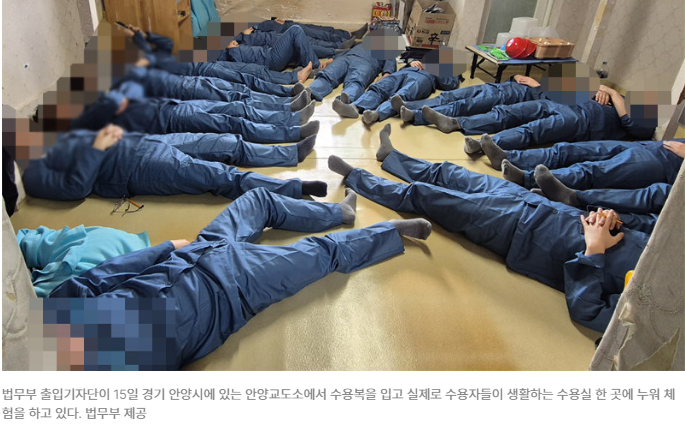
법무부 출입기자단이 15일 경기 안양시에 있는 안양교도소에서 수용복을 입고 실제로 수용자들이 생활하는 수용실 한 곳에 누워 체험을 하고 있다. 법무부 제공
15일 오전 경기 안양시 안양교도소의 한 혼거실. 교도소를 찾은 기자 18명이 24.61m²(약 7.5평) 크기의 수용실에 들어서자 ‘콩나물 시루’처럼 빽빽한 장면이 펼쳐졌다. 이 혼거실의 정원은 9명이지만 실제로는 15명 이상이 한 방에 머문다. 18명이 한 공간에 누워 보니 어깨가 서로 맞닿을 정도였다.
이날 법무부는 ‘과밀 수용 체험’을 통해 여러 명의 재소자가 함께 이용하는 교도소 혼거실을 공개했다. 방 하나로 이뤄진 공간 안에는 개인별 관물대와 이불, 공용 TV, 라디오가 있었다. 화장실은 1개뿐이었다. 교도관들은 “10여 명이 함께 지내다 보니 아침마다 화장실을 쓰기 위한 ‘전쟁’이 벌어진다”고 말했다.
배식과 식사, 설거지까지 모두 이 공간에서 이뤄진다. 짧은 시간에 사용이 몰리면서 물이 끊기는 일도 잦다. 이날 낮 12시 25분, 기자들이 점심식사 후 식판을 씻으려 했지만 수돗물이 나오지 않았다. 교도관은 “사람이 많다 보니 아래층에서 먼저 물을 많이 써 일시적으로 끊긴 것 같다”고 했다.
과밀 수용은 수치로도 확인된다.
17일 기준 전국 58개 교정시설 수용 정원은 5만614명.
하지만 현재 실제 수용돼 있는 인원은 6만3842명으로 수용률은 126%를 넘어섰다. 수감자가 많은 편인 안양교도소의 경우 정원 1700명에 현원은 2284명(134.4%)에 달한다.
좁은 공간에 많은 인원이 머무르다 보니 마찰도 잦아질 수밖에 없다. 교정시설 내에서 폭력 등 갈등을 일으켜 ‘조사·징벌’을 받게 된 인원은 2022년 1830명에서 매년 늘어 지난해 2870명으로 집계됐다. 5년 새 56.8% 급증한 수치다. 교정 당국은 “여름철에는 더위까지 겹쳐 상황이 더 악화된다”고 설명했다.
이 때문에 일부 수용자는 혼거실을 피하려고 일부러 소동을 일으켜 독거실로 옮겨가기도 한다. 그러나 독거실 수요가 늘면서 최근 안양교도소에서는 36개 독거방에 61명이 들어가 한 방에 2∼3명이 생활하고 있다. 독거실이라고 쾌적한 것은 아니다. 독거실 면적도 4.13㎡(약 1.3평)로 성인이 몸을 뻗기에도 빠듯한 수준이었다. 방 안 화장실에서는 내내 악취가 풍겼다.
과밀뿐 아니라 시설 노후화도 문제다. 이날 살펴본 교도소 내부 벽지 곳곳에는 곰팡이가 퍼져 있었고, 창틀은 페인트칠이 벗겨져 너덜거렸다. 한 교도관은 “1963년 준공된 건물이라 수도 배관과 설비가 낡아 물 사용이 더 원활하지 않은 것 같다”고 설명했다. 상황이 이렇지만 수용자 처우 개선에 대한 부정적인 여론은 여전하다. “왜 세금을 교도소에 쓰느냐”는 반응이 적지 않다.
그러나 교정 당국은 교도소가 단순 수용 시설이 아니라는 점을 강조한다. 수용자들이 사회로 복귀할 수 있도록 교화 기능을 강화해야 한다는 것이다. 안양교도소의 한 관계자는“단순한 구금 기능만 강조하던 ‘감옥’에서 명칭을 ‘교도소’로 바꾼 건 교화, 사회 복귀 기능을 위한 것”이라며 “그러나 현재는 과밀 수용으로 인해 현상 유지에만 급급한 게 현실”이라고 말했다. 윤창식 안양교도소장도 “교도소 여건 개선에 대한 국민적 여론이 우호적이진 않지만 수용자가 교정시설에 있을 때 교화가 돼야 사회가 안전해진다”고 말했다.
이날 과밀수용 체험엔 정성호 법무부 장관도 참여했다. 파란색 수용복을 입고 혼거실에서 머문 정 장관은 “교도소에서 교화가 되지 않으면서 결국 사회적 비용이 또 발생하고 만다”며 “과밀 수용 해소와 시설 개선을 통해 교정의 실효성을 높이겠다”고 말했다.
2. 노르웨이 감옥.
How Norway turns criminals into good neighbours
6 July 2019
Share
Save
Add as preferred on Google
Reuters Prayer room in Halden prisonReuters
The prayer room in Halden prison
BBC Presentational white space
What is the point of sending someone to prison - retribution or rehabilitation? Twenty years ago, Norway moved away from a punitive "lock-up" approach and sharply cut reoffending rates. The BBC's Emma Jane Kirby went to see the system in action, and to meet prison officers trained to serve as mentors and role models for prisoners.
"OK, and now put your big toes together and put your bum behind you!" calls the enthusiastic yoga instructor in English to the 20 or so participants who are shuffling into child's pose on rubber mats spread out on the grass in the faint early morning sunshine.
"Can you feel the stretch?" she gently asks a heavily tattooed man as she settles his ruffled T-shirt and smoothes his wide back with her hand. "It's OK, yeah?"
It could be a yoga class at any holistic health retreat anywhere in the world but the participants here at Norway's maximum security Halden Prison are rather far removed from the usual yummy mummy spa clientele. Barefoot murderers, rapists and drug smugglers practise downward-facing dog and the lotus position alongside their prison officers, each participant fully concentrating on the clear instructions from the teacher.
"It calms them," says prison governor Are Hoidal approvingly, as we watch from the sidelines. "We don't want anger and violence in this place. We want calm and peaceful inmates."
Halden prison
Tranquillity does not come cheaply. A place at Halden Prison costs about £98,000 per year. The average annual cost of a prison place in England in Wales is now about £40,000, or £59,000 in a Category A prison.
A uniformed prison officer on a silver micro-scooter greets us cheerily as he wheels past. Two prisoners jogging dutifully by his side, keep pace.
Hoidal laughs at my nonplussed face.
"It's called dynamic security!" he grins. "Guards and prisoners are together in activities all the time. They eat together, play volleyball together, do leisure activities together and that allows us to really interact with prisoners, to talk to them and to motivate them."
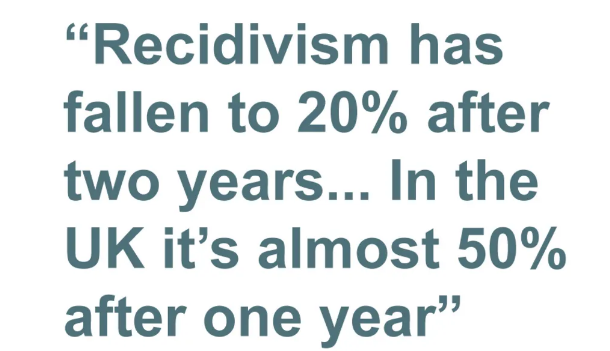
Quotebox: Recidivism has fallen to 20% after two years... in the UK it's almost 50% after one year
When Are Hoidal first began his career in the Norwegian Correctional service in the early 1980s, the prison experience here was altogether different.
"It was completely hard," he remembers. "It was a masculine, macho culture with a focus on guarding and security. And the recidivism rate was around 60-70%, like in the US."
But in the early 1990s, the ethos of the Norwegian Correctional Service underwent a rigorous series of reforms to focus less on what Hoidal terms "revenge" and much more on rehabilitation. Prisoners, who had previously spent most of their day locked up, were offered daily training and educational programmes and the role of the prison guards was completely overhauled.
Are Hoidal
Are Hoidal, governor of Halden Prison
Presentational white space
"Not 'guards'," admonishes Hoidal gently, when I use the term. "We are prison 'officers' and of course we make sure an inmate serves his sentence but we also help that person become a better person. We are role models, coaches and mentors. And since our big reforms, recidivism in Norway has fallen to only 20% after two years and about 25% after five years. So this works!"
In the UK, the recidivism rate is almost 50% after just one year.
The architecture of Halden Prison has been designed to minimise residents' sense of incarceration, to ease psychological stress and to put them in harmony with the surrounding nature - in fact the prison, which cost £138m to build, has won several design awards for its minimalist chic. Set in beautiful blueberry woods and peppered with majestic silver birch and pine trees, the two-storey accommodation blocks and wooden chalet-style buildings give the place an air of a trendy university campus rather than a jail.
Presentational grey line
Find out more
Listen to Emma Jane Kirby's reports for the PM programme on BBC Radio 4, at 17:00 on Monday 8 July and Tuesday 9 July
Presentational grey line
A thick, curving 24ft-high concrete wall snakes around the circumference of the prison but there's no barbed wire or electric fence in sight and you really have to look for the discreet security cameras. There are movement detector sensors on each side of the wall, Hoidal assures me - but no-one has ever tried to escape.
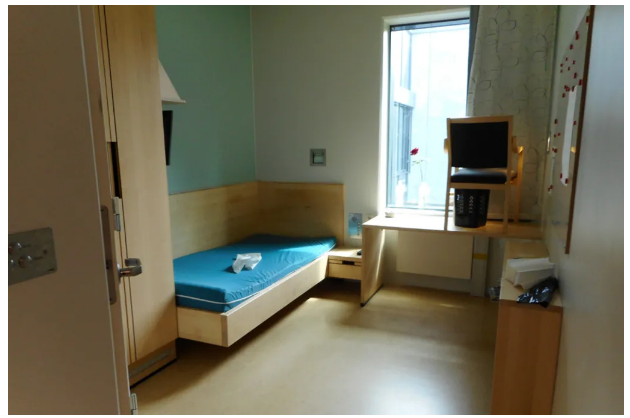
When I see the inside of a cell - every inmate has his own cell, which comes with an en suite toilet and shower room, a fridge, desk, flat TV screen and forest views - and when I clock the immaculate sofas and well-equipped kitchenette in the communal common room, I ask Halden's governor whether the level of comfort here isn't a bit too cushy.
cell in Halden prison
Are Hoidal nods politely. He's been expecting this question, of course. It's one he answers every day, whether it comes from astounded foreign journalists or from critics within Norway itself.
"It is not easy to have your freedom taken away," he insists.
"In Norway, the punishment is just to take away someone's liberty. The other rights stay. Prisoners can vote, they can have access to school, to health care; they have the same rights as any Norwegian citizen. Because inmates are human beings. They have done wrong, they must be punished, but they are still human beings."
Quotebox: There are no life sentences - so we are releasing your neighbour
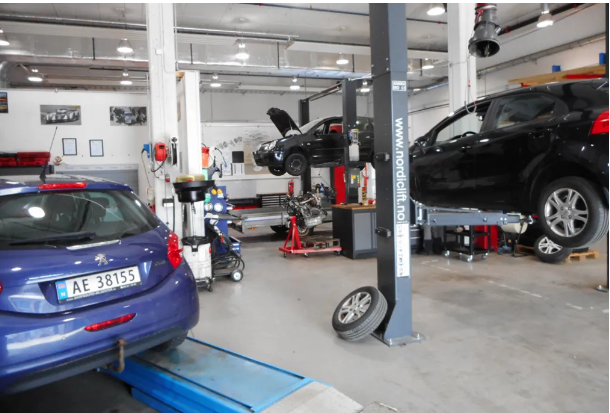
In the on-site garage, two inmates in overalls are tinkering with the wheel arch of a car, brushing out mud and carefully re-fixing bolts. Like most of the prisoners here, they leave their cells at 07:30 each morning and are at work by 08:15. Apart from one hour's rest in their cells during the afternoon, to coincide with the guards' break, they are not locked in again until 20:30 at night.
The idea is to give them a sense of normality and to help them focus on preparing for a new life when they get out. Many inmates will be released from Halden as fully qualified mechanics, carpenters and chefs.
Car repair workshop
"We start planning their release on the first day they arrive," explains Hoidal, as we walk through to the carpentry workshop where several inmates are making wooden summer houses and benches to furnish a new prison being built in the south of Norway.
"In Norway, all will be released - there are no life sentences," he reminds me.
Linn Andreassen, prison officer
Almost half of the staff at the prison are women - Linn Andreassen is one of them
"So we are releasing your neighbour," he continues. "If we treat inmates like animals in prison, then we will release animals on to your street."
(The maximum sentence in Norway is 21 years, but the law does allow for preventative detention, which is the extension of a sentence in five-year increments if the convicted person is deemed to be a continued threat to society.)
In the graphic design studio, quietly spoken Fredrik is putting the finishing touches to his striking design for the front cover of the prison's cookery book. Sentenced to 15 years for murder, Fredrik says he has struggled to come to terms with what he has done and the pain he has caused. Going on a silent three-week retreat within the prison has helped him achieve peace, he adds, and to reflect on his past.
Prisoners' cookery book design
Presentational white space
He is not boasting when he tells me that he's achieved a diploma in graphic design since he arrived at Halden, nor that he's passed eight other exams at A and B grade and is now studying the Norwegian equivalent of A-level maths and physics; he is just keen that I should understand he is using his time inside wisely for a projected future outside the curved wall.
"If you don't have opportunities and you are just locked in a cage, you don't become a good citizen," Fredrik says as he adjusts the colours on one of the photos on his screen. "Here there are good opportunities, you can have a diploma and when you come out, you can maybe get a stable job and that's important."
When I congratulate Fredrik on his recent exam success he nods shyly and confides that he hopes, once he's transferred to an open prison, to work on getting a degree, a Masters, or even a doctorate.
Normalising life behind bars (not that there are any bars on the windows at Halden) is the key philosophy that underpins the Norwegian Correctional service. At Halden, this means not only providing daily routines but ensuring family contact is maintained too. Once every three months, inmates with children can apply to a "Daddy In Prison" scheme which, if they pass the necessary safeguarding tests, means they can spend a couple of nights with their partner, sons and daughters in a cosy chalet within the prison grounds.
"Lots of toys and children's books," points out prison officer Linn Andreassen as she unlocks the gate and shows me the little play garden. I note the double bed in the main bedroom, flanked by a cot.
Family chalet in Halden prison
Presentational white space
Bedroom for family visits
"Yeah, they get to play house, play happy families," she smiles. "It's a big privilege for them so they have to earn it."
Linn is a slight young woman in her early 30s. She's been in the prison service for 11 years already, 10 of which have been spent at Halden - almost half of the staff at this category A prison are female. But Linn assures me she has sounded the personal alarm that all Norwegian prison officers carry only twice in her career, and insists she has never felt sexually threatened.
"It's normal to have women in society," she shrugs. "So the guys here need to cope with that. They need to respect not just the uniform but the person, the woman as well. And we respect them, so they respect us."
In the craft workshop, John, who is serving a long sentence for drug smuggling, is stitching a black toy sheep on his sewing machine. When I ask John what is good about the Halden regime, the presence of female officers is one of the first things he mentions.
"They're more effective to keep the macho guys down," he reflects thoughtfully. "You have to think a bit differently around them." He places an eye on to his sheep, ready to stitch.
"And when we play football, women are not such bad referees."
Quotebox: It takes 12 weeks in the UK to train a prison officer - in Norway it takes two to three years
Another prisoner, Khan, is interested in our conversation and puts down the frog he's sewing.
"We are lucky to have women in the guard system," he agrees. "It normalises things."
It takes 12 weeks in the UK to train a prison officer. In Norway it takes two to three years. Eight kilometres north-east of Oslo in Lillestrom, an impressive white and glass building houses the University College of the Norwegian Correctional Service, where each year, 175 trainees, selected from over 1,200 applicants, start their studies to become a prison officer.
Hans-Jorgen Brucker walks me around the training prison on campus, which is kitted out with reproduction cells and prison-style furniture. I note a bulging pile of helmets and stab vests in one storage room. Brucker acknowledges that prison officers will undergo security and riot training, but he's fairly dismissive of this part of the course.
Hans-Jorgen Brucker
Hans-Jorgen Brucker
"We want to stop reoffending which means officers need to be well educated," he says. He shows me a paper outlining the rigorous selection process, which involves written exams in Norwegian and English (about a third of the prison population is non-native, so officers are expected to be fluent in English) and physical fitness tests.
"My students will study law, ethics, criminology, English, reintegration and social work. Then they will have a year training in a prison and then they will come back to take their final exams."
He winces when I ask him if he would employ a prison officer who had trained for only three months.
Quotebox: I really don't remember the last time we had violence here
"I think there is a high risk for corruption with a short training," he says, clearly a little uncomfortable criticising the UK's system.
"In our system, officers are quite well paid and when an officer knows more about the law, he knows more about how to deal with inmates and how to avoid violence."
Every year his students go to the UK to spend a day observing an English prison and I ask him what his students say about their experience in English high-security jails. He tells me they are always surprised by the noise, the crowding and the relatively small number of staff.
"It's an eye-opener," he says, clearing his throat politely.
The only loud noise at Halden that I encounter comes from the TV in the drug addiction unit's sitting room, where a rather spaced-out looking inmate is watching a cops and robbers show. At one point my guide, prison officer Linn Andreassen, disappears briefly to check something with a colleague and I am left alone with the inmate. He grins at me, points to the gun-wielding policemen on screen and makes a joke in Norwegian before wandering off to his cell.
Communal area in Halden prison
When I ask the prison governor, Are Hoidal, about the level of violence in Halden prison, he looks genuinely surprised. I tell him that in England and Wales, assaults on staff have almost tripled in five years and that there were 10,213 assaults on staff in 2018, with 995 of those classed as serious.
He scratches his head.
"Of course, in some of our older prisons there is occasional violence but I really don't remember the last time we had violence here," he reflects. "Maybe we had one or two incidences of spitting?"
In the gardens at Halden, 28-year-old trainee officer Jon Fredrik Andorsen is taking a break from his duties with his experienced colleague, Linn. At Halden there are 258 inmates (including 22 who are in a half-way house on the other side of the wall) and 290 employees, 190 of whom are prison officers. (The rest work as workshop tutors, teachers and admin staff.) Jon Fredrik, who used to work as a car salesman, admits he would never have considered joining the prison service if he hadn't felt his safety was guaranteed. So far, he says, he has never felt threatened at Halden - he has confidence in his training and in the wisdom of the more experienced officers. Norwegian prison officers do not even carry pepper sprays.
Prison guard Jon Fredrik Andorsen
"My first defence is my voice and our social connection with the inmates," he explains. "We defuse situations before they happen."
Linn interjects: "You can't help others if you don't have good conditions yourself. You need to have a clear head at all times in this job. To focus. If you're going around scared you can't help anyone."
She tells me how shocked she was, when visiting a prison in the UK, that prison officers told her it was dangerous to stand in certain places around the building as the inmates might throw things down on her. She screws up her face.
Quotebox: Scotland locks up 150 people per 100,000, compared to Norway's 63
"And there were so many prisoners! The UK locks up a lot more people than here in Norway, no?"
Scotland, England and Wales have the highest imprisonment rates in Western Europe. Scotland locks up 150 people per 100,000 of the population and England and Wales almost 140 people, compared to Norway's 63.
The smaller prison population means that at Halden prison, for instance, each officer can be given three individual prisoners for whom he or she will act as a point of contact. The contact officer helps fill out applications, addresses complaints and makes sure that inmates get their quota of phone calls home.
Reuters Corridor in Halden prisonReuters
Kim, who is serving 17 years for murder, raises his eyebrows rather sarcastically when I mention this system.
"Some prisoners like to interact and some don't," he shrugs, closely watching Are Hoidal, who is in the room with us.
"I'm sceptical about opening up to guards too much - if I open up will they use it against me? It's a double-edged sword. Some guards are OK but…" He trails off, still looking at Hoidal who is grinning good-naturedly back at him.
As Hoidal and I walk back together towards his office, past some colourful abstract paintings, he reminds me that the practice of dynamic security at Halden is not always popular with prisoners because the officers' omnipresence makes dealing drugs difficult. There certainly is drug dealing at Halden, he admits, but these are not drugs like heroin and spice that have been smuggled into the prison from outside, they tend to be medications - opiates and painkillers - that inmates have been prescribed by prison doctors.
Message on wall in Halden prison
An encouraging message on a wall in Halden prison
Hoidal is extremely enthusiastic about the prison's new projects. A choir has just started up - inmates already have their own on-site recording studio, the aptly named Criminal Records - and he's hoping for a Christmas concert to coincide with the release of the inmates' new cookery book. But underneath his indefatigable positivity there is a nagging worry; profits from oil production in the North Sea are dwindling and the government has warned that swingeing cuts - including to prison budgets - are on their way.
"If you want quality and high-class results, we need money," argues Hoidal firmly. "I fear there will be more violence and the recidivism rate will go up if we can't have all the programmes we have now. It's not good. It's not good at all."
In Unit C, a cell door has swung open and I can see a red rose in a glass on the window sill. The former occupant has just been transferred to another lower-security prison but, perhaps needing to impart the wisdom he has learnt during his time at Halden, he has stuck a hastily scrawled message on the magnetic whiteboard for the new inmate who will take his place.
"To love is to give without asking for anything back," his note reads. "Loving makes you free. Free from yourself, my friend."
You may also be interested in:
Lily Lewis pictured on day release
For many people, receiving a jail sentence would be the worst thing that ever happened to them. But when you've been experiencing domestic abuse - as most female prisoners have - you may see things slightly differently.
'The day I went to prison, I got my life back'

'진보정당_리더십 > 사회복지국가 _논쟁' 카테고리의 다른 글
| 캐나다 노인기초연금의 역사 - Old Age Pensions and Policy-making in Canada (Kenneth Bryden) 1974 (0) | 2024.03.10 |
|---|---|
| 캐나다 사회복지제도의 기원. 1932년, 대공황과 '더스트볼'을 극복하자는 "협동 사회 연합 CCF " 창당과 그 정책들. (0) | 2023.11.24 |
| 2007년 심상정 "가난한 사람 위한 민주주의" 슬로건 몇가지 문제들 (0) | 2017.04.29 |
| 신빈곤층 조사/정책 감시와 더불어, 자립 자활 대책 필요하다 - 2004.07.23 (0) | 2016.10.19 |
| 2차 세계대전의 영향력, 서유럽 복지국가 체제 출현의 정치/군사/사회 조건들 (0) | 2013.07.08 |
| 복지국가는 보수주의,자유주의,사민주의도 다 실현가능 (0) | 2012.07.28 |
| 2010년 주대환, 이상이 비판/ 한국정치의 독해: 5+4 프레임, 정치적 우려의 배경 (0) | 2012.03.14 |


