캐나다 노동위원회인, CIRB (캐나다 산업 연관 위원회 ) 의장, 구성원들
캐나다 노동위원회-캐나다 노동위원회인, CIRB (캐나다 산업 연관 위원회 ) 의장, 구성원들
1. 의장 1명. 메리세 트렘블레이

https://www.cirb-ccri.gc.ca/en/about-us/about-board
About the Board - Canada Industrial Relations Board
The Canada Industrial Relations Board is an independent administrative tribunal. This means that it functions like a court, but its procedures are less formal. The Board’s job is to resolve workplace disputes and certain appeals that arise under the Cana
www.cirb-ccri.gc.ca
https://www.cirb-ccri.gc.ca/en/about-us/members
Members - Canada Industrial Relations Board
External Adjudicators The Chairperson has the statutory authority to appoint external adjudicators to determine matters under Parts II, III or IV of the Code (section 12.001 of the Code). When appointed to adjudicate a matter, the external adjudicator has
www.cirb-ccri.gc.ca
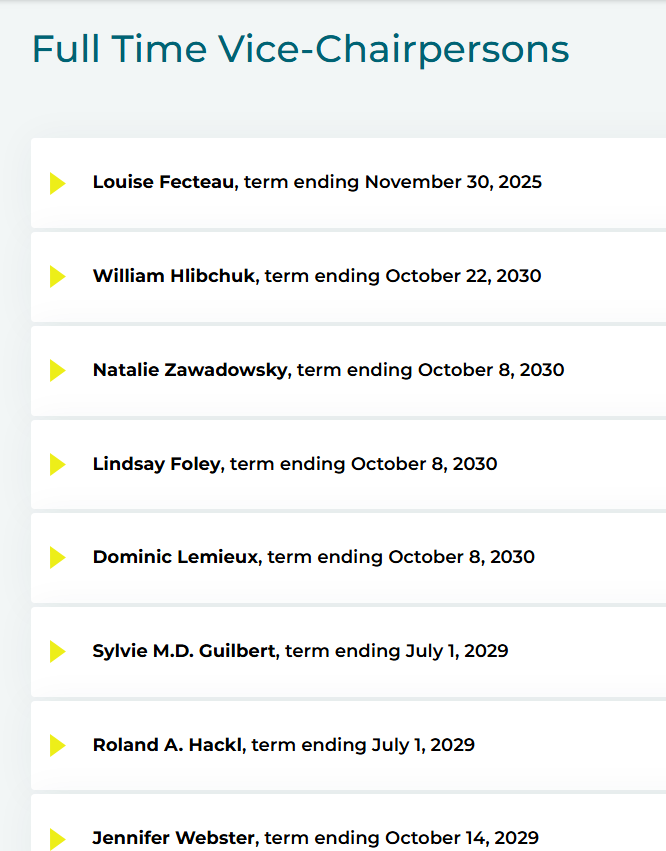
부의장. 8명
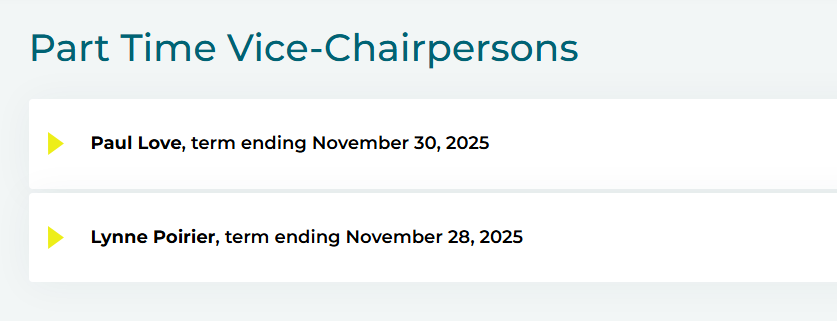
파트 파임 부의장 2명
고용자 측 대표 4명

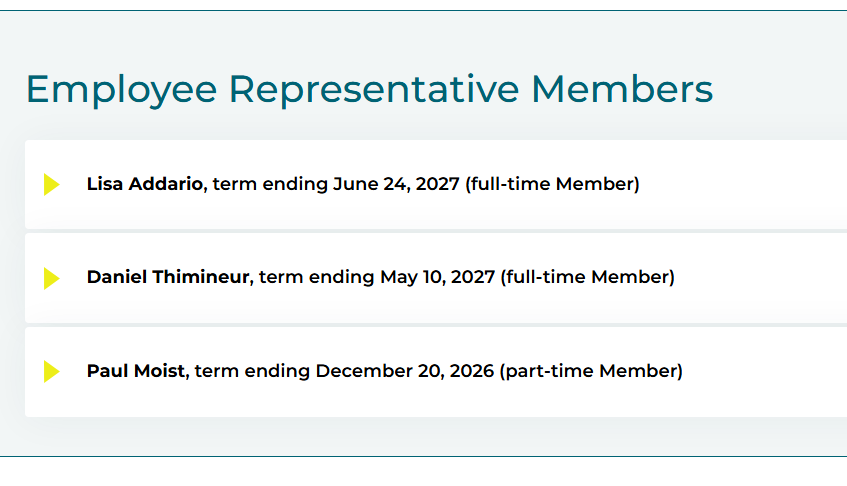
노동자 대표 3명
그외. '외부 중재자들'
External Adjudicators
The Chairperson has the statutory authority to appoint external adjudicators to determine matters under Parts II, III or IV of the Code (section 12.001 of the Code).
When appointed to adjudicate a matter, the external adjudicator has all the powers of the Board and their decisions are decisions of the Board.
- Pier-Olivier Angers
- Mark Asbell
- Mark Asbell, K.C., is an arbitrator, mediator and adjudicator. With 17 years of experience as Chair of the Alberta Labour Relations Board, Mark is a nationally recognized leader in labour law and labour dispute adjudication.
- Adam Beatty
- Johanne Cavé
- Johanne Cavé is an arbitrator and mediator and currently a part-time Vice-Chair with the Ontario Labour Relations Board. Prior to establishing her arbitration practice, she practiced labour and employment law for 20 years as in-house counsel with large federally regulated employers.
- Marie-Eve Crevier
- Geneviève Debané
- Pierre Flageole
- Dominic Garneau
- Najeeb Hassan
- BC Labour Relations Board, and Director of the BC Collective Agreement Arbitration Bureau, Najeeb is currently a member of the Arbitrators’ Association of BC, a BCCAAB rostered arbitrator and is internationally recognized for his labour law expertise, professionalism and civility as a Fellow of the College of Labor and Employment Lawyers in the neutral category.
- Louise-Hélène Guimond
- Pierre-Marc Hamelin
- Jesse Kugler
- Nathalie Léger
- Allison Matacheskie
- Michael McCrory
- Jitesh Mistry
- Sheilagh M. Murphy
- With more than 20 years of experience, Sheilagh M. Murphy, K.C., former Chair and Vice-Chair of the Newfoundland and Labrador Labour Relations Board, currently performs neutral labour relations work as an arbitrator, mediator and independent workplace investigator. She is also a member of the Government of Newfoundland and Labrador’s roster of qualified arbitrators.
- Simon-Pierre Paquette
- Amanda Rogers
- Douglas Sanderson
- Jay Sengupta
- Paula Turtle
- Deanna Webb
About the Board
Mandate of the Canada Industrial Relations Board
The Canada Industrial Relations Board is an independent administrative tribunal. This means that it functions like a court, but its procedures are less formal. The Board’s job is to resolve workplace disputes and certain appeals that arise under the Canada Labour Code, the Status of the Artist Act and the Wage Earner Protection Program Act.
What are the laws that the Board interprets and applies?
The Canada Industrial Relations Board hears and decides complaints, applications and appeals related to:
the Canada Labour Code;
the Status of the Artist Act; and
the Wage Earner Protection Program Act.
The Canada Labour Code governs labour relations, health and safety, employment standards, and administrative monetary penalties.
The Status of the Artist Act governs professional relations between artists and producers.
The Canada Labour Code and the Status of the Artist Act apply to federally regulated workplaces.
The Wage Earner Protection Program Act deals with wage earner protection when an employer declares bankruptcy or is insolvent. It applies to provincially regulated AND federally regulated workplaces.
The Board hears appeals of decisions under the Wage Earner Protection Program Act when any employer in Canada, whether provincially or federally regulated, is bankrupt or insolvent and owes wages to its employees. If you have questions about benefits under the Wage Earner Protection Program Act, click here.
For more information on each of these areas, click on About Appeals, Applications and Complaints in the header menu.
What is a federally regulated workplace?
Federal Works, Undertakings or Businesses
Only the activities of certain businesses fall under the jurisdiction of the federal government, and therefore the Canada Industrial Relations Board, for the purposes of the Canada Labour Code and the Status of the Artist Act. Among others, they include the following sectors:
Air transportation and airports;
Banks;
Broadcasting;
Grain storage and distribution (wheat, etc.);
Postal services;
Shipping and navigation;
Telecommunications (telephone, television, Internet);
Transportation, interprovincial or international (by road, railway, ferry or pipeline); and
Uranium mining and processing.
In all these sectors, the Board hears complaints, applications and appeals related to the Canada Labour Code (labour relations, occupational health and safety, and employment standards).
For businesses in the broadcasting sector, the Board also hears complaints and applications related to Part II of the Status of the Artist Act (professional relations).
Businesses Located in a Territory
The Canada Industrial Relations Board hears complaints and applications related to Part I of the Canada Labour Code (labour relations) for private sector businesses located in the territories (Yukon, Nunavut, and the Northwest Territories).
The Board does not handle complaints and applications related to occupational health and safety or employment standards for private sector businesses located in the territories (that is, complaints under Parts II and III of the Canada Labour Code). Questions and complaints about health and safety and employment standards compliance should be directed to the appropriate territorial offices. Links to provincial and territorial information are provided here.
Crown Corporations
Crown corporations are federally owned organizations that are structured like independent companies.
The Canada Industrial Relations Board hears complaints, applications and appeals related to Parts I, II and III of the Canada Labour Code (labour relations, occupational health and safety, and employment standards), as well as Part II of the Status of the Artist Act (professional relations), for corporations owned by the federal government. For example:
Atomic Energy of Canada Limited;
The Canada Post Corporation;
The Canadian Broadcasting Corporation;
National museums (for example, the Canadian Museum of History, the National Gallery of Canada, and the Canadian War Museum); and
Via Rail.
Indigenous Businesses
For Indigenous businesses located in the territories, the Canada Industrial Relations Board hears complaints and applications related to Part I (labour relations) of the Canada Labour Code.
Provincial courts have jurisdiction over complaints and applications related to labour laws that govern Indigenous businesses located in the provinces. However, the Board hears complaints and applications involving certain Indigenous businesses located in the provinces, such as band councils. The Board will evaluate these situations on a case-by-case basis.
Federal Public Service
The federal public service includes federal government departments and agencies.
The Board hears applications and appeals related to:
Part II of the Canada Labour Code (occupational health and safety)*
Part II of the Status of the Artist Act (professional relations)
*Exception: The Federal Public Sector Labour Relations and Employment Board, and not the Canada Industrial Relations Board, deals with health and safety reprisal complaints against a federal government department or agency. If a federal public servant wants to file a complaint about retaliation for raising health and safety issues in the workplace, it must be filed with the Federal Public Sector Labour Relations and Employment Board.
Other federal tribunals and agencies that deal with workplace issues
Other federal tribunals and agencies are responsible for hearing certain labour-related applications and complaints. These include:
The Labour Program of Employment and Social Development Canada;
The Federal Public Sector Labour Relations and Employment Board; and
The Canadian Human Rights Commission.
To make sure your application or complaint is dealt with efficiently, verify that you are filing with the right organization. For further information, please visit our helpful links page.