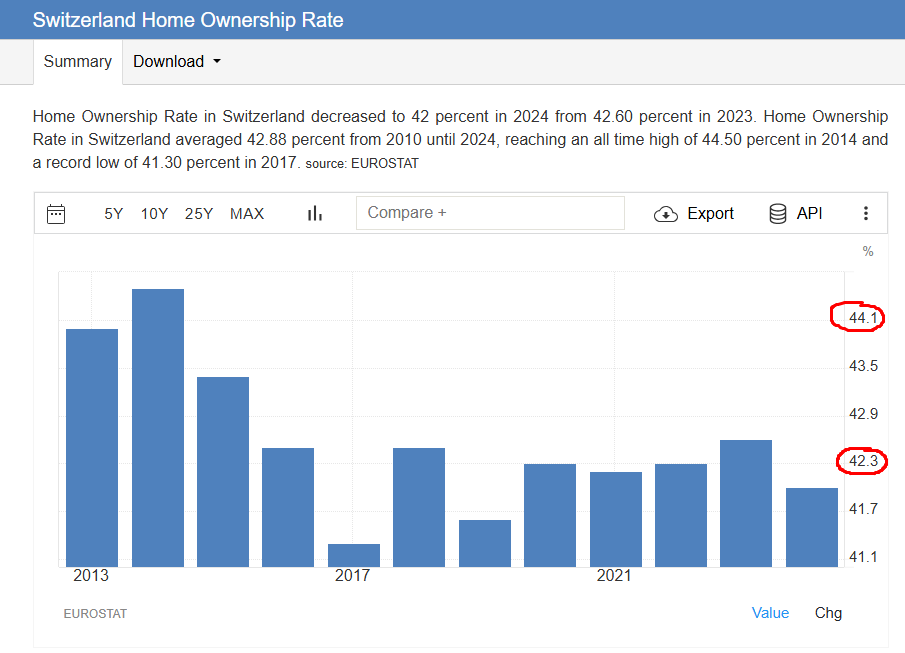
2024년 스위스 자가 주택소유율 42%.
Switzerland Population
8,967,407
Cooperative: 4% cooperative housing
Ownership : 42% (home ownership rate)
Social/Public : 5% (social/public housing)
💡
3 Things About Switzerland You Might Not Know
▲
1
Switzerland has a unique tradition of "yodeling," a form of singing that involves rapid changes of pitch and is often associated with the Swiss Alps. This vocal technique has deep roots in Swiss culture and is celebrated in various folk festivals.
2
The Swiss are known for their neutrality, but they also have a tradition of direct democracy. Citizens can challenge laws passed by the government through referendums, allowing them to vote on various issues, from environmental policies to social reforms.
3
Despite its small size, Switzerland has four national languages: German, French, Italian, and Romansh. This linguistic diversity reflects the country’s cultural richness and regional differences, with each language representing distinct traditions and customs.
📊
Housing Market
In Switzerland, the housing market is characterized by a strong rental sector, with about 57.4% of households renting their homes, while only 42.6% own their homes. As of June 2025, the national average price for buying an apartment is approximately 9,224 Swiss francs per square meter, which is about 9,350 euros per square meter.
The rental market is also seeing increases, with rents for new tenancies rising significantly in urban centers like Zurich and Geneva. However, there is no direct conversion for median rent prices available in a per square meter format for the entire country.
Publicly owned housing in Switzerland is virtually non-existent, as there is no national or public rental sector. Instead, affordable housing is mainly provided by non-profit housing cooperatives. These cooperatives offer a cost-rental model, where rents cover costs without profit, often 20-40% lower than private rentals. Public housing and social housing are not the same in Switzerland; public housing refers to any housing owned by the state, while social housing refers to affordable housing options typically provided by cooperatives and non-profit organizations. Social housing plays a crucial role but remains a minor component of the Swiss housing market.
🔗
Sources (8)
▼
🚨
Housing Crisis
Switzerland faces a severe and persistent housing crisis, marked by extremely low vacancy rates, rising rents, and strong price growth. As of June 2025, the national housing vacancy rate dropped to just 1%, with 15 cantons below this level and Zurich at a critical low of 0.07%. Shortages are most pronounced in urban centers like Zurich, Geneva, and Zug, but widespread across French-speaking regions as well.
Rents for new tenancies have increased across the country, with an annual rise of 2.6% nationally and up to 4.4% quarter-on-quarter in Zurich. Asking rents jumped 4.7% on average in 2024—the highest in 25 years. Purchase prices also continue to climb: single-family homes increased over 4.6% year-on-year, and apartments by more than 4.4%.
The shortage is primarily driven by surging demand from record immigration and population growth, while construction activity remains insufficient due to slow approval processes and high building costs. Nearly all new supply is absorbed quickly, particularly three- and four-room family apartments, leaving limited options even in surrounding regions.
The crisis affects a broad spectrum: families seeking larger units, new immigrants, the middle class in urban areas, and anyone looking for affordable housing. Notably, families and lower-income renters are especially vulnerable, since available affordable units are scarce and competition for them is intense.
🔗
Sources (8)
▼
🏛️
National programs
The Swiss national government addresses affordable and sustainable housing primarily by aligning housing policy with international frameworks, such as the UN Geneva Charter on Sustainable Housing, and by focusing recent efforts on renovation and sustainability, rather than large-scale new public housing. In 2025, communicated national targets concentrate on promoting energy efficiency, reducing emissions from buildings, and improving housing access for vulnerable groups. These include the goal of achieving net-zero building emissions by 2050 and boosting the share of high energy-performance homes.
Key concrete activities and programs include:
Incentivizing the retrofitting of existing buildings with energy efficiency upgrades and renewable energy installations, using targeted subsidies and regulatory reforms.
Supporting innovative financing tools, like green bonds and blended finance instruments, to attract private capital towards sustainable housing development.
Promoting new models for construction and densification within existing urban zones, including modular building and initiatives to resolve legal barriers that slow down new developments.
Regulating short-term vacation rentals to reduce speculative housing use in city centers and encourage housing for permanent residents.
Fostering collaboration with cantonal and municipal authorities to reinforce programs for accessibility and age-friendly housing, driven by Switzerland’s aging population.
Strengthening data-driven policy frameworks to ensure that affordability and sustainability goals are reached nationwide.
Official communication highlights the need for integrating affordability with emissions reductions and adapting existing residential stock to changing demographic needs, rather than creating broad public housing schemes.
🔗
Sources (8)
▼
🤝
Cooperative Housing
Housing cooperatives in Switzerland play a significant social role by providing affordable rental housing through non-profit models that emphasize democratic control, community involvement, and long-term stability. As of 2025, cooperatives account for about 4% of all Swiss housing units, with just under 185,000 dwellings managed by such entities. Their presence is markedly stronger in urban areas, such as Zurich, where cooperative housing represents over a quarter of the total housing stock; in most rural regions, its share is negligible.
Cooperatives remain highly popular due to their cost-rent model, often resulting in rents roughly 20% lower than those in the private sector, and demand continues to surpass supply, reflected in extensive waiting lists. The sector is undergoing steady development, with new projects and expansions frequently planned, aiming to balance social integration, innovation, sustainable building practices, and solutions for elderly citizens’ housing needs.
National policy does not directly create public housing but promotes cooperatives as a core provider of affordable and sustainable homes. The government’s current strategy emphasizes retrofitting existing buildings for energy efficiency, fostering collaborations with municipalities, supporting innovative finance mechanisms, and pushing for policy reforms to enable urban densification and legal clarity. The focus is on increasing the share of sustainable housing, integrating social diversity, and adapting existing stock to changing needs rather than expanding direct public ownership.